
Class 9 Science Chapter 8 – Journey Inside the Atom
NCERT Exploration | Class 9 Science | 2026–27
Class 9 Science Chapter 8 – Journey Inside the Atom takes students on a journey into the structure of the atom. The chapter explores the development of atomic models, from Dalton and Thomson to Rutherford and Bohr, and introduces the three fundamental subatomic particles: electrons, protons, and neutrons.
Students also learn how electrons are arranged in different energy levels and how valency, atomic number, mass number, isotopes and isobars help us understand and identify atoms.
Official NCERT textbooks and educational resources can also be accessed through the NCERT website.
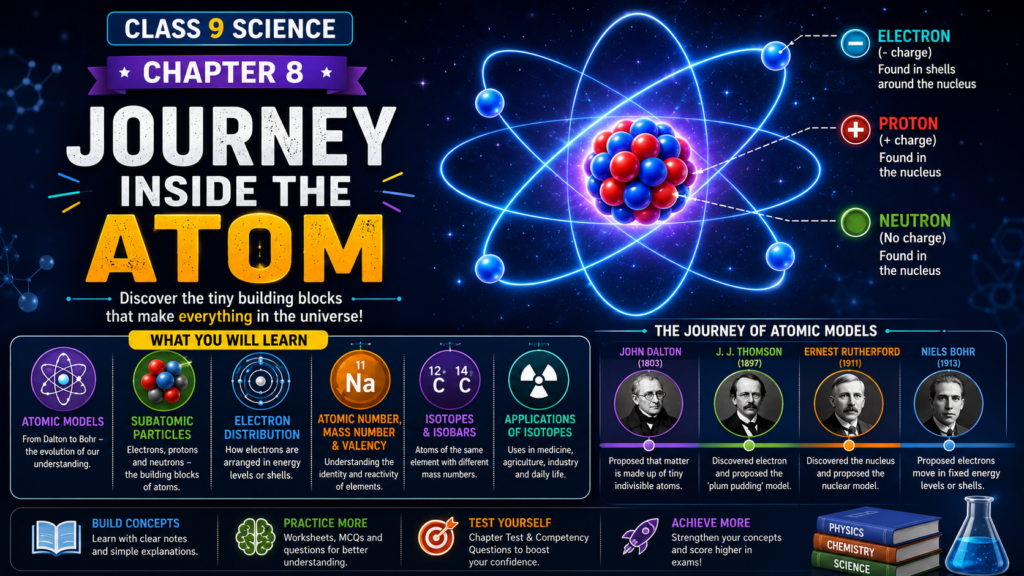
Table of Contents
📅 Last Updated: August 2026
📘 Syllabus: Based on the latest CBSE Class 9 (2026–27) syllabus
✅ Updated Resources Include:
- Chapter-wise Study Notes
- Free PDF Downloads
- MCQs
Chapter Overview
| Information | Details |
|---|---|
| Class | 9 |
| Subject | Science |
| Textbook | Exploration |
| Chapter | 8 |
| Chapter Title | Journey Inside the Atom |
| Academic Session | 2026–27 |
| Resources | Notes, Worksheets, Questions, Tests & Revision |
About This Chapter
Journey Inside the Atom introduces the basic structure of atoms and explains how our understanding of the atom has developed through different scientific models.
In this chapter, students explore:
- Atoms as the basic units of elements
- Subatomic particles
- Electron, proton and neutron
- Dalton’s Atomic Model
- Thomson’s Atomic Model
- Rutherford’s Atomic Model
- Bohr’s Atomic Model
- Distribution of electrons in shells
- Valence electrons
- Valency
- Atomic number
- Mass number
- Isotopes
- Isobars
- Chemical symbols of the first 18 elements
- Applications of isotopes
- Development of atomic models
The chapter also connects atomic science with real-world applications, including healthcare, nuclear energy, agriculture and technology.
🎯 Learning Outcomes
After completing Class 9 Science Chapter 8 – Journey Inside the Atom, students will be able to:
- Differentiate between electrons, protons and neutrons based on their charge and position in an atom.
- Explain how electrons are distributed in different energy levels or shells.
- Identify valence electrons and explain their role in determining valency.
- Explain valency, atomic number and mass number.
- Calculate the number of protons, neutrons and electrons using atomic number and mass number.
- Explain the concepts of isotopes and isobars.
- Recognise and correctly use the chemical symbols of the first 18 elements.
- Describe the development of atomic models proposed by Dalton, Thomson, Rutherford and Bohr.
- Draw labelled diagrams of Thomson’s, Rutherford’s and Bohr’s atomic models.
- Explain the contribution of important scientists to our understanding of atomic structure.
- Use appropriate scientific notation for electrons, protons, neutrons and atomic mass unit (u).
- Interpret information about atomic mass, electron distribution and valency.
- Connect the properties and applications of isotopes with their uses in medicine, energy and other fields.
This chapter is particularly suitable for your Diagrams + MCQs + Competency Questions + Numerical Problems resources because the official syllabus specifically expects students to calculate subatomic particles and draw labelled atomic-model diagrams.
🔑 Key Topics
- Structure of the Atom
- Subatomic Particles
- Electrons
- Protons
- Neutrons
- Dalton’s Atomic Model
- Thomson’s Atomic Model
- Rutherford’s Atomic Model
- Bohr’s Atomic Model
- Development of Atomic Models
- Electron Distribution in Energy Levels / Shells
- Valence Electrons
- Valency
- Atomic Number
- Mass Number
- Isotopes
- Isobars
- Chemical Symbols of the First 18 Elements
- Applications of Isotopes
- Atomic Mass and Unified Atomic Mass Unit (u)
- Calculating Protons, Neutrons and Electrons
- Labelled Diagrams of Atomic Models
These topics are based on the Class 9 Science 2026–27 syllabus and the NCERT Exploration Chapter 8, Journey Inside the Atom.
⭐ Class 9 Science Chapter 8 Study Resources
What You'll Find in Chapter 8
- 📘 Chapter 8 Study Notes
- 📖 NCERT Textbook Solutions
- ❓ Important MCQs
- 📌 Important Questions for Exam Preparation
- 🧬 Important Diagrams and Visual Revision
- 🎁 Free Worksheet with Answer Key
🧬 Important Diagrams
Detailed labelled diagrams and visual explanations for the chapter.
📌 Important Questions
Important questions based on the NCERT chapter to help students.
🎁 Free Class 9 Science Chapter 8 Worksheet with Answers
Download our free printable Class 9 Science Chapter 8 worksheet with answer key for practice and revision.
Why Students Choose Our Class 9 Science Resources?
2026–27 Focused
Printable PDFs
Original Practice
Chapter-Wise Resources
Mobile Friendly
Answer Keys
❓FAQ
Q1. What textbook is used for Class 9 Science in 2026–27?
Answer about the new NCERT Exploration textbook.
Q2. Which chapter is this page about?
Chapter 7 of Exploration is Journey Inside the Atom
Q3. Are these NCERT textbook copies?
No. Our worksheets, notes and practice materials are independently created learning resources. They are designed to support students studying the NCERT curriculum.
Q4. Are the worksheets free?
Explain which resources are free and which may be available as complete practice resources.
Q5. Are answer keys included?
Explain depending on the particular resource.
Q6. Are these resources suitable for school revision?
Yes.
Q7. Will more Chapter 8 resources be added?
Yes. New resources may be added as they are developed.
🚀 Continue Learning
← Previous Chapter
📚 All Chapters
Next Chapter →
Chapter 9 – Atomic Foundations of Matter →
Ready to Practise Class 9 Science?
Download our free printable Class 9 Science Chapter 8 worksheet with answer key for practice and revision.
Share this Chapter
Found these Class 9 Science resources useful? Share this chapter with students, parents or teachers.
Did you find this helpful?
Rate this chapter