
Class 9 Science Chapter 9 – Atomic Foundations of Matter
NCERT Exploration | Class 9 Science | 2026–27
Class 9 Science Chapter 9 – Atomic Foundations of Matter explores how atoms combine to form molecules and compounds and how chemical bonds hold atoms together. Building on the previous chapter’s understanding of atomic structure and valence electrons, students learn how atoms achieve stability through the sharing or transfer of electrons.
The chapter introduces covalent and ionic bonding, the formation of molecules and ions, properties of ionic and covalent compounds, and methods for writing chemical formulae. It also develops the concepts of molecular mass and formula unit mass.
Official NCERT textbooks and educational resources can also be accessed through the NCERT website.
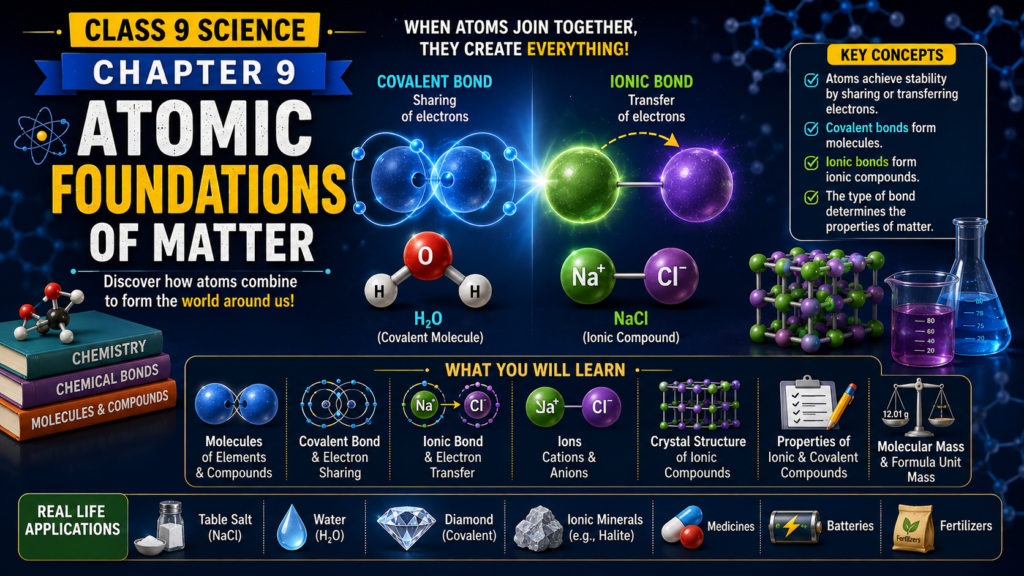
Table of Contents
📅 Last Updated: August 2026
📘 Syllabus: Based on the latest CBSE Class 9 (2026–27) syllabus
✅ Updated Resources Include:
- Chapter-wise Study Notes
- Free PDF Downloads
- MCQs
Chapter Overview
| Information | Details |
|---|---|
| Class | 9 |
| Subject | Science |
| Textbook | Exploration |
| Chapter | 9 |
| Chapter Title | Atomic Foundations of Matter |
| Academic Session | 2026–27 |
| Resources | Notes, Worksheets, Questions, Tests & Revision |
About This Chapter
Atomic Foundations of Matter helps students understand what happens when atoms interact and combine. The chapter connects electron configuration with the formation and properties of chemical substances.
Students explore:
- How Atoms Combine
- Molecules of Elements and Compounds
- Chemical Bonds
- Covalent Bond
- Sharing of Electrons
- Formation of Molecules
- Ionic Bond
- Transfer of Electrons
- Cations and Anions
- Formation of Ionic Compounds
- Crystal Structure of Ionic Compounds
- Properties of Ionic and Covalent Compounds
- Writing Chemical Formulae
- Naming Covalent Compounds
- Molecular Mass
- Formula Unit Mass
- Applications of Chemical Compounds
The chapter also includes activities involving solubility and electrical conductivity of ionic and covalent compounds and opportunities to explore how chemical bonding relates to the properties of substances.
🎯 Learning Outcomes
After completing Class 9 Science Chapter 9 – Atomic Foundations of Matter, students will be able to:
- Explain why atoms combine to form molecules and compounds.
- Describe how atoms achieve greater stability through electron sharing or electron transfer.
- Explain the formation of a covalent bond through sharing of electrons.
- Explain the formation of an ionic bond through transfer of electrons.
- Distinguish between cations and anions.
- Represent the formation of simple molecules and ionic compounds using appropriate diagrams.
- Write chemical formulae using the valencies/charges of ions.
- Name simple covalent compounds and ionic compounds.
- Differentiate between the properties of ionic and covalent compounds.
- Explain why ionic compounds form crystal structures.
- Calculate the molecular mass of covalent compounds.
- Calculate the formula unit mass of ionic compounds.
- Use atomic and molecular information to solve simple chemical problems.
- Apply the concepts of electron transfer and sharing to predict how elements may combine.
The chapter’s end-of-chapter questions specifically include predicting ionic or covalent bonding, writing compound formulae, calculating molecular mass, and working with ions and their numbers of electrons and neutrons.
🔑 Key Topics
- How Atoms Combine
- Molecules of Elements
- Molecules of Compounds
- Chemical Bonds
- Covalent Bond
- Electron Sharing
- Ionic Bond
- Electron Transfer
- Cations and Anions
- Formation of Ionic Compounds
- Crystal Structure & Crystal Lattice
- Properties of Ionic Compounds
- Properties of Covalent Compounds
- Writing Chemical Formulae
- Naming Compounds
- Molecular Mass
- Formula Unit Mass
- Valency and Chemical Bonding
- Applications of Chemical Compounds
⭐ Class 9 Science Chapter 9 Study Resources
What You'll Find in Chapter 9
- 📘 Chapter 9 Study Notes
- 📖 NCERT Textbook Solutions
- ❓ Important MCQs
- 📌 Important Questions for Exam Preparation
- 🧬 Important Diagrams and Visual Revision
- 🎁 Free Worksheet with Answer Key
🧬 Important Diagrams
Detailed labelled diagrams and visual explanations for the chapter.
📌 Important Questions
Important questions based on the NCERT chapter to help students.
🎁 Free Class 9 Science Chapter 9 Worksheet with Answers
Download our free printable Class 9 Science Chapter 9 worksheet with answer key for practice and revision.
Why Students Choose Our Class 9 Science Resources?
2026–27 Focused
Printable PDFs
Original Practice
Chapter-Wise Resources
Mobile Friendly
Answer Keys
❓FAQ
Q1. What textbook is used for Class 9 Science in 2026–27?
Answer about the new NCERT Exploration textbook.
Q2. Which chapter is this page about?
Chapter 9 of Exploration is Atomic Foundations of Matter
Q3. Are these NCERT textbook copies?
No. Our worksheets, notes and practice materials are independently created learning resources. They are designed to support students studying the NCERT curriculum.
Q4. Are the worksheets free?
Explain which resources are free and which may be available as complete practice resources.
Q5. Are answer keys included?
Explain depending on the particular resource.
Q6. Are these resources suitable for school revision?
Yes.
Q7. Will more Chapter 9 resources be added?
Yes. New resources may be added as they are developed.
🚀 Continue Learning
← Previous Chapter
📚 All Chapters
Next Chapter →
Chapter 10 – Sound Waves: Characteristics and Applications →
Ready to Practise Class 9 Science?
Explore chapter-wise notes, worksheets, practice questions and other Class 9 Science resources for Exploring Mixtures and Their Separation.
Share this Chapter
Found these Class 9 Science resources useful? Share this chapter with students, parents or teachers.
Did you find this helpful?
Rate this chapter