
Class 9 Science Chapter 11 – Reproduction: How Life Continues
NCERT Exploration | Class 9 Science | 2026–27
Class 9 Science Chapter 11 – Reproduction: How Life Continues explores how living organisms produce new individuals and how life continues from one generation to the next. The chapter introduces asexual and sexual reproduction in organisms and plants, followed by reproduction in human beings.
Students learn how new organisms are produced through processes such as vegetative propagation, pollination, fertilisation, formation of zygote and development of the embryo. The chapter also explains reproductive maturity and the male and female reproductive systems in humans.
Official NCERT textbooks and educational resources can also be accessed through the NCERT website.
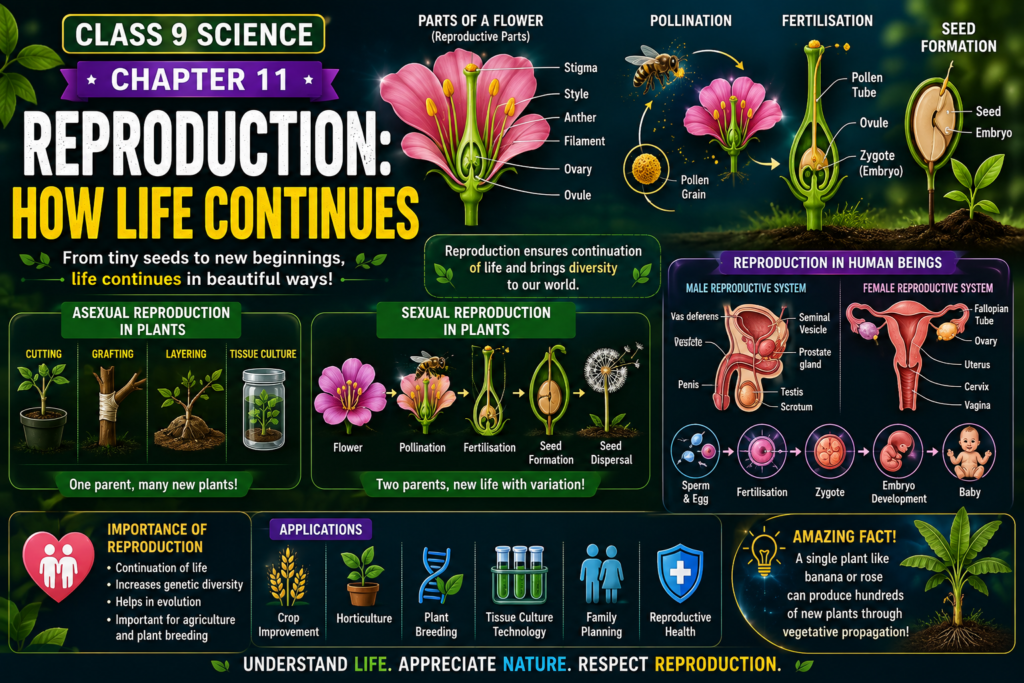
Table of Contents
📅 Last Updated: August 2026
📘 Syllabus: Based on the latest CBSE Class 9 (2026–27) syllabus
✅ Updated Resources Include:
- Chapter-wise Study Notes
- Free PDF Downloads
- MCQs
Chapter Overview
| Information | Details |
|---|---|
| Class | 9 |
| Subject | Science |
| Textbook | Exploration |
| Chapter | 11 |
| Chapter Title | Reproduction: How Life Continues |
| Academic Session | 2026–27 |
| Resources | Notes, Worksheets, Questions, Tests & Revision |
About This Chapter
Reproduction: How Life Continues helps students understand the different ways organisms reproduce and how reproduction contributes to the continuation and diversity of life.
In this chapter, students explore:
- Asexual Reproduction
- Vegetative Propagation
- Cutting, Grafting and Layering
- Tissue Culture
- Sexual Reproduction in Plants
- Parts of a Flower Involved in Reproduction
- Pollination
- Self-Pollination and Cross-Pollination
- Pollen Germination and Pollen Tube
- Fertilisation in Plants
- Formation and Development of Seeds
- Seed Dispersal
- Reproductive Strategies in Plants
- Reproduction in Human Beings
- Reproductive Maturity
- Male Reproductive System
- Female Reproductive System
- Gametes — Sperm and Egg
- Fertilisation and Formation of Zygote
- Embryo and Foetal Development
- Pregnancy
- Birth Control Methods
- Reproductive Health
The chapter also connects reproduction with agriculture and plant breeding, including selective breeding and artificial hybridisation.
🎯 Learning Outcomes
After completing Class 9 Science Chapter 11 – Reproduction: How Life Continues, students will be able to:
- Explain the importance of reproduction for the continuation of life.
- Differentiate between asexual and sexual reproduction.
- Describe different methods of asexual reproduction.
- Explain vegetative propagation and its applications in agriculture and horticulture.
- Describe methods such as cutting, grafting, layering and tissue culture.
- Identify the reproductive parts of a flower.
- Explain the processes of pollination and fertilisation in flowering plants.
- Differentiate between self-pollination and cross-pollination.
- Explain how pollen germinates and how the pollen tube develops.
- Describe seed formation and seed dispersal.
- Explain how sexual reproduction contributes to variation and genetic diversity.
- Describe the changes associated with reproductive maturity in human beings.
- Identify the major parts and functions of the male and female reproductive systems.
- Explain the formation and role of sperm and egg cells.
- Describe fertilisation, zygote formation, embryo development and pregnancy.
- Explain the basic purpose of birth control methods.
- Connect reproductive processes with applications such as plant breeding and agriculture.
The chapter’s end-of-chapter questions also assess concepts such as cross-pollination, fertilisation, asexual reproduction, genetic diversity, vegetative propagation and reproductive processes in humans.
🔑 Key Topics
- Importance of Reproduction
- Asexual Reproduction
- Vegetative Propagation
- Cutting
- Grafting
- Layering
- Tissue Culture
- Sexual Reproduction in Plants
- Reproductive Parts of a Flower
- Pollination
- Self-Pollination
- Cross-Pollination
- Pollen Germination
- Pollen Tube
- Fertilisation
- Seed Formation
- Seed Dispersal
- Reproduction in Human Beings
- Reproductive Maturity
- Male Reproductive System
- Female Reproductive System
- Sperm and Egg
- Fertilisation and Zygote Formation
- Embryo and Foetal Development
- Pregnancy
- Birth Control
- Reproductive Health
- Plant Breeding and Artificial Hybridisation
⭐ Class 9 Science Chapter 11 Study Resources
What You'll Find in Chapter 11
- 📘 Chapter 11 Study Notes
- 📖 NCERT Textbook Solutions
- ❓ Important MCQs
- 📌 Important Questions for Exam Preparation
- 🧬 Important Diagrams and Visual Revision
- 🎁 Free Worksheet with Answer Key
🧬 Important Diagrams
Detailed labelled diagrams and visual explanations for the chapter.
📌 Important Questions
Important questions based on the NCERT chapter to help students.
🎁 Free Class 9 Science Chapter 11 Worksheet with Answers
Download our free printable Class 9 Science Chapter 11 worksheet with answer key for practice and revision.
Why Students Choose Our Class 9 Science Resources?
2026–27 Focused
Printable PDFs
Original Practice
Chapter-Wise Resources
Mobile Friendly
Answer Keys
❓FAQ
Q1. What textbook is used for Class 9 Science in 2026–27?
Answer about the new NCERT Exploration textbook.
Q2. Which chapter is this page about?
Chapter 11 of Exploration is Reproduction: How Life Continues
Q3. Are these NCERT textbook copies?
No. Our worksheets, notes and practice materials are independently created learning resources. They are designed to support students studying the NCERT curriculum.
Q4. Are the worksheets free?
Explain which resources are free and which may be available as complete practice resources.
Q5. Are answer keys included?
Explain depending on the particular resource.
Q6. Are these resources suitable for school revision?
Yes.
Q7. Will more Chapter 11 resources be added?
Yes. New resources may be added as they are developed.
🚀 Continue Learning
← Previous Chapter
📚 All Chapters
Next Chapter →
Chapter 12 – Patterns in Life: Diversity and Classification→
Ready to Practise Class 9 Science?
Explore chapter-wise notes, worksheets, practice questions and other Class 9 Science resources for Reproduction: How Life Continues.
Share this Chapter
Found these Class 9 Science resources useful? Share this chapter with students, parents or teachers.
Did you find this helpful?
Rate this chapter