
Class 9 Social Science Chapter 2 – Life on Earth
Understanding Society: India and Beyond | New Syllabus 2026–27
Explore Class 9 Social Science Chapter 2, Life on Earth – Part 2, with notes, worksheets, competency-based questions, MCQs, revision resources and NCERT exercise solutions for the 2026–27 syllabus. This chapter explores biomes, the biosphere, forests, wildlife, conservation, forest dwellers, ecotourism and government efforts to protect biodiversity.
This chapter follows the latest Class 9 Social Science curriculum for 2026–27. For official curriculum information, visit CBSE Academic.
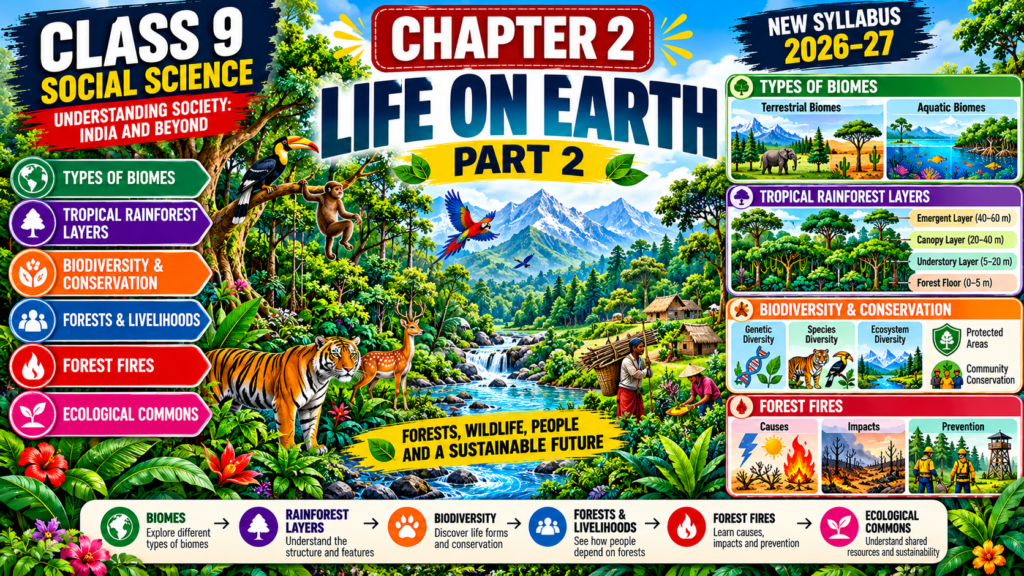
Table of Contents
📅 Last Updated: September 2026
📘 Syllabus: Based on the latest CBSE Class 9 (2026–27) syllabus
✅ Updated Resources Include:
- 📚 Chapter-wise Study Notes
- 📄 Free PDF Downloads
- ❓ MCQs
- 📝 Worksheets
- 📖 NCERT Exercise Solutions
Chapter Overview of Class 9 Social Science Chapter 2, Life on Earth – Part 2
Life on Earth introduces students to the diversity of life and the relationship between living organisms and their environment. The chapter explores biomes, including terrestrial and aquatic biomes, and explains how climate, temperature, rainfall and vegetation influence different ecosystems.
Students learn about major terrestrial biomes such as forests, grasslands, deserts and tundra, along with aquatic biomes such as freshwater and marine ecosystems. The chapter also highlights biodiversity, forests and their importance, and the different ways people depend on forests for food, fuel, medicine, livelihoods and cultural practices.
The chapter examines the lives and challenges of forest dwellers, including their traditional knowledge, livelihood activities, forest protection practices and access to resources. It also introduces Geographical Indication (GI) tags for forest products, conservation efforts, government initiatives and the Mendha Lekha community forest-management case study.
Students also explore the idea of ecological commons—shared natural resources such as forests, rivers, lakes, grazing lands, air and biodiversity. Traditional and community-based management practices, including fisheries management in Bihar and traditional water tanks, demonstrate how shared resources can be managed collectively and sustainably.
| Detail | Information |
|---|---|
| Class | 9 |
| Subject | Social Science – Geography |
| Chapter | 2 |
| Chapter Name | Life on Earth |
| Textbook | Understanding Society: India and Beyond, Part 2 |
| Academic Session | 2026–27 |
About This Chapter Class 9 Social Science Chapter 2, Life on Earth Part 2
In this chapter, students explore the diversity of life on Earth and understand how climate, landforms, water and human activities shape different environments. The chapter introduces biomes and explains how plants, animals and other living organisms are adapted to different climatic conditions.
Students learn about major terrestrial biomes, including forests, grasslands, deserts and tundra, as well as aquatic biomes, including freshwater and marine environments. The chapter also explains the interconnectedness between biomes and living beings, the importance of biodiversity, and the need to maintain ecological balance.
The chapter further explores forests and livelihoods, including the dependence of forest-dwelling communities on forest resources, traditional knowledge, forest protection and Geographical Indication (GI)-tagged forest products. Students also learn about the challenges faced by people living in forests and various government efforts to support forest dwellers.
The chapter concludes with the idea of ecological commons—shared natural resources and examines community-based resource management through examples such as fisheries management in Bihar and traditional water tanks in India.
Learning Outcomes of Class 9 Social Science Chapter 2, Life on Earth Part 2
After completing Chapter 2, students should be able to:
- Explain the meaning of biomes and distinguish between terrestrial and aquatic biomes.
- Identify and describe major terrestrial biomes such as forests, grasslands, deserts and tundra.
- Explain how climate, temperature and rainfall influence vegetation and animal life in different biomes.
- Describe the characteristics of freshwater and marine biomes.
- Explain the interconnectedness between biomes, living organisms and human activities.
- Understand the meaning and importance of biodiversity.
- Identify important biodiversity hotspots in India and explain the need for their conservation.
- Explain the importance of forests for livelihoods, culture, biodiversity and ecological balance.
- Describe the relationship between forest dwellers and forest resources.
- Understand the role of traditional knowledge and community participation in forest conservation.
- Explain the meaning and significance of Geographical Indication (GI) for region-specific forest products.
- Identify major challenges faced by people living in forests.
- Describe important government efforts and programmes supporting forest dwellers.
- Understand the concept of ecological commons and the importance of shared-resource management.
- Explain how community-based management can contribute to sustainable use of natural resources.
Key Topics of Class 9 Social Science Chapter 2, Life on Earth Part 2
🌍 Biomes
Meaning of biomes, characteristics of biomes, factors influencing biomes and distribution of different biomes across the world.
🌳 Terrestrial Biomes
Forest, grassland, desert and tundra biomes, their climatic conditions, vegetation, animals and human activities.
🌲 Forest Biome
Tropical rainforests, biodiversity, forest layers, ecological importance and forests as a storehouse of genetic resources.
🌾 Grassland Biome
Temperate grasslands, tropical grasslands or savannas, vegetation, wildlife, agriculture and livestock activities.
🏜️ Desert Biome
Hot and cold deserts, low rainfall, adaptations of plants and animals, desert livelihoods and water-related challenges.
❄️ Tundra Biome
Harsh climatic conditions, permafrost, limited vegetation and adaptations of plants and animals.
🌊 Aquatic Biomes
Freshwater and marine biomes, their importance for biodiversity, climate, food, livelihoods and human activities.
🔺 Biome Pyramid
Relationship between climate conditions and different biome types, including temperature and moisture patterns.
🦋 Biodiversity & Ecological Balance
Meaning of biodiversity, variety of species and habitats, ecological balance and the importance of conserving life forms.
🌿 Biodiversity Conservation
Biodiversity hotspots, ecosystem-based conservation, protected areas, geographical barriers and corridors, and human–environment interaction.
🌲 Forest Ecotourism
Responsible tourism, conservation, local communities, sustainable tourism and the example of Thenmala Ecotourism in Kerala.
👩🌾 Forests and Livelihoods
Food, fuel, fodder, timber, bamboo, medicinal plants, non-timber forest products, livestock, employment and cultural practices.
🧑🤝🧑 Forest Dwellers
Livelihoods, traditional knowledge, household needs, cultural connections and the role of communities in forest protection.
🏷️ Geographical Indication (GI)
Meaning of GI, region-specific forest products and examples of GI-tagged forest products from different Indian states.
⚠️ Challenges Faced by People Living in Forests
Access to healthcare, education and clean water, livelihood challenges, forest fires, human-wildlife conflict, disasters and economic difficulties.
🏛️ Government Efforts to Support Forest Dwellers
Forest Rights Act, tribal welfare initiatives, Joint Forest Management, PESA, DAJGUA and PM-JANMAN.
🌳 Mendha Lekha Case Study
Community forest management, self-governance, traditional knowledge, sustainable use of forest resources and community participation.
🤝 Ecological Commons
Shared natural resources such as forests, rivers, lakes, grazing lands, air and biodiversity, and the importance of collective management.
🐟 Commons-Based Fisheries Management
The Bihar fisheries case study, community participation, sustainable resource use and the Bihar Fish Jalkar Management Act.
💧 Traditional Water Management
Historical water tanks, community-based water management and examples such as tanks in Bundelkhand, Karnataka, Tamil Nadu, Andhra Pradesh, Odisha and Bihar.
⭐ Class 9 Social Science Chapter 2 Study Resources – Part 2
Get complete study and practice resources for Class 9 Social Science Chapter 2, Life on Earth Part 2 from Understanding Society: India and Beyond, Part 2, based on the new Class 9 Social Science curriculum for 2026–27.
📌 Important Questions
Most important questions to prepare for exams and chapter revision.
❓ Big Questions of Class 9 Social Science Chapter 2
Key questions and quick answers to help students understand and revise the important concepts of Chapter
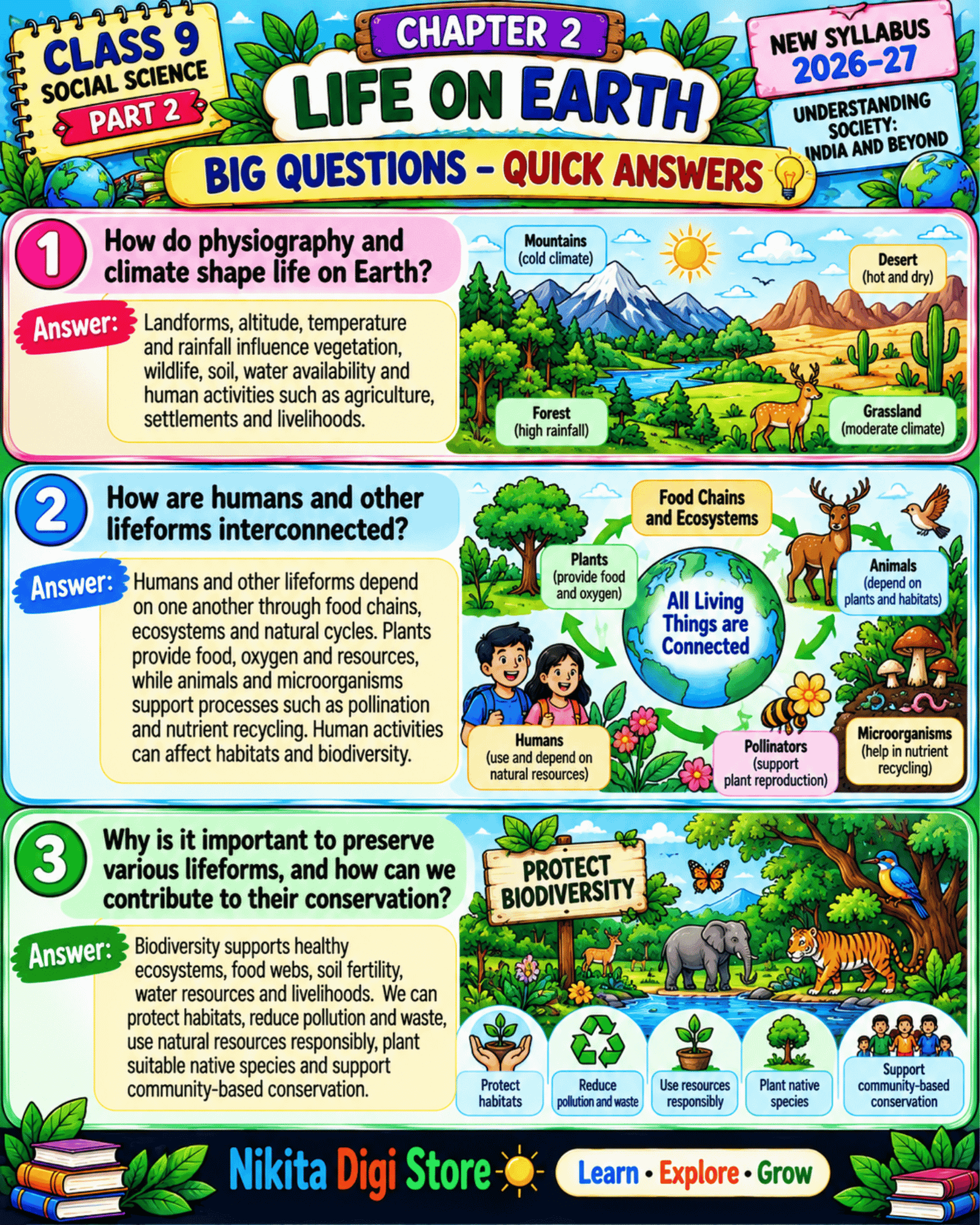
1. How do physiography and climate shape life on Earth?
Answer:
Physiography and climate influence the conditions in which plants, animals and humans live. Factors such as landforms, altitude, temperature and rainfall affect vegetation, wildlife, soil, water availability and human activities such as agriculture, settlements and livelihoods.
2. How are humans and other lifeforms interconnected?
Answer:
Humans and other lifeforms depend on one another through food chains, ecosystems and natural cycles. Plants provide food, oxygen and other resources, while animals and microorganisms contribute to processes such as pollination and nutrient recycling. Human activities can also affect habitats and biodiversity.
3. What is the importance of preserving various lifeforms, and how can we contribute to their conservation?
Answer:
Preserving biodiversity helps maintain healthy ecosystems, food webs, soil fertility, water resources and livelihoods. We can contribute by protecting habitats, conserving biodiversity, reducing pollution and waste, using natural resources responsibly, planting suitable native species and supporting community-based conservation efforts.
🎨 Visual Revision: Big Questions at a Glance
Key questions and quick answers to help students understand and revise the important concepts of Chapter
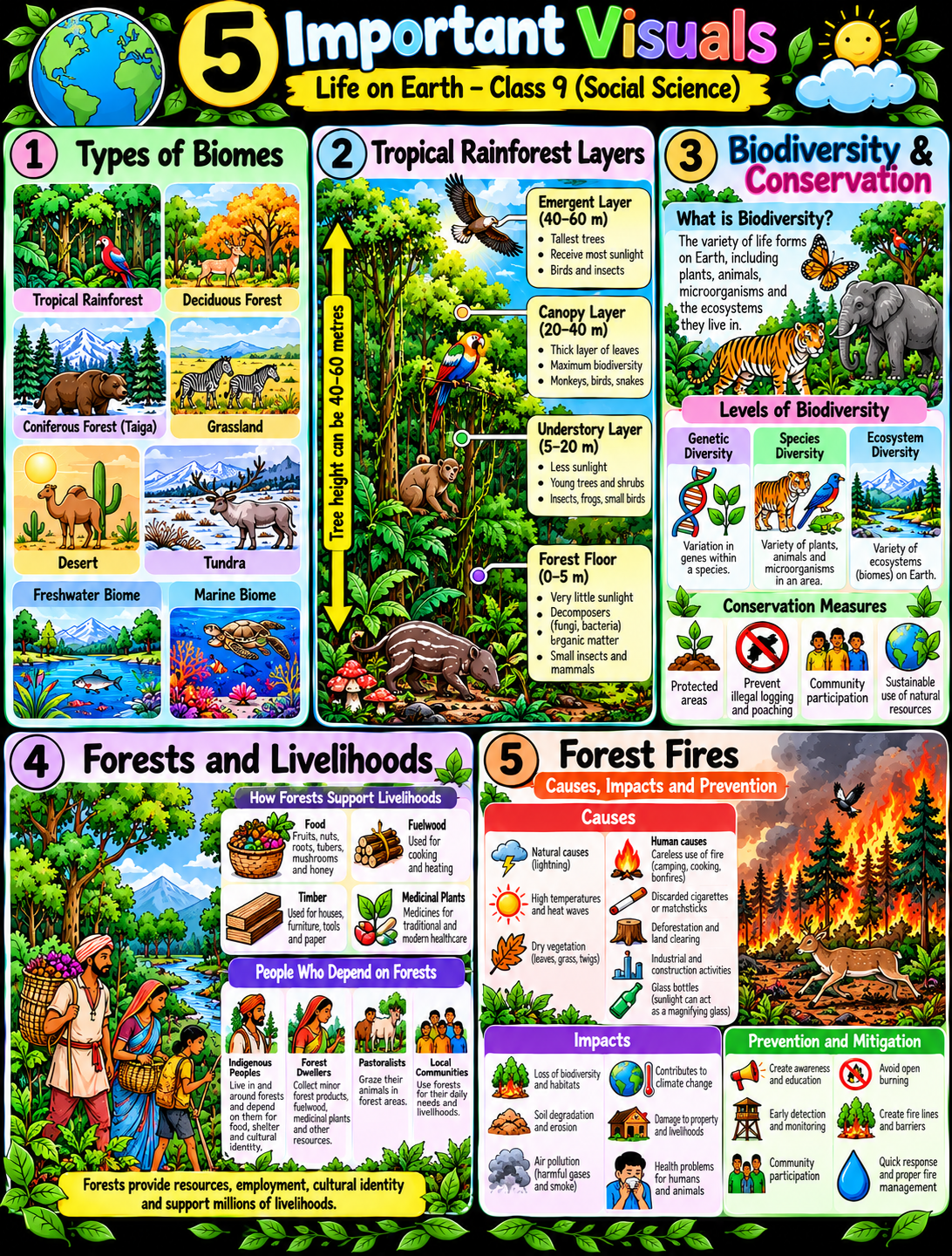
🗺️ Visual Learning Resources
Explore maps, diagrams and visual resources to understand the key concepts of Life on Earth, including biomes, biodiversity, forests, livelihoods and ecological commons.
The 5 most important visuals for Class 9 Social Science – Chapter 2: Life on Earth are:
- 🌍 Types of Biomes
- 🌳 Tropical Rainforest Layers
- 🐅 Biodiversity & Conservation
- 🌲 Forests & Livelihoods
- 🔥 Forest Fires – Causes, Impacts & Prevention
🎁 Free Class 9 Social Science Chapter 2 Worksheets – Part 2
Start your Chapter 2 preparation with selected practice questions covering biomes, terrestrial and aquatic biomes, biodiversity, ecological balance, forests and livelihoods, forest dwellers, GI-tagged forest products, and ecological commons.
📚 NCERT Exercise Solutions – Chapter 2 | Part 2
Find helpful answers to the questions and activities from Chapter 2 – Life on Earth.
The chapter includes activities related to biomes, forests, grasslands, deserts, tundra, aquatic biomes, biodiversity conservation, forest livelihoods, forest dwellers, GI-tagged forest products, government efforts, community forest management, ecological commons, fisheries and traditional water management.
Why Students Choose Our Class 9 Social Science Resources?
2026–27 Focused
Printable PDFs
Original Practice
Chapter-Wise Resources
Mobile Friendly
Answer Keys
❓ FAQ of Class 9 Social Science Chapter 2, Life on Earth Part 2
Q1. What is Chapter 2 of Class 9 Social Science Part 2?
Chapter 2 is “Life on Earth” from Understanding Society: India and Beyond, Part 2. It explores biomes, biodiversity, forests, livelihoods, forest conservation and the relationship between humans and the natural environment.
Q2. What are the main topics in Chapter 2 – Life on Earth?
The main topics include biomes, terrestrial and aquatic biomes, forests, grasslands, deserts, tundra, biodiversity, ecological balance, forest livelihoods, forest dwellers, GI-tagged forest products, conservation, ecological commons and community-based resource management.
Q3. What is a biome?
A biome is a large natural region where particular types of plants and animals live under similar climatic conditions. Examples include tundra, forests, grasslands and deserts.
Q4. What are the main types of terrestrial biomes?
The main terrestrial biomes discussed in the chapter are forests, grasslands, deserts and tundra. Their characteristics depend largely on factors such as temperature and rainfall.
Q5. What is biodiversity?
Biodiversity refers to the variety of life on Earth, including plants, animals, microorganisms, genetic differences within species and different habitats and ecosystems.
Q6. Why are forests important?
Forests support biodiversity, ecological balance and climate regulation and provide resources such as food, fuel, fodder, timber, bamboo, medicinal plants and non-timber forest products. They are also important for the livelihoods and cultures of many communities.
Q7. What is meant by forest dwellers?
Forest dwellers are people and communities who have strong connections with forests and depend on forest resources for household needs, livelihoods, traditional knowledge and cultural practices. The chapter also discusses their role in forest protection and conservation.
Q8. What are ecological commons?
Ecological commons are natural resources such as forests, rivers, lakes, grazing lands, air and biodiversity that are shared by communities and managed collectively for their survival and well-being.
Q9. What is a Geographical Indication (GI)?
A Geographical Indication (GI) is a label that identifies a product as originating from a particular place when its quality, reputation or other characteristics are linked to that geographical origin. The chapter discusses several GI-tagged forest products of India.
Q10. How are communities involved in conserving forests and natural resources?
Local communities contribute through traditional knowledge, community-based management, sustainable use of resources, forest protection and collective decision-making. The chapter includes the Mendha Lekha case study as an example of community forest management.
Q11. What are some challenges faced by people living in forests?
Forest communities may face difficulties related to healthcare, education, clean water, livelihood opportunities, forest fires, natural disasters, human-wildlife conflict, access to forest resources and economic insecurity.
Q12. What are ecological commons and why are they important?
Ecological commons are shared natural resources that support livelihoods, ecological balance and biodiversity. Their sustainable management is important because communities and ecosystems depend on these resources over the long term.
🚀 Continue Your Class 9 Social Science Journey
Keep learning with Class 9 Social Science Part 2 chapter-wise study and practice resources.
Previous Chapter
Next Chapter
📚 All Chapters
Ready to Practise Class 9 Social Science?
Build your understanding of Class 9 Social Science Chapter 2, Life on Earth Part 2 with chapter-wise study and practice resources.
Share this Chapter Class 9 Social Science Chapter 1, Oceans and Life Part 2
Found these Class 9 Social Science Chapter 2 resources helpful? Share this page with students, parents and teachers.
Did You Find This Chapter Helpful?
👍 Yes / 👎 No
- More worksheets
- More MCQs
- More important questions
- More maps & diagrams
- More revision notes
- NCERT solutions