
Class 9 Social Science Chapter 3 – Resistance and Resilience
Understanding Society: India and Beyond | New Syllabus 2026–27
Explore Class 9 Social Science Chapter 3, Resistance and Resilience – Part 2, with notes, worksheets, competency-based questions, MCQs, revision resources and NCERT exercise solutions for the 2026–27 syllabus. This chapter explores resistance, resilience, Rajput kingdoms, the Ahom kingdom, Vijayanagara Empire, Marathas, Sikh and Jat resistance, Bhakti and Sufi traditions, temples, agriculture, trade and merchant communities.
This chapter follows the latest Class 9 Social Science curriculum for 2026–27. For official curriculum information, visit CBSE Academic.
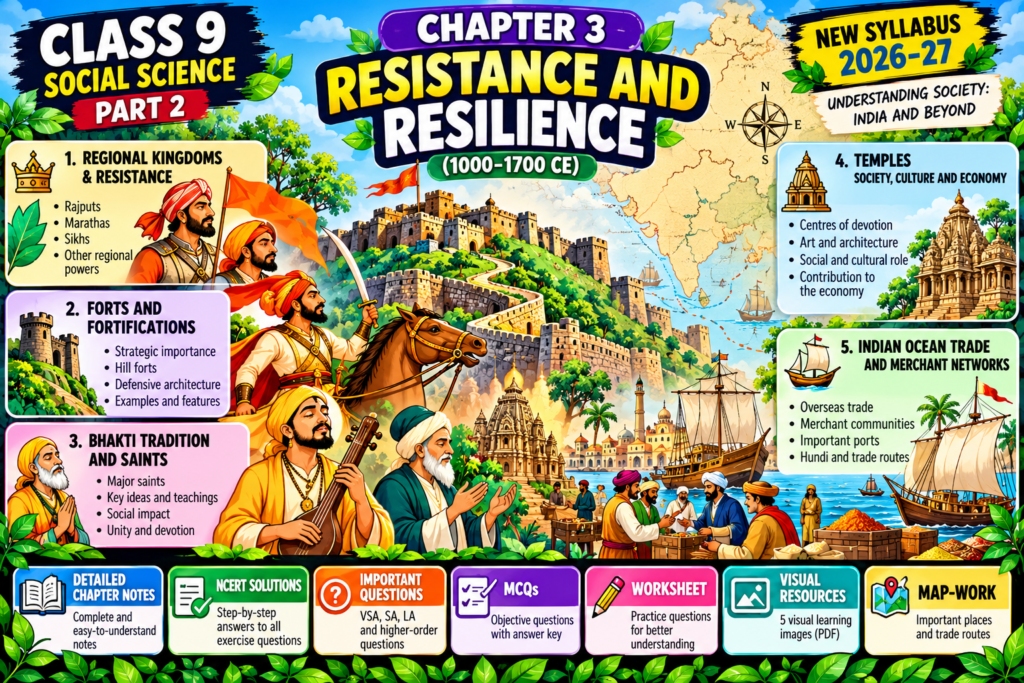
Table of Contents
📅 Last Updated: September 2026
📘 Syllabus: Based on the latest CBSE Class 9 (2026–27) syllabus
✅ Updated Resources Include:
- 📚 Chapter-wise Study Notes
- 📄 Free PDF Downloads
- ❓ MCQs
- 📝 Worksheets
- 📖 NCERT Exercise Solutions
Chapter Overview of Class 9 Social Science Chapter 3, Resistance and Resilience (1000–1700 CE) Part 2
Resistance and Resilience explores how Indian kingdoms, communities and traditions responded to political challenges and changing circumstances between 1000 and 1700 CE. The chapter examines the connection between resistance and resilience and how societies adapted while preserving their political, cultural and spiritual identities.
Students learn about Rajput resistance, alliances and confederacies, including the role of Mewar and Maharana Pratap. The chapter also covers the Ahom Kingdom, its strategic use of local geography, the Paik system and the Battle of Saraighat.
The chapter explores the Vijayanagara Empire, its rise in southern India, Hampi, its resistance to expansion by neighbouring powers and the later emergence of Nayaka kingdoms. It also examines the Marathas and the idea of Swarajya, including Chhatrapati Shivaji, strategic forts, alliances and guerrilla warfare.
Students also study Sikh and Jat resistance, including the development of Sikh political organisation, the Khalsa and the role of community-based resistance. The chapter highlights the Bhakti tradition, regional languages, devotional movements, prominent Bhakti saints, equality and inclusion, along with the role of Sufi traditions and Sulh-i-Kul.
The chapter further examines temples as resilient social, cultural and economic institutions, including their role in employment, trade, education, irrigation and community life. Finally, students explore agriculture, irrigation, land revenue, hundis, merchant communities, inland trade and Indian Ocean trade, showing how economic networks contributed to the resilience of Indian society.
| Detail | Information |
|---|---|
| Class | 9 |
| Subject | Social Science – History |
| Chapter | 3 |
| Chapter Name | Resistance and Resilience (1000–1700 CE) |
| Textbook | Understanding Society: India and Beyond, Part 2 |
| Academic Session | 2026–27 |
About This Chapter Class 9 Social Science Chapter 3, Resistance and Resilience (1000–1700 CE) Part 2
In this chapter, students explore how Indian kingdoms, communities and traditions responded to political challenges and changing circumstances between 1000 and 1700 CE. The chapter examines the ideas of resistance and resilience and how societies protected their territories, identities, institutions and cultural traditions.
Students learn about the Rajputs, Ahoms, Vijayanagara Empire, Marathas, Sikhs and Jats, and the different strategies they used to respond to political and military pressures. The chapter highlights the importance of forts, alliances, local geography, guerrilla warfare, military organisation and self-governance in shaping resistance.
The chapter also explores the Bhakti and Sufi traditions, including the contributions of saints, the use of regional languages, devotional practices, equality and inclusion, and the role of Sufism and Sulh-i-Kul in India’s religious and social landscape.
Students examine the importance of temples as religious, cultural, economic and social institutions, including their role in employment, education, trade, irrigation and community life. The chapter further introduces agriculture, irrigation systems, land revenue, trading networks, merchant communities and hundis.
Finally, students explore the Indian Ocean trading network and understand how agriculture, commerce, cultural exchange and community networks contributed to the resilience of Indian society between 1000 and 1700 CE.
Learning Outcomes of Class 9 Social Science Chapter 3, Resistance and Resilience (1000–1700 CE) Part 2
After completing Chapter 3, students should be able to:
- Explain the meaning of resistance and resilience in the historical context of India between 1000 and 1700 CE.
- Describe the resistance strategies of the Rajputs, Ahoms, Vijayanagara rulers, Marathas, Sikhs and Jats.
- Explain the importance of forts, military strategies, alliances and local geography in resistance.
- Understand the ideas of Swarajya and community-based political organisation.
- Describe the role of the Bhakti tradition and prominent Bhakti saints in Indian society.
- Explain important features of Sufi traditions and the idea of Sulh-i-Kul.
- Examine how regional languages, devotional traditions and cultural practices contributed to social resilience.
- Explain the religious, cultural, economic and political significance of temples.
- Understand the development of agriculture, irrigation and land-revenue systems.
- Describe the role of merchant communities, trading networks and hundis in the Indian economy.
- Explain the importance of the Indian Ocean trade network and India’s connections with other regions.
- Analyse how political, economic, social and cultural institutions contributed to resistance and resilience.
Key Topics of Class 9 Social Science Chapter 3, Resistance and Resilience (1000–1700 CE) Part 2
🛡️ Resistance and Resilience
Meaning of resistance and resilience, changing political conditions, adaptation, alliances and strategies used by different communities.
🏰 Rajput Resistance
Rajput kingdoms, Mewar, Maharana Pratap, alliances, forts and strategies of resistance.
⚔️ Ahom Kingdom
Ahom state, local geography, military organisation, Paik system and the Battle of Saraighat.
🏛️ Vijayanagara Empire
Rise of Vijayanagara, Hampi, administration, military strength, cultural development and resistance to neighbouring powers.
🦁 Marathas and Swarajya
Chhatrapati Shivaji, Swarajya, forts, guerrilla warfare, strategic alliances and expansion of Maratha influence.
🪯 Sikh and Jat Resistance
Development of Sikh political organisation, Khalsa, community mobilisation and Jat resistance.
🕉️ Bhakti Tradition
Bhakti saints, devotional practices, regional languages, equality, inclusion and social participation.
☪️ Sufi Traditions & Sulh-i-Kul
Sufi orders, khanqahs, interaction with local traditions, Akbar’s Sulh-i-Kul and religious tolerance.
🛕 Temples and Sacred Sites
Temples as centres of religion, education, culture, employment, trade, landholding and economic activity.
🌾 Agriculture and Irrigation
Agricultural expansion, land revenue, irrigation technologies, Persian wheel, canals and local irrigation systems.
💰 Trade and Merchant Communities
Inland trade, caravans, banjaras, merchant communities, money changers and hundis.
🌊 Indian Ocean Trade
Maritime trade, ports, Arabian Sea, Persian Gulf, East Africa, Southeast Asia and connections with wider trading networks.
🌍 Continuity, Change and Resilience
How political resistance, economic networks, cultural traditions and community institutions helped Indian society adapt and endure between 1000 and 1700 CE
❓ Big Questions of Class 9 Social Science Chapter 3
Key questions and quick answers to help students understand and revise the important concepts of Chapter
Resistance and Resilience (1000–1700 CE) | Part 2
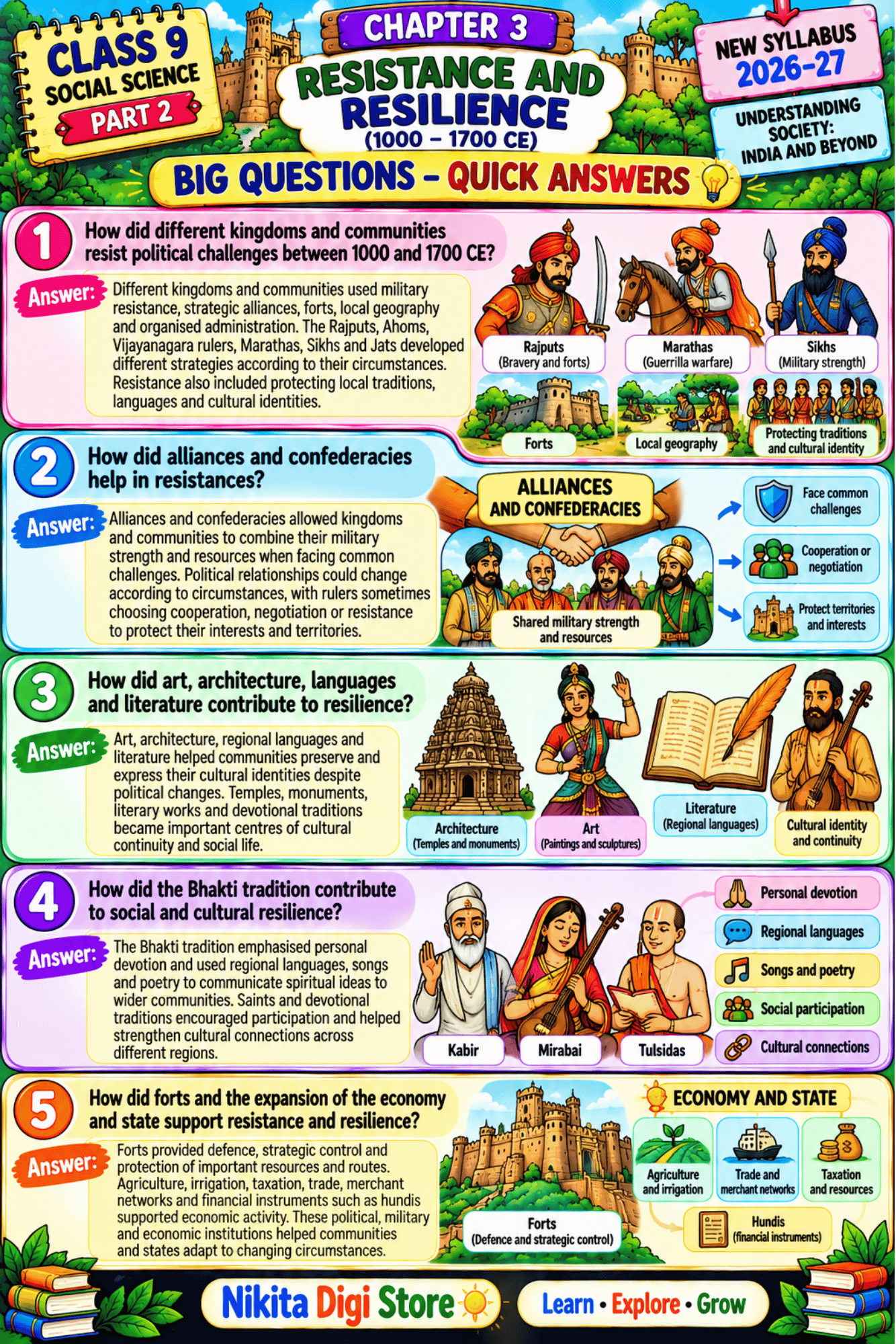
1️⃣ How did different kingdoms and communities resist political challenges between 1000 and 1700 CE?
Different kingdoms and communities used a combination of military resistance, strategic alliances, forts, local geography and organised administration. The Rajputs, Ahoms, Vijayanagara rulers, Marathas, Sikhs and Jats developed different strategies according to their circumstances. Resistance also included protecting local traditions, languages and cultural identities. Nikitadigistore.com
2️⃣ How did alliances and confederacies help in resistance?
Alliances and confederacies allowed kingdoms and communities to combine their military strength and resources when facing common challenges. Political relationships could change according to circumstances, with rulers sometimes choosing cooperation, negotiation or resistance to protect their interests and territories.
3️⃣ How did art, architecture, languages and literature contribute to resilience?
Art, architecture, regional languages and literature helped communities preserve and express their cultural identities despite political changes. Temples, monuments, literary works and devotional traditions became important centres of cultural continuity and social life. Nikitadigistore.com
4️⃣ How did the Bhakti tradition contribute to social and cultural resilience?
The Bhakti tradition emphasised personal devotion and used regional languages, songs and poetry to communicate spiritual ideas to wider communities. Saints and devotional traditions encouraged participation and helped strengthen cultural connections across different regions. Nikitadigistore.com
5️⃣ How did forts and the expansion of the economy and state support resistance and resilience?
Forts provided defence, strategic control and protection of important resources and routes. At the same time, agriculture, irrigation, taxation, trade, merchant networks and financial instruments such as hundis supported economic activity. These political, military and economic institutions helped communities and states adapt to changing circumstances.
Quick Revision:
🛡️ Resistance → opposing or responding to political and military challenges
🌱 Resilience → adapting, surviving and preserving identity through change
🏰 Forts → defence and strategic control
🤝 Alliances → cooperation and shared strength
🕉️ Bhakti → devotion, regional languages and cultural participation
💰 Economy & Trade → resources that supported communities and states
🎨 Visual Revision: Big Questions at a Glance
Key questions and quick answers to help students understand and revise the important concepts of Chapter
⭐ Class 9 Social Science Chapter 3 Study Resources – Part 2
Get complete study and practice resources for Class 9 Social Science Chapter 3, Resistance and Resilience (1000–1700 CE) from Understanding Society: India and Beyond, Part 2, based on the new Class 9 Social Science curriculum for 2026–27.
📌 Important Questions
Most important questions to prepare for exams and chapter revision.
🗺️ Visual Learning Resources
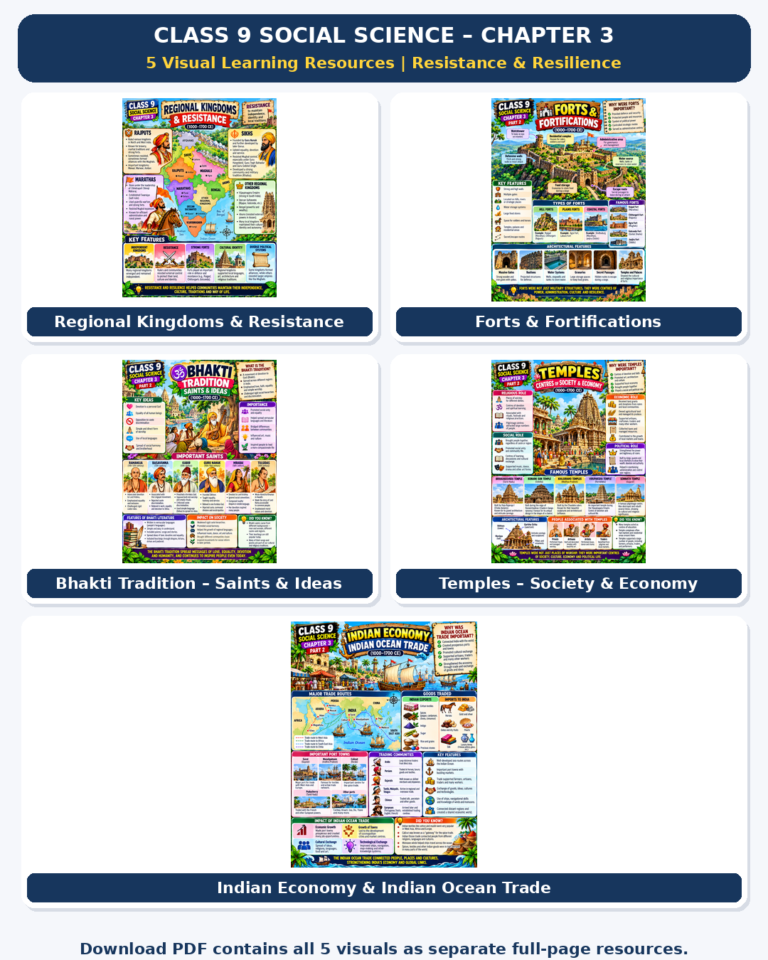
Explore maps, diagrams and visual resources to understand the key concepts of Resistance and Resilience (1000–1700 CE), including regional kingdoms, forts, Bhakti and Sufi traditions, temples, trade and the Indian economy.
The 5 most important visuals for Class 9 Social Science – Chapter 3: Resistance and Resilience (1000–1700 CE) are:
- 🗺️ Regional Kingdoms & Resistance – Map
- 🏰 Forts & Fortifications
- 🕉️ Bhakti Tradition – Saints & Ideas
- 🛕 Temples – Centres of Society & Economy
- 🌊 Indian Economy & Indian Ocean Trade
🎁 Free Class 9 Social Science Chapter 3 Worksheets – Part 2
Start your Chapter 3 preparation with selected practice questions covering resistance and resilience, Rajputs, Ahoms, Vijayanagara, Marathas, Sikhs, Jats, Bhakti and Sufi traditions, temples, agriculture, trade, merchant communities and the Indian Ocean trading network.
📚 NCERT Exercise Solutions – Chapter 3 | Part 2
Find helpful answers to the questions and activities from Chapter 3 – Resistance and Resilience (1000–1700 CE).
The chapter includes activities related to resistance strategies, forts, Swarajya, Bhakti saints, Sufi traditions, Sulh-i-Kul, temples, agriculture, irrigation, land revenue, hundis, merchant communities and Indian Ocean trade.
Why Students Choose Our Class 9 Social Science Resources?
2026–27 Focused
Printable PDFs
Original Practice
Chapter-Wise Resources
Mobile Friendly
Answer Keys
❓ FAQ of Class 9 Social Science Chapter 3, Resistance and Resilience (1000–1700 CE) Part 2
Q1. What is Chapter 3 of Class 9 Social Science Part 2?
Chapter 3 is “Resistance and Resilience (1000–1700 CE)” from Understanding Society: India and Beyond, Part 2. It explores how different kingdoms, communities and traditions responded to political, military, social and economic challenges during this period.
Q2. What are the main topics in Chapter 3 – Resistance and Resilience?
The main topics include Rajput resistance, the Ahom kingdom, Vijayanagara, Marathas and Swarajya, Sikh and Jat resistance, Bhakti traditions, Sufi traditions, Sulh-i-Kul, temples, agriculture, irrigation, land revenue, merchant communities, hundis and Indian Ocean trade.
Q3. What does resistance and resilience mean in Chapter 3?
Resistance refers to efforts to oppose or respond to political and military pressures, while resilience refers to the ability of communities and institutions to adapt, survive and continue despite challenges.
Q4. Which kingdoms and communities are discussed in Chapter 3?
The chapter discusses the Rajputs, Ahoms, Vijayanagara rulers, Marathas, Sikhs and Jats, along with the social and cultural contributions of various communities and traditions.
Q5. What is the importance of forts in Chapter 3?
Forts served as strategic military centres, defensive positions, safe retreats and bases for resistance. Their location and design were often connected to the geographical features of the region.
Q6. What is the Bhakti tradition?
The Bhakti tradition emphasised personal devotion to a deity. Bhakti saints used regional languages, devotional songs and poetry to communicate spiritual ideas and reach wider sections of society.
Q7. What were Sufi traditions?
Sufism was a mystical tradition within Islam that spread through various orders. Sufi khanqahs and shrines became important centres of spiritual and social life.
Q8. What was Sulh-i-Kul?
Sulh-i-Kul, associated with Akbar’s later reign, represented the principle of “peace with all” or universal tolerance and was adopted as a state policy.
Q9. Why were temples important during this period?
Temples were not only places of worship. They also functioned as centres of education, culture, employment, economic activity, land management and community life.
Q10. What was the role of trade and merchant communities?
Merchant communities connected rural and urban markets, financed and facilitated trade, and participated in inland and overseas trading networks.
Q11. What was a hundi?
A hundi was a traditional financial instrument used for commercial transactions and long-distance transfer of money. It helped merchants conduct transactions without physically carrying large amounts of currency.
Q12. Why was the Indian Ocean important?
The Indian Ocean trading network connected India with regions such as the Persian Gulf, Arabian Sea, East Africa, Southeast Asia and other parts of the world, facilitating the movement of goods, people and ideas.
🚀 Continue Your Class 9 Social Science Journey
Keep learning with Class 9 Social Science Part 2 chapter-wise study and practice resources.
Previous Chapter
Next Chapter
📚 All Chapters
Ready to Practise Class 9 Social Science?
Build your understanding of Class 9 Social Science Chapter 3, Resistance and Resilience (1000–1700 CE) Part 2 with chapter-wise study and practice resources.
Share this Class 9 Social Science Chapter 3, Resistance and Resilience (1000–1700 CE) Part 2
Found these Class 9 Social Science Chapter 3 resources helpful? Share this page with students, parents and teachers.
Did You Find This Chapter Helpful?
👍 Yes / 👎 No
- More worksheets
- More MCQs
- More important questions
- More maps & diagrams
- More revision notes
- NCERT solutions