
CBSE Class 10 Maths Chapter 13 – Probability (2026–27)
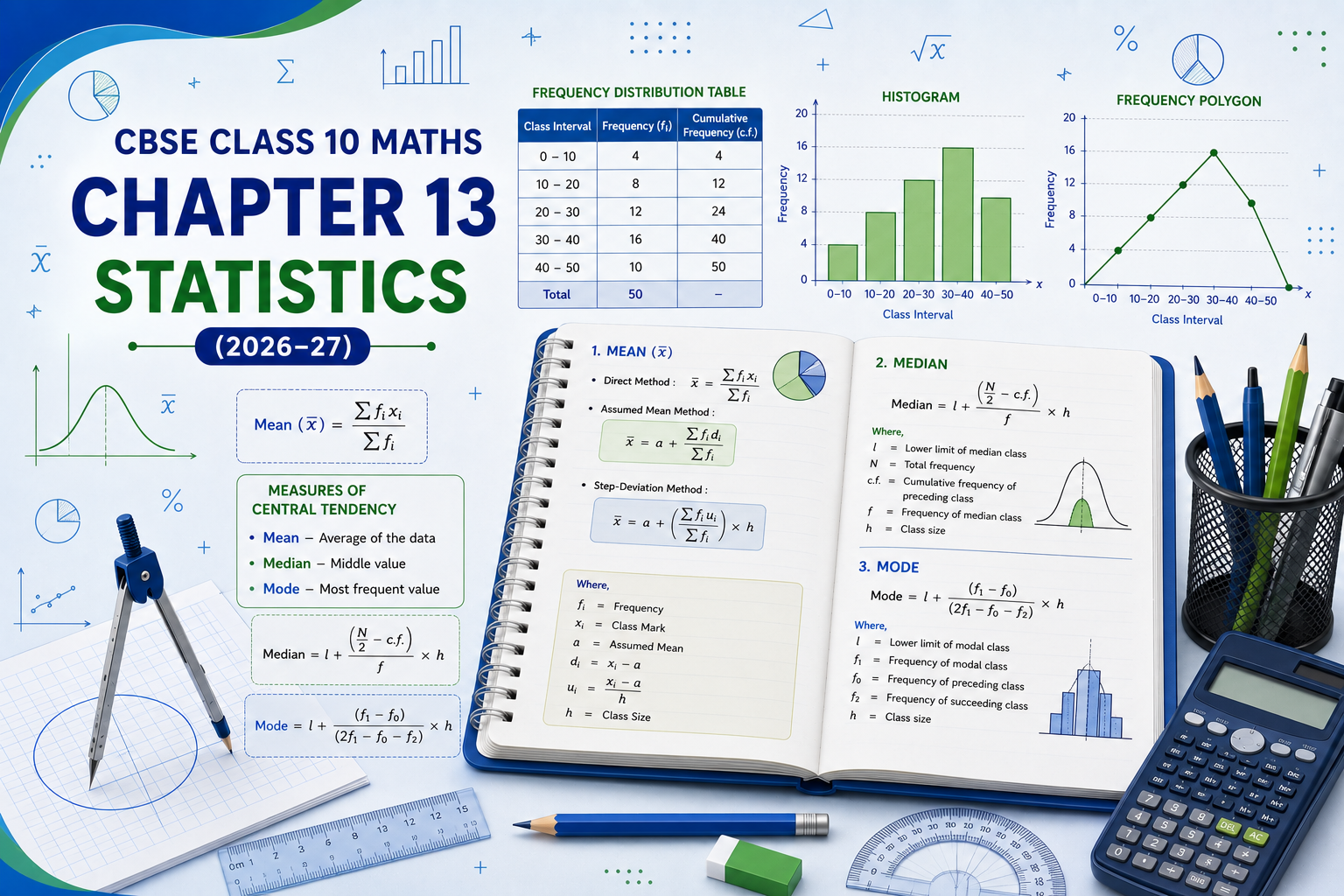
Master Chapter 13 – Statistics with comprehensive study notes, NCERT solutions, exercise-wise solutions, MCQs, important questions, PDF downloads, and video lessons based on the latest CBSE Class 10 Mathematics (2026–27) syllabus. Learn how to calculate the mean, median, and mode of grouped data, interpret frequency distribution tables, and solve statistical problems using step-by-step methods.
📊Statistics
📖 Exercises
🎥 Video Lessons
📄 Study Notes
📥Free PDFs
📝 MCQs
Chapter Summary
Statistics helps students collect, organize, analyze, and interpret numerical data. In this chapter, students learn to calculate the mean, median, and mode for grouped data using different methods, including the direct method, assumed mean method, and step-deviation method. They also learn how to represent data using frequency distribution tables and cumulative frequency.
By practicing NCERT exercises, solved examples, MCQs, and important questions, students develop strong data-handling and analytical skills required for the CBSE Class 10 board examination.
Learning Outcomes
After completing this chapter, students will be able to:
- ✅ Organize data into frequency distribution tables.
- ✅ Calculate the mean of grouped data using different methods.
- ✅ Find the median of grouped data.
- ✅ Calculate the mode using graphical and formula-based methods.
- ✅ Interpret statistical data accurately.
- ✅ Solve NCERT and board-level statistical problems confidently.
- ✅ Improve logical reasoning and data analysis skills.
- ✅ Prepare effectively for the CBSE board examination.
Key Topics
- 📊 Statistics
- 📋 Frequency Distribution
- 📈 Mean
- 📉 Median
- 📌 Mode
- 🧮 Direct Method
- 🔢 Assumed Mean Method
- ➗ Step-Deviation Method
- 📐 Cumulative Frequency
- 📑 Class Interval
⭐ Study Resources
📝 Exercise Solutions
Step-by-step video lessons covering every concept based on the latest CBSE syllabus.
📄 Study Notes
Comprehensive notes with explanations, solved examples, and important concepts.
🧠 Mind Map
Visual chapter summary for quick revision of important concepts and formulas.
📚 Formula Sheet
Formula Sheet
Access all important formulas, revision points, and key facts for quick exam preparation.
📘 NCERT Solutions
Step-by-step solutions for every NCERT textbook exercise with clear explanations.
📘 Exemplar Solutions
Detailed solutions for NCERT Exemplar questions to strengthen higher-order thinking.
📑 Important Questions
Most expected board exam questions with detailed solutions and explanations.
❓ MCQs
Chapter-wise multiple-choice questions for concept reinforcement and quick revision.
🎥 Video Lessons
Step-by-step video lessons covering every concept based on the latest CBSE syllabus.
📑 Competency Based Questions
Assertion & Reason and Case Study questions based on the latest CBSE pattern..
📄 PDF Notes
Additional practice questions to improve problem-solving skills and self-assessment.
📝Exercise-wise Solutions
📘 Exercise 13.1 – Mean of Grouped Data
Exercise 13.1 introduces the concept of the mean of grouped data. Students learn to calculate the mean using the Direct Method, organize data in frequency distribution tables, and solve numerical problems with detailed NCERT solutions and step-by-step explanations.
📘 Exercise 13.2 – Mean Using Assumed Mean and Step-Deviation Methods
Exercise 13.2 focuses on finding the mean of grouped data using the Assumed Mean Method and the Step-Deviation Method. Students practice faster calculation techniques and develop accuracy in solving statistical problems through detailed NCERT solutions.
📘 Exercise 13.3 – Median and Mode of Grouped Data
Exercise 13.3 covers the calculation of the median and mode of grouped data using standard statistical formulas. Students learn to interpret frequency distribution tables, solve application-based questions, and strengthen their understanding of statistical concepts with detailed NCERT solutions and easy-to-follow explanations.
Free PDF Downloads
📄 Chapter Notes PDF
Download Notes
📘 NCERT Solutions PDF
Download Solutions
📝 Exercise Solutions PDF
Download Exercises
❓ MCQs PDF
Download MCQs
📑 Important Questions PDF
Download Questions
📚 Formula Sheet PDF
Download Formula Sheet
🎥 YouTube Playlists
Mathematics
✍️ Complete Class 10 Maths Playlist
⭐ ⭐ Why students choose Online Teaching With Nikita
CBSE 2026–27 Syllabus
Download Free PDFs
Video Lessons
Chapter-wise Notes
Previous Year Questions
Regular Updates
Mobile Friendly
Board Exam Focused
❓ Frequently Asked Questions
1. What is Statistics?
Statistics is the branch of mathematics that deals with collecting, organizing, analyzing, interpreting, and presenting numerical data.
2. How many exercises are there in Chapter 13?
Chapter 13 contains 3 exercises:
- 📘 Exercise 13.1 – Mean of Grouped Data
- 📘 Exercise 13.2 – Mean Using Assumed Mean and Step-Deviation Methods
- 📘 Exercise 13.3 – Median and Mode of Grouped Data
3. What measures of central tendency are covered in this chapter?
This chapter covers the three main measures of central tendency:
- 📈 Mean
- 📉 Median
- 📌 Mode
4. Are these notes based on the latest CBSE syllabus?
Yes. All study notes, solutions, and learning resources are prepared according to the latest CBSE Class 10 Mathematics (2026–27) syllabus.
5. Are NCERT exercise solutions available?
Yes. Step-by-step solutions for Exercise 2.1 and Exercise 2.2 are available with detailed explanations.
6. Can I download the Chapter 13 notes as a PDF?
Yes. Free PDF notes and other downloadable study resources are available on this page.
7. Are MCQs and important questions included?
Yes. This chapter includes chapter-wise MCQs, important questions, and additional practice material for exam preparation.
8.Why is Chapter 13 important for the CBSE board examination?
Chapter 13 is an important scoring chapter because it focuses on data analysis and interpretation. Questions based on the mean, median, mode, and grouped data are regularly asked in the CBSE board examination, making this chapter essential for building strong statistical and analytical skills.
9. Are video lessons available for this chapter?
Yes. Video lessons are provided to help students understand each concept with clear explanations and solved examples.
10. Who can use these study resources?
These resources are suitable for CBSE Class 10 students, teachers, and parents looking for reliable notes, NCERT solutions, MCQs, PDFs, and revision material.
11. What methods are used to calculate the mean?
Students learn three methods:
- 🧮 Direct Method
- 🔢 Assumed Mean Method
- ➗ Step-Deviation Method
12. What is a frequency distribution table?
A frequency distribution table organizes data into class intervals along with the number of observations (frequency) in each interval, making it easier to analyze grouped data.
13. What types of questions are asked from this chapter?
This chapter includes questions on:
- 📊 Mean
- 📉 Median
- 📌 Mode
- 📋 Frequency Distribution
- 📐 Cumulative Frequency
- 📝 Data Interpretation
📖 Ready to Master Class 10
Stay updated with new chapter videos, free PDF notes, revision materials, and board exam resources. Subscribe to our YouTube channel and visit NikitaDigiStore.com regularly for the latest updates.
🚀Continue Learning
Keep building your mathematics skills by exploring the next chapter in the CBSE Class 10 Mathematics syllabus.
📖 Chapter 12 – Surface Areas and Volumes
Available
📖 Chapter 14 – Probability
🟠 Under Preparation
📚 View All Chapters
🟠 Under Preparation
🚀Ready to Score Better in Mathematics?
Access free notes, exercise solutions, PDFs, MCQs, and video lessons for every CBSE Class 10 Mathematics chapter.
Share this Chapter
Did you find this helpful?
Rate this chapter