
Class 9 Science – Chapter 5: Exploring Mixtures and Their Separation
NCERT Exploration | Class 9 Science | 2026–27
Explore Mixtures & Their Separation
Discover how different substances combine to form mixtures and learn how scientists separate their components using simple and effective techniques. This chapter takes you through solutions, suspensions, colloids, solubility, concentration, and separation methods such as filtration, evaporation, crystallisation, chromatography, centrifugation, sublimation, separating funnel, and distillation.
Learn the concepts • Understand the processes • Explore labelled diagrams • Master the chapter
Official NCERT textbooks and educational resources can also be accessed through the NCERT website.
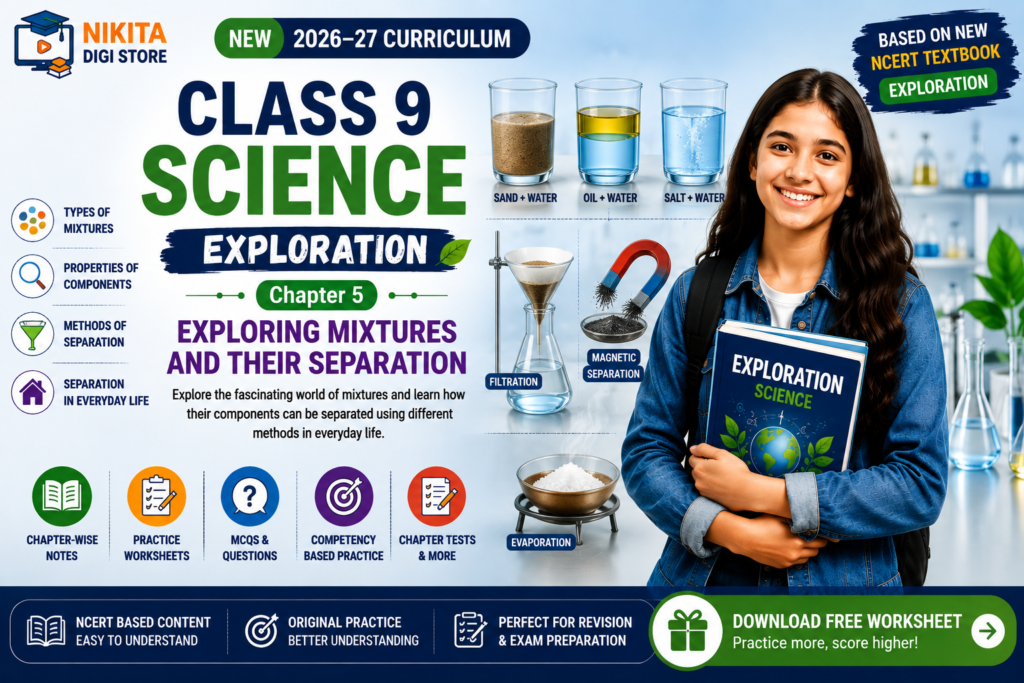
Table of Contents
📅 Last Updated: August 2026
📘 Syllabus: Based on the latest CBSE Class 9 (2026–27) syllabus
✅ Updated Resources Include:
- Chapter-wise Study Notes
- Free PDF Downloads
- MCQs
Chapter Overview
| Information | Details |
|---|---|
| Class | 9 |
| Subject | Science |
| Textbook | Exploration |
| Chapter | 5 |
| Chapter Title | Exploring Mixtures and Their Separation |
| Academic Session | 2026–27 |
| Resources | Notes, Worksheets, Questions, Tests & Revision |
📖 About This Chapter
Class 9 Science Chapter 5 – Exploring Mixtures and their Separation helps students understand the different types of mixtures, their properties and the scientific methods used to separate their components. 🧪
In this chapter, you will explore homogeneous and heterogeneous mixtures and learn how to identify solutions, suspensions and colloids. You will also study concentration and solubility of solutions and how temperature can affect solubility. 📊🌡️
The chapter introduces important separation techniques such as crystallisation, distillation, paper chromatography, sublimation, centrifugation and coagulation. You will understand how these methods work and how suitable techniques are selected based on the physical properties of the components. 🔬⚗️
You will also connect these concepts with everyday life, including water treatment, waste separation, recycling and other environmental applications, helping you understand the importance of separation techniques in creating a cleaner and more sustainable world. ♻️🌍
🧪 Chapter 5 — Diagram Free PDF Available
- 🧪 Homogeneous vs Heterogeneous Mixtures
- 🧂 Solution – Solute, Solvent & Solution
- 🔬 Solution, Suspension & Colloid – Particle Comparison
- 💡 Tyndall Effect – Light Scattering
- 📊 Solubility Curve
- 📈 Effect of Temperature on Solubility
- 🧪 Filtration – Separation of Insoluble Solid
- 💧 Evaporation – Separation of Soluble Solid
- ❄️ Crystallisation – Step-by-Step Process
- 🔥 Distillation – Apparatus & Process
- 🧻 Paper Chromatography – Detailed Setup
- 🧴 Separating Funnel – Immiscible Liquids
- 🌫️ Sublimation – Separation of Sublimable Solid
- 🌀 Centrifugation – Separation by Spinning
- 🧬 Colloids – Dispersed Phase & Dispersion Medium
🎯 Learning Outcomes
By the end of Class 9 Science Chapter 5 – Exploring Mixtures and their Separation, students will be able to:
- 🧪 Differentiate between homogeneous and heterogeneous mixtures based on their properties.
- 🔬 Classify mixtures as solutions, suspensions and colloids by studying their characteristics.
- 📊 Define and calculate the concentration of solutions using mass by mass, mass by volume and volume by volume percentages.
- 🌡️ Analyse solubility graphs and explain how the solubility of substances changes with temperature.
- 🧫 Demonstrate and explain different separation techniques, including crystallisation, distillation, paper chromatography, sublimation, centrifugation and coagulation.
- ⚙️ Understand the scientific principles behind separation techniques and select suitable methods based on the physical properties of components.
- 📈 Use scientific conventions and standard units to express the concentration of solutions.
- 📝 Draw labelled diagrams or flow charts of different separation techniques.
- 🌍 Relate separation methods to everyday life, local practices and environmental applications, including waste separation and recycling.
- ♻️ Develop awareness of the role of chemistry in making life healthier, cleaner and more sustainable.
- 🧤 Handle common laboratory chemicals and apparatus safely.
📌 Key Topics
- 🧩 Homogeneous and Heterogeneous Mixtures
- 🥤 Solutions and Their Properties
- 🌫️ Suspensions and Their Properties
- 🥛 Colloids and Their Properties
- 📊 Concentration of Solutions
- Mass by Mass Percentage
- Mass by Volume Percentage
- Volume by Volume Percentage
- 🌡️ Solubility and the Effect of Temperature
- 💡 Tyndall Effect
- ⚗️ Separation of Mixtures Based on Physical Properties
- 💎 Crystallisation
- 💧 Distillation
- 🧪 Paper Chromatography
- 🫗 Separating Funnel
- 🌬️ Sublimation and Deposition
- 🌀 Centrifugation
- 🔗 Coagulation
- ♻️ Separation Techniques in Daily Life and Environmental Sustainability
What You'll Find in Chapter 5
- 📘 Chapter 5 Study Notes
- 📖 NCERT Textbook Solutions
- ❓ Important MCQs
- 📌 Important Questions for Exam Preparation
- 🧬 Important Diagrams and Visual Revision
- 🎁 Free Worksheet with Answer Key
📚 Class 9 Science Chapter 5 Study Resources
🧬 Important Diagrams
Detailed labelled diagrams and visual explanations for the chapter.
📌 Important Questions
Important questions based on the NCERT chapter to help students.
🎁 Free Class 9 Science Chapter 5 Worksheet with Answers
Download our free printable Class 9 Science Chapter 5 worksheet with answer key for practice and revision.
Why Students Choose Our Class 9 Science Resources?
2026–27 Focused
Printable PDFs
Original Practice
Chapter-Wise Resources
Mobile Friendly
Answer Keys
❓Frequently Asked Questions
Q1. What textbook is used for Class 9 Science in 2026–27?
Answer about the new NCERT Exploration textbook.
Q2. Which chapter is this page about?
Chapter 5 of Exploration is Exploring Mixtures and Their Separation
Q3. Are these NCERT textbook copies?
No. Our worksheets, notes and practice materials are independently created learning resources. They are designed to support students studying the NCERT curriculum.
Q4. Are the worksheets free?
Explain which resources are free and which may be available as complete practice resources.
Q5. Are answer keys included?
Explain depending on the particular resource.
Q6. Are these resources suitable for school revision?
Yes.
Q7. Will more Chapter 5 resources be added?
Yes. New resources may be added as they are developed.
🚀 Continue Learning
← Previous Chapter
📚 All Chapters
Next Chapter →
Chapter 6 – How Forces Affect Motion →
Ready to Practise Class 9 Science?
Explore chapter-wise worksheets, practice questions and printable Science resources for the 2026–27 academic session.
Share this Chapter
Found these Class 9 Science resources useful? Share this chapter with students, parents or teachers.
Did you find this helpful?
Rate this chapter