
Class 9 Science Chapter 10 – Sound Waves: Characteristics and Applications
NCERT Exploration | Class 9 Science | 2026–27
Class 9 Science Chapter 10 – Sound Waves: Characteristics and Applications explores how sound is produced, how it travels through different media, and how we perceive it. Students investigate sound as a form of energy and learn how vibrations produce sound and how sound propagates as a longitudinal wave through a medium.
The chapter develops an understanding of wavelength, frequency, time period, amplitude, intensity and speed of sound, along with pitch and loudness. It also explains the reflection of sound, including echo, reverberation and echolocation.
Official NCERT textbooks and educational resources can also be accessed through the NCERT website.
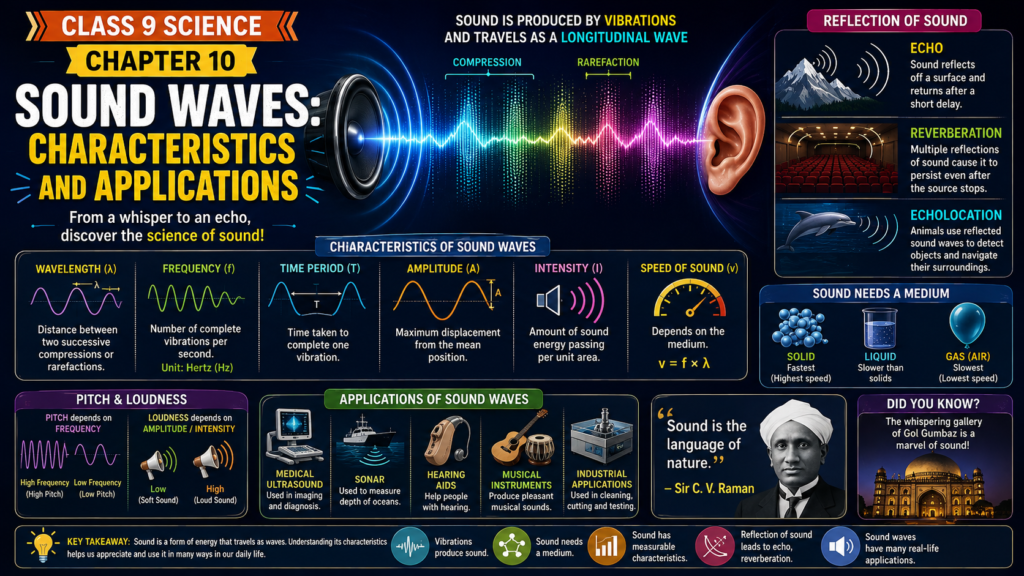
Table of Contents
📅 Last Updated: August 2026
📘 Syllabus: Based on the latest CBSE Class 9 (2026–27) syllabus
✅ Updated Resources Include:
- Chapter-wise Study Notes
- Free PDF Downloads
- MCQs
Chapter Overview
| Information | Details |
|---|---|
| Class | 9 |
| Subject | Science |
| Textbook | Exploration |
| Chapter | 10 |
| Chapter Title | Sound Waves: Characteristics and Applications |
| Academic Session | 2026–27 |
| Resources | Notes, Worksheets, Questions, Tests & Revision |
About This Chapter
Sound Waves: Characteristics and Applications helps students understand the science behind the sounds they experience in everyday life—from voices and musical instruments to echoes and animal echolocation.
In this chapter, students explore:
- Production of Sound
- Vibrations and Sound
- Propagation of Sound
- Sound as a Longitudinal Wave
- Medium Required for Sound
- Sound in Solids, Liquids and Gases
- Graphical Representation of Sound Waves
- Wavelength
- Frequency
- Time Period
- Amplitude
- Intensity
- Speed of Sound
- Pitch and Loudness
- Human Audible Range
- Reflection of Sound
- Echo
- Reverberation
- Echolocation
- Applications of Sound Waves
The chapter also connects sound with music, including the relationship between pitch and frequency, and highlights the whispering gallery of Gol Gumbaz and the contribution of Sir C. V. Raman.
🎯 Learning Outcomes
After completing Class 9 Science Chapter 10 – Sound Waves: Characteristics and Applications, students will be able to:
- Demonstrate that sound is produced by vibrations.
- Demonstrate that sound can travel through air, solids and liquids.
- Explain why sound requires a medium for propagation.
- Explain that sound travels as a longitudinal wave.
- Identify and explain compressions and rarefactions in a sound wave.
- Represent sound waves using appropriate graphs.
- Define and explain wavelength, frequency, time period, amplitude, intensity and speed of a sound wave.
- Establish the relationship between frequency and time period.
- Derive and use the mathematical expression for the speed of sound.
- Calculate the speed of sound using the appropriate expression.
- Explain human perception of sound in terms of audible range, pitch and loudness.
- Explain the relationship between frequency and pitch and between amplitude/intensity and loudness.
- Explain the reflection of sound.
- Describe and apply the concepts of echo and reverberation.
- Explain how sound waves are used for echolocation.
- Analyse graphs representing sound waves.
- Relate the characteristics of sound waves to music and musical sounds.
- Recognise the scientific and cultural significance of structures designed to produce or demonstrate echoes.
🔑 Key Topics
- Production of Sound
- Vibrations
- Propagation of Sound
- Sound Requires a Medium
- Longitudinal Sound Waves
- Compressions and Rarefactions
- Graphical Representation of Sound Waves
- Wavelength
- Frequency
- Time Period
- Amplitude
- Intensity
- Speed of Sound
- Relationship Between Frequency and Time Period
- Pitch
- Loudness
- Human Audible Range
- Propagation of Sound Through Solids and Liquids
- Reflection of Sound
- Echo
- Reverberation
- Echolocation
- Applications of Sound Waves
- Sound in Music
- Gol Gumbaz and Echoes
- Sir C. V. Raman
These topics follow the official Class 9 Science 2026–27 syllabus for the Sound unit and the actual Chapter 10 Exploration textbook.
⭐ Class 9 Science Chapter 10 Study Resources
What You'll Find in Chapter 10
- 📘 Chapter 10 Study Notes
- 📖 NCERT Textbook Solutions
- ❓ Important MCQs
- 📌 Important Questions for Exam Preparation
- 🧬 Important Diagrams and Visual Revision
- 🎁 Free Worksheet with Answer Key
🧬 Important Diagrams
Detailed labelled diagrams and visual explanations for the chapter.
📌 Important Questions
Important questions based on the NCERT chapter to help students.
🎁 Free Class 9 Science Chapter 10 Worksheet with Answers
Download our free printable Class 9 Science Chapter 10 worksheet with answer key for practice and revision.
Why Students Choose Our Class 9 Science Resources?
2026–27 Focused
Printable PDFs
Original Practice
Chapter-Wise Resources
Mobile Friendly
Answer Keys
❓FAQ
Q1. What textbook is used for Class 9 Science in 2026–27?
Answer about the new NCERT Exploration textbook.
Q2. Which chapter is this page about?
Chapter 10 of Exploration is Sound Waves: Characteristics and Applications
Q3. Are these NCERT textbook copies?
No. Our worksheets, notes and practice materials are independently created learning resources. They are designed to support students studying the NCERT curriculum.
Q4. Are the worksheets free?
Explain which resources are free and which may be available as complete practice resources.
Q5. Are answer keys included?
Explain depending on the particular resource.
Q6. Are these resources suitable for school revision?
Yes.
Q7. Will more Chapter 10 resources be added?
Yes. New resources may be added as they are developed.
🚀 Continue Learning
← Previous Chapter
📚 All Chapters
Next Chapter →
Chapter 11 – Reproduction: How Life Continues →
Ready to Practise Class 9 Science?
Explore chapter-wise notes, worksheets, practice questions and other Class 9 Science resources for Exploring Mixtures and Their Separation.
Share this Chapter
Found these Class 9 Science resources useful? Share this chapter with students, parents or teachers.
Did you find this helpful?
Rate this chapter