
Class 9 Science Chapter 12 – Patterns in Life: Diversity and Classification
NCERT Exploration | Class 9 Science | 2026–27
Class 9 Science Chapter 12 – Patterns in Life: Diversity and Classification explores the remarkable diversity of living organisms and explains why scientists need systematic ways to identify, group and name them. Students learn how organisms can be classified using characteristics such as cellular organisation, mode of nutrition, body structure and ecological role.
The chapter traces the development of biological classification systems and introduces the five-kingdom classification. It then explores the major groups of plants and animals, along with binomial nomenclature and viruses as acellular entities.
Official NCERT textbooks and educational resources can also be accessed through the NCERT website.
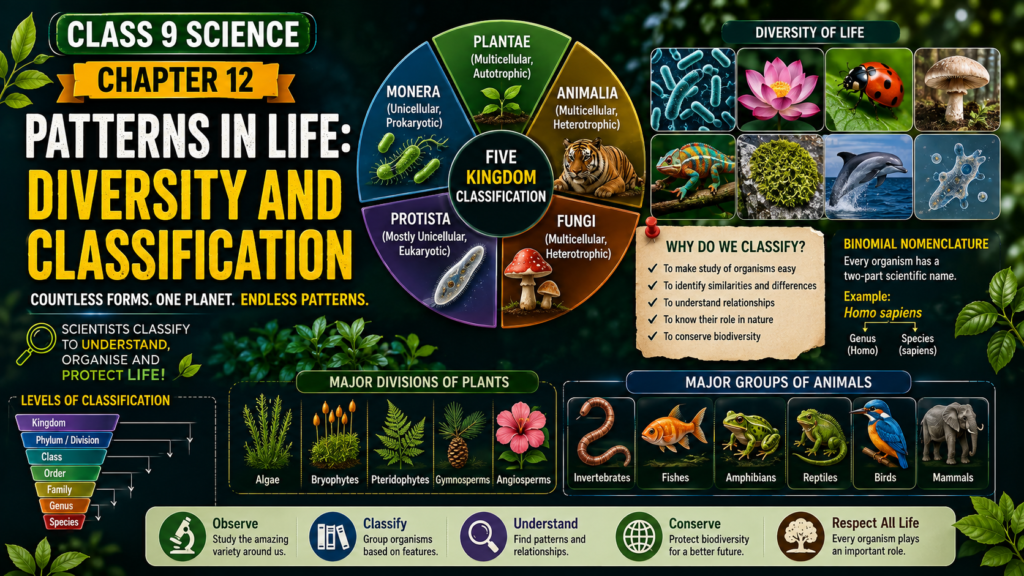
Table of Contents
📅 Last Updated: August 2026
📘 Syllabus: Based on the latest CBSE Class 9 (2026–27) syllabus
✅ Updated Resources Include:
- Chapter-wise Study Notes
- Free PDF Downloads
- MCQs
Chapter Overview
| Information | Details |
|---|---|
| Class | 9 |
| Subject | Science |
| Textbook | Exploration |
| Chapter | 12 |
| Chapter Title | Patterns in Life: Diversity and Classification |
| Academic Session | 2026–27 |
| Resources | Notes, Worksheets, Questions, Tests & Revision |
About This Chapter
Patterns in Life: Diversity and Classification helps students understand the patterns that scientists use to organise Earth’s enormous variety of life.
In this chapter, students explore:
- Importance of Classification
- Diversity of Living Organisms
- Criteria for Classification
- Cellular Organisation
- Unicellular and Multicellular Organisms
- Prokaryotic and Eukaryotic Organisms
- Mode of Nutrition
- Five-Kingdom Classification
- Kingdom Monera
- Kingdom Protista
- Kingdom Fungi
- Kingdom Plantae
- Kingdom Animalia
- Major Divisions of Plants
- Major Groups of Animals
- Levels of Organisation in Animals
- Binomial Nomenclature
- Scientific Naming of Organisms
- Viruses as Acellular Entities
- Ecological Roles of Organisms
- Interactions Between Organisms
The chapter also examines how classification systems have changed over time, from earlier systems based mainly on observable characteristics to systems using cellular and other biological features.
🎯 Learning Outcomes
After completing Class 9 Science Chapter 12 – Patterns in Life: Diversity and Classification, students will be able to:
- Explain the importance of classification in studying biodiversity.
- Distinguish organisms based on characteristics such as number of cells, cellular organisation and mode of nutrition.
- Classify organisms into groups using appropriate biological characteristics.
- Explain the major features of the five kingdoms and give suitable examples.
- Compare prokaryotic and eukaryotic organisms.
- Distinguish between unicellular and multicellular organisms.
- Explain how mode of nutrition helps in classification.
- Describe the major divisions of plants and animals.
- Compare organisms on the basis of their body organisation and structural features.
- Explain the significance and rules of binomial nomenclature.
- Apply binomial nomenclature to common organisms.
- Explain the ecological roles and interactions of different groups of organisms, including examples such as lichens.
- Recognise viruses as acellular entities.
- Analyse why classification systems have changed as scientific knowledge has developed.
These outcomes closely follow the official Class 9 Science 2026–27 syllabus, which specifically requires classification based on cellular organisation and ecological role, understanding the five kingdoms, major plant and animal divisions, binomial nomenclature and viruses
🔑 Key Topics
- Diversity of Life
- Importance of Classification
- Characteristics Used for Classification
- Cellular Organisation
- Unicellular and Multicellular Organisms
- Prokaryotes and Eukaryotes
- Mode of Nutrition
- Five-Kingdom Classification
- Kingdom Monera
- Kingdom Protista
- Kingdom Fungi
- Kingdom Plantae
- Kingdom Animalia
- Major Plant Groups
- Major Animal Groups
- Body Organisation in Animals
- Ecological Roles of Organisms
- Binomial Nomenclature
- Scientific Names
- Taxonomic Hierarchy
- Viruses – Acellular Entities
- Lichens and Organism Interactions
- Classification and Evolutionary Relationships
⭐ Class 9 Science Chapter 12 Study Resources
What You'll Find in Chapter 12
- 📘 Chapter 12 Study Notes
- 📖 NCERT Textbook Solutions
- ❓ Important MCQs
- 📌 Important Questions for Exam Preparation
- 🧬 Important Diagrams and Visual Revision
- 🎁 Free Worksheet with Answer Key
🧬 Important Diagrams
Detailed labelled diagrams and visual explanations for the chapter.
📌 Important Questions
Important questions based on the NCERT chapter to help students.
🎁 Free Class 9 Science Chapter 12 Worksheet with Answers
Download our free printable Class 9 Science Chapter 12 worksheet with answer key for practice and revision.
Why Students Choose Our Class 9 Science Resources?
2026–27 Focused
Printable PDFs
Original Practice
Chapter-Wise Resources
Mobile Friendly
Answer Keys
❓FAQ
Q1. What textbook is used for Class 9 Science in 2026–27?
Answer about the new NCERT Exploration textbook.
Q2. Which chapter is this page about?
Chapter 12 of Exploration is Patterns in Life: Diversity and Classification
Q3. Are these NCERT textbook copies?
No. Our worksheets, notes and practice materials are independently created learning resources. They are designed to support students studying the NCERT curriculum.
Q4. Are the worksheets free?
Explain which resources are free and which may be available as complete practice resources.
Q5. Are answer keys included?
Explain depending on the particular resource.
Q6. Are these resources suitable for school revision?
Yes.
Q7. Will more Chapter 12 resources be added?
Yes. New resources may be added as they are developed.
🚀 Continue Learning
← Previous Chapter
📚 All Chapters
Next Chapter →
Chapter 13 – Earth as a System: Energy, Matter, and Life →
Ready to Practise Class 9 Science?
Explore chapter-wise notes, worksheets, practice questions and other Class 9 Science resources for Patterns in Life: Diversity and Classification
Share this Chapter
Found these Class 9 Science resources useful? Share this chapter with students, parents or teachers.
Did you find this helpful?
Rate this chapter