
Class 9 Science Chapter 13 – Earth as a System: Energy, Matter, and Life
NCERT Exploration | Class 9 Science | 2026–27
Class 9 Science Chapter 13 – Earth as a System: Energy, Matter, and Life brings together the processes that make Earth a dynamic and interconnected system. The chapter explains how energy and matter move through Earth’s different spheres and how changes in one sphere can influence the others.
Students explore the role of the Sun as the main source of energy, the uneven heating of Earth’s surface, movement of air and water, and the cycling of essential elements and water through the Earth system.
Official NCERT textbooks and educational resources can also be accessed through the NCERT website.
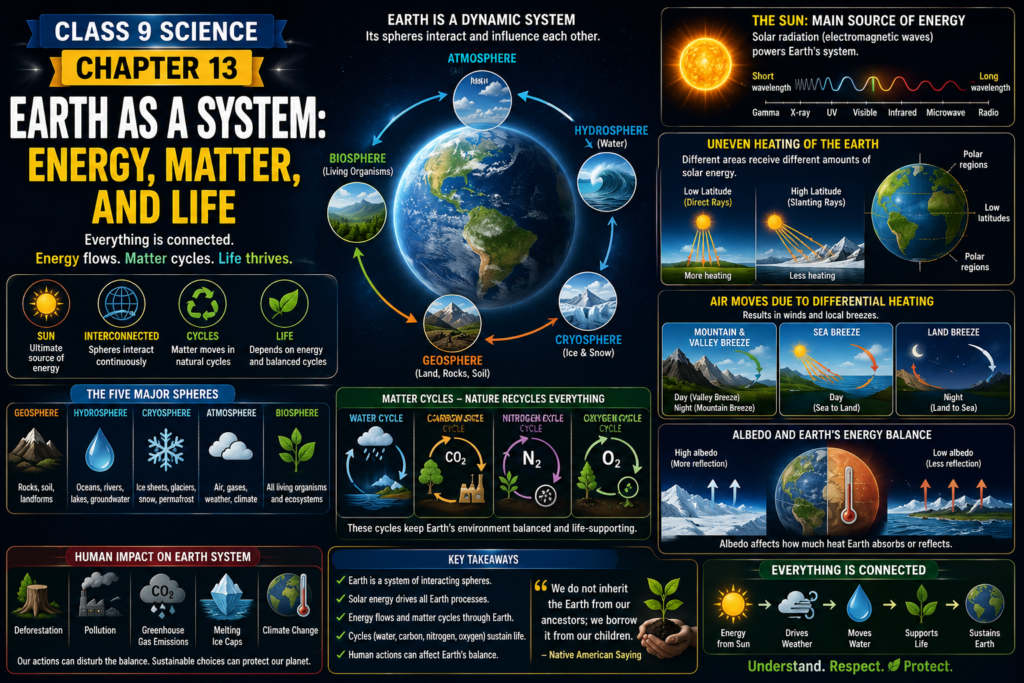
Table of Contents
📅 Last Updated: August 2026
📘 Syllabus: Based on the latest CBSE Class 9 (2026–27) syllabus
✅ Updated Resources Include:
- Chapter-wise Study Notes
- Free PDF Downloads
- MCQs
Chapter Overview
| Information | Details |
|---|---|
| Class | 9 |
| Subject | Science |
| Textbook | Exploration |
| Chapter | 13 |
| Chapter Title | Earth as a System: Energy, Matter, and Life |
| Academic Session | 2026–27 |
| Resources | Notes, Worksheets, Questions, Tests & Revision |
About This Chapter
Earth as a System: Energy, Matter, and Life helps students understand Earth as a connected system rather than a collection of separate processes.
In this chapter, students explore:
- Earth as an Interconnected System
- Geosphere
- Hydrosphere
- Cryosphere
- Atmosphere
- Biosphere
- Solar Energy and Solar Radiation
- Electromagnetic Nature of Solar Radiation
- Uneven Heating of the Earth
- Differential Heating of Earth’s Surface
- Atmosphere and Weather
- Winds and Air Movement
- Mountain and Valley Breezes
- Sea and Land Breezes
- Water Cycle
- Carbon Cycle
- Nitrogen Cycle
- Oxygen Cycle
- Biogeochemical Cycles
- Albedo and Earth’s Energy Balance
- Human Impact on Earth’s System
- Climate Change and Earth-System Interactions
The chapter emphasises that Earth’s spheres continuously interact. For example, changes in snowfall can affect water availability and vegetation, while warming oceans can influence evaporation, monsoon patterns and ecosystems.
🎯 Learning Outcomes
After completing Class 9 Science Chapter 13 – Earth as a System: Energy, Matter, and Life, students will be able to:
- Explain the interconnectedness of Earth’s spheres—geosphere, hydrosphere, cryosphere, atmosphere and biosphere.
- Explain the nature of solar radiation and recognise it as electromagnetic radiation.
- Explain how the shape, latitude and tilt of Earth influence the distribution of solar energy.
- Explain how solar radiation interacts with Earth’s surface and atmosphere.
- Explain differential heating of Earth’s surface.
- Relate differential heating to atmospheric phenomena such as air movement and evaporation.
- Explain the formation of mountain, valley, sea and land breezes.
- Identify components of Earth that interact with solar energy.
- Explain the role of the atmosphere in weather and climate.
- Understand albedo/reflectivity and its influence on Earth’s surface temperature and climate.
- Explain how carbon, nitrogen, oxygen and water are recycled between biotic and abiotic environments.
- Describe the role of biogeochemical cycles in maintaining environmental balance.
- Create flow charts and concept maps representing Earth-system processes and biogeochemical cycles.
- Formulate hypotheses and make predictions about changes in differential heating and biogeochemical cycles.
- Analyse how changes in one part of the Earth system can produce effects in other parts.
These outcomes closely follow the official Class 9 Science 2026–27 syllabus, which specifically lists Earth’s interconnected spheres, solar radiation, differential heating, atmospheric phenomena and biogeochemical cycles
🔑 Key Topics
- Earth as an Interconnected System
- Geosphere
- Hydrosphere
- Cryosphere
- Atmosphere
- Biosphere
- Solar Radiation
- Electromagnetic Spectrum
- Solar Energy
- Uneven Heating of Earth
- Differential Heating
- Latitude and Solar Radiation
- Earth’s Tilt and Heating
- Atmospheric Heating
- Winds and Air Movement
- Mountain Breeze
- Valley Breeze
- Sea Breeze
- Land Breeze
- Water Cycle
- Carbon Cycle
- Nitrogen Cycle
- Oxygen Cycle
- Biogeochemical Cycles
- Albedo / Reflectivity
- Earth’s Energy Balance
- Weather and Climate
- Human Impact on Earth’s System
- Climate Change
⭐ Class 9 Science Chapter 13 Study Resources
What You'll Find in Chapter 13
- 📘 Chapter 13 Study Notes
- 📖 NCERT Textbook Solutions
- ❓ Important MCQs
- 📌 Important Questions for Exam Preparation
- 🧬 Important Diagrams and Visual Revision
- 🎁 Free Worksheet with Answer Key
🧬 Important Diagrams
Detailed labelled diagrams and visual explanations for the chapter.
📌 Important Questions
Important questions based on the NCERT chapter to help students.
🎁 Free Class 9 Science Chapter 13 Worksheet with Answers
Download our free printable Class 9 Science Chapter 13 worksheet with answer key for practice and revision.
Why Students Choose Our Class 9 Science Resources?
2026–27 Focused
Printable PDFs
Original Practice
Chapter-Wise Resources
Mobile Friendly
Answer Keys
❓FAQ
Q1. What textbook is used for Class 9 Science in 2026–27?
Answer about the new NCERT Exploration textbook.
Q2. Which chapter is this page about?
Chapter 13 of Exploration is Earth as a System: Energy, Matter, and Life
Q3. Are these NCERT textbook copies?
No. Our worksheets, notes and practice materials are independently created learning resources. They are designed to support students studying the NCERT curriculum.
Q4. Are the worksheets free?
Explain which resources are free and which may be available as complete practice resources.
Q5. Are answer keys included?
Explain depending on the particular resource.
Q6. Are these resources suitable for school revision?
Yes.
Q7. Will more Chapter 13 resources be added?
Yes. New resources may be added as they are developed.
🚀 Continue Learning
← Previous Chapter
📚 All Chapters
Ready to Practise Class 9 Science?
Explore chapter-wise notes, worksheets, practice questions and other Class 9 Science resources.
Share this Chapter
Found these Class 9 Science resources useful? Share this chapter with students, parents or teachers.
Did you find this helpful?
Rate this chapter