
Class 9 Social Science Chapter 2 – Shaping of the Earth’s Surface
CBSE Class 9 Social Science 2026–27 | New Syllabus | Chapter-wise Study Resources
Explore Class 9 Geography Chapter 2 from Exploring Society: India and Beyond with study notes, key concepts, diagrams, maps, worksheets, competency-based questions, MCQs, revision resources and NCERT exercise solutions for 2026–27.
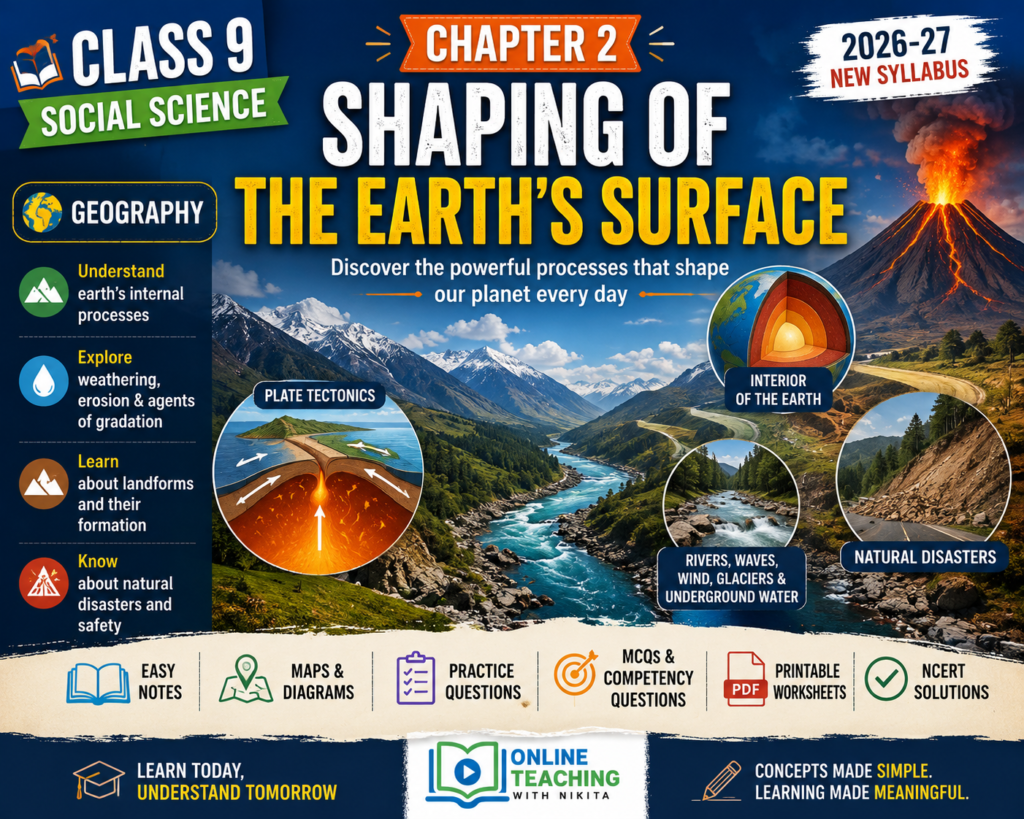
Table of Contents
📅 Last Updated: August 2026
📘 Syllabus: Based on the latest CBSE Class 9 (2026–27) syllabus
✅ Updated Resources Include:
- Chapter-wise Study Notes
- Free PDF Downloads
- MCQs
Chapter Overview
Shaping of the Earth’s Surface is Chapter 2 of the new Class 9 Social Science textbook Exploring Society: India and Beyond. This Geography chapter explores how the Earth’s surface is continuously shaped and reshaped by processes operating within the Earth and on its surface.
Students learn about plate tectonics, the interior of the Earth, weathering and erosion, different agents of gradation, the formation of landforms, and natural disasters such as earthquakes, landslides, avalanches and Glacial Lake Outburst Floods (GLOFs).
| Detail | Information |
|---|---|
| Class | 9 |
| Subject | Social Science – Geography |
| Chapter | 2 |
| Chapter Name | Shaping of the Earth’s Surface |
| Textbook | Exploring Society: India and Beyond |
| Academic Session | 2026–27 |
About This Chapter
The Earth’s surface is not static. It is continuously modified by powerful natural processes. Some processes originate inside the Earth, while others operate on or near its surface.
In this chapter, students explore how plate tectonics and movements within the Earth contribute to major changes in the Earth’s surface. They also study the role of weathering, erosion and deposition in gradually modifying landscapes.
Rivers, waves and currents, wind, glaciers and underground water act as important agents in shaping different landforms. The chapter also connects geographical processes with hazards such as earthquakes, landslides, avalanches and Glacial Lake Outburst Floods.
The chapter therefore helps students understand that the Earth’s surface is a dynamic system that changes over time.
Learning Outcomes
After completing this chapter, students should be able to:
- explain the theory of plate tectonics
- understand how tectonic plates influence Earth’s surface
- locate major tectonic plates on a world map
- describe the interior of the Earth
- explain the processes of weathering and erosion
- identify different agents of gradation
- explain how rivers, waves, wind, glaciers and underground water modify landforms
- identify major landforms and explain their formation
- understand the relationship between internal and external processes
- explain the causes of selected natural disasters
- suggest appropriate measures for disaster mitigation
These outcomes closely follow the 2026–27 syllabus material available for the chapter.
Key Topics
🌍 Theory of Plate Tectonics
Cover:
- meaning of plate tectonics
- tectonic plates
- movement of plates
- importance of plate movement
- major plate boundaries
- relationship between plate movement and Earth’s surface
🌎 Interior of the Earth
Cover:
- Earth’s internal structure
- major layers
- crust
- mantle
- core
- lithosphere
- asthenosphere
- relationship between Earth’s interior and surface processes
🪨 Weathering
Explain:
- meaning of weathering
- physical/mechanical weathering
- chemical weathering
- biological weathering
- factors affecting weathering
🌊 Erosion and Deposition
Explain:
- erosion
- transportation
- deposition
- how erosion changes landscapes
- how deposition creates new landforms
🌊 Agents of Gradation
Cover :
Rivers
Waves and Currents
Wind
Glaciers
Underground Water
The syllabus specifically identifies these agents.
🏔️ Landforms
Explain how natural processes create and modify:
- mountains
- valleys
- plains
- river landforms
- coastal landforms
- wind-created landforms
- glacial landforms
- other prominent landforms covered in the chapter
⚠️ Natural Disasters
Include:
- earthquakes
- landslides
- avalanches
- Glacial Lake Outburst Floods (GLOFs)
- causes and effects
- disaster preparedness and mitigation
The 2026–27 syllabus specifically includes these disaster topics.
⭐Class 9 Social Science Chapter 2 Study Resources
📌 Important Questions
Most important questions to prepare for exams and chapter revision.
🎁 Free Class 9 Social Science Chapter 2 Worksheets
Practise important concepts from Shaping of the Earth’s Surface with free printable worksheets designed for Class 9 students.
NCERT Exercise Solutions – Shaping of the Earth’s Surface
Get clear, student-friendly explanations for the exercise questions from Class 9 Social Science Chapter 2.
Why Students Choose Our Class 9 Science Resources?
2026–27 Focused
Printable PDFs
Original Practice
Chapter-Wise Resources
Mobile Friendly
Answer Keys
❓FAQ
Q1. What is Class 9 Social Science Chapter 2 about?
Chapter 2, “Shaping of the Earth’s Surface,” explains how internal and external geographical processes continuously shape and modify the Earth’s surface.
Q2. What is plate tectonics?
Plate tectonics is a theory that explains the movement of large tectonic plates forming the Earth’s outer rigid layer and their role in shaping the Earth’s surface.
Q3. What are the main topics in Chapter 2?
The chapter covers plate tectonics, the interior of the Earth, weathering, erosion, agents of gradation, landforms and natural disasters.
Q4. What is weathering?
Weathering is the breakdown or alteration of rocks at or near the Earth’s surface. It contributes to the gradual modification of landscapes.
Q5. What is erosion?
Erosion is the wearing away and removal of material from the Earth’s surface by agents such as running water, wind, glaciers and waves.
Q6. Which agents help shape the Earth's surface?
Important agents discussed in the chapter include rivers, waves and currents, wind, glaciers and underground water
Q7. What are landforms?
Landforms are natural physical features of the Earth’s surface, such as mountains, valleys and plains, formed and modified by different geographical processes.
Q8. Which natural disasters are covered in Chapter 2?
The chapter includes earthquakes, landslides, avalanches and Glacial Lake Outburst Floods (GLOFs) as natural hazards associated with the changing Earth’s surface
Q9. Is Chapter 2 part of Geography?
Yes. Shaping of the Earth’s Surface is Chapter 2 and is the first chapter under the Geography section of the new Class 9 Social Science textbook.
Q10. What resources are available for Chapter 2?
Students can use chapter notes, practice questions, MCQs, competency-based questions, worksheets, maps and diagrams, revision resources and NCERT exercise support, depending on the resources available on this page.
🚀 Continue Your Class 9 Social Science Journey
Previous Chapter
📚 All Chapters
Explore All Class 9 Social Science Chapters →
Next Chapter →
Ready to Practise Class 9 Social Science?
Strengthen your understanding of Earth’s surface, geographical processes and landforms with chapter-wise practice resources for the 2026–27 curriculum.
Share this Chapter
Found these Class 9 Geography resources useful? Share this chapter with classmates, parents or teachers preparing for the 2026–27 academic session.
Did you find this helpful?
Rate this chapter