
Class 9 Social Science Chapter 5 – Managing Your Personal Finances | Part 2
Understanding Society: India and Beyond | New Syllabus 2026–27
Explore Class 9 Social Science Chapter 5, Managing Your Personal Finances – Part 2, with notes, worksheets, competency-based questions, MCQs, revision resources and exercise solutions for the 2026–27 syllabus. This chapter introduces personal finance, budgeting, saving, investing, insurance, borrowing and credit, risk and return, and income tax.
This chapter follows the latest Class 9 curriculum. For official curriculum information, visit CBSE Academic.

Table of Contents
📅 Last Updated: September 2026
📘 Syllabus: Based on the latest CBSE Class 9 (2026–27) syllabus
✅ Updated Resources Include:
- 📚 Chapter-wise Study Notes
- 📄 Free PDF Downloads
- ❓ MCQs
- 📝 Worksheets
- 📖 NCERT Exercise Solutions
Chapter Overview of Class 9 Social Science Chapter 5, Managing Your Personal Finances Part 2
Managing Your Personal Finances introduces students to the importance of making informed financial decisions in everyday life. The chapter explains personal finance, budgeting, saving and investing, and shows how financial planning can help individuals manage income and expenses and work towards future goals.
Students learn about budgeting and financial goals, including identifying expenses, setting saving goals, tracking spending and reviewing a budget. The chapter also introduces common investment options such as fixed deposits, bonds, stocks or shares, and mutual funds, along with concepts such as compounding, inflation, purchasing power and liquidity.
The chapter further explains protection and risk management, including insurance and its different types, as well as borrowing and credit and the importance of responsible borrowing. Students also learn about risk, return, time horizon and liquidity when considering financial decisions.
The chapter concludes with an introduction to taxes and personal income tax, explaining direct and indirect taxes and the role of income tax in supporting public services and national development.
| Detail | Information |
|---|---|
| Class | 9 |
| Subject | Social Science – Economics |
| Chapter | 5 |
| Chapter Name | Managing Your Personal Finances |
| Textbook | Understanding Society: India and Beyond, Part 2 |
| Academic Session | 2026–27 |
About This Chapter Class 9 Social Science Chapter 5, Managing Your Personal Finances Part 2
In this chapter, students explore the importance of personal financial management and learn how individuals can make informed decisions about earning, spending, saving and investing. The chapter introduces budgeting, financial goals, saving and investing, helping students understand how careful financial planning can support future needs and goals.
Students learn about inflation, purchasing power, liquidity and compounding, along with common investment options such as fixed deposits, bonds, stocks or shares, and mutual funds. The chapter also explains the relationship between risk and return and the importance of considering financial goals and time horizon when making investment decisions.
The chapter further covers protection and risk management, insurance, borrowing and credit, and responsible financial decision-making. Finally, students learn about taxes and personal income tax and understand how taxes contribute to public services and national development.
Learning Outcomes of Class 9 Social Science Chapter 5, Managing Your Personal Finances Part 2
After completing Chapter 5, students should be able to:
- Explain what personal financial management means and why it is important in everyday life.
- Understand how income, spending, saving and investment are connected to financial stability and future goals.
- Explain inflation and its impact on purchasing power.
- Understand the difference between simple and compound interest.
- Prepare a simple personal or family budget showing income, expenditure and savings.
- Identify different saving and investment options, including fixed deposits, bonds, stocks and mutual funds.
- Explain the relationship between risk and return in different investments.
- Understand the importance of insurance and risk management.
- Explain the basics of borrowing and credit and the importance of responsible borrowing.
- Understand the concept of personal income tax and why citizens pay taxes.
Key Topics of Class 9 Social Science Chapter 5, Managing Your Personal Finances Part 2
💰 Personal Finance
Understanding income, spending, saving, investing and financial planning.
📊 Budgeting
Planning expenses, setting financial goals, tracking spending and adjusting the budget.
🏦 Saving
Setting aside money for future needs, emergencies and financial goals.
📈 Investing & Compounding
Understanding investment, returns, compounding and the benefits of investing over time.
💼 Common Investment Options
Fixed deposits, bonds, stocks or shares and mutual funds.
📉 Inflation & Purchasing Power
Understanding how rising prices can affect the value and purchasing power of money.
🛡️ Protection & Risk Management
Understanding financial risks and ways to protect income, savings and assets.
🏥 Insurance
Health, life and general insurance and the role of insurance in managing financial risks.
💳 Borrowing & Credit
Understanding loans, EMIs, debt and responsible borrowing.
⚖️ Risk, Return, Time Horizon & Liquidity
Important factors to consider when making investment decisions.
🧾 Taxes & Personal Income Tax
Understanding direct and indirect taxes and the importance of income tax.
❓ Big Questions of Class 9 Social Science Chapter 5
Key questions and quick answers to help students understand and revise the important concepts of Chapter
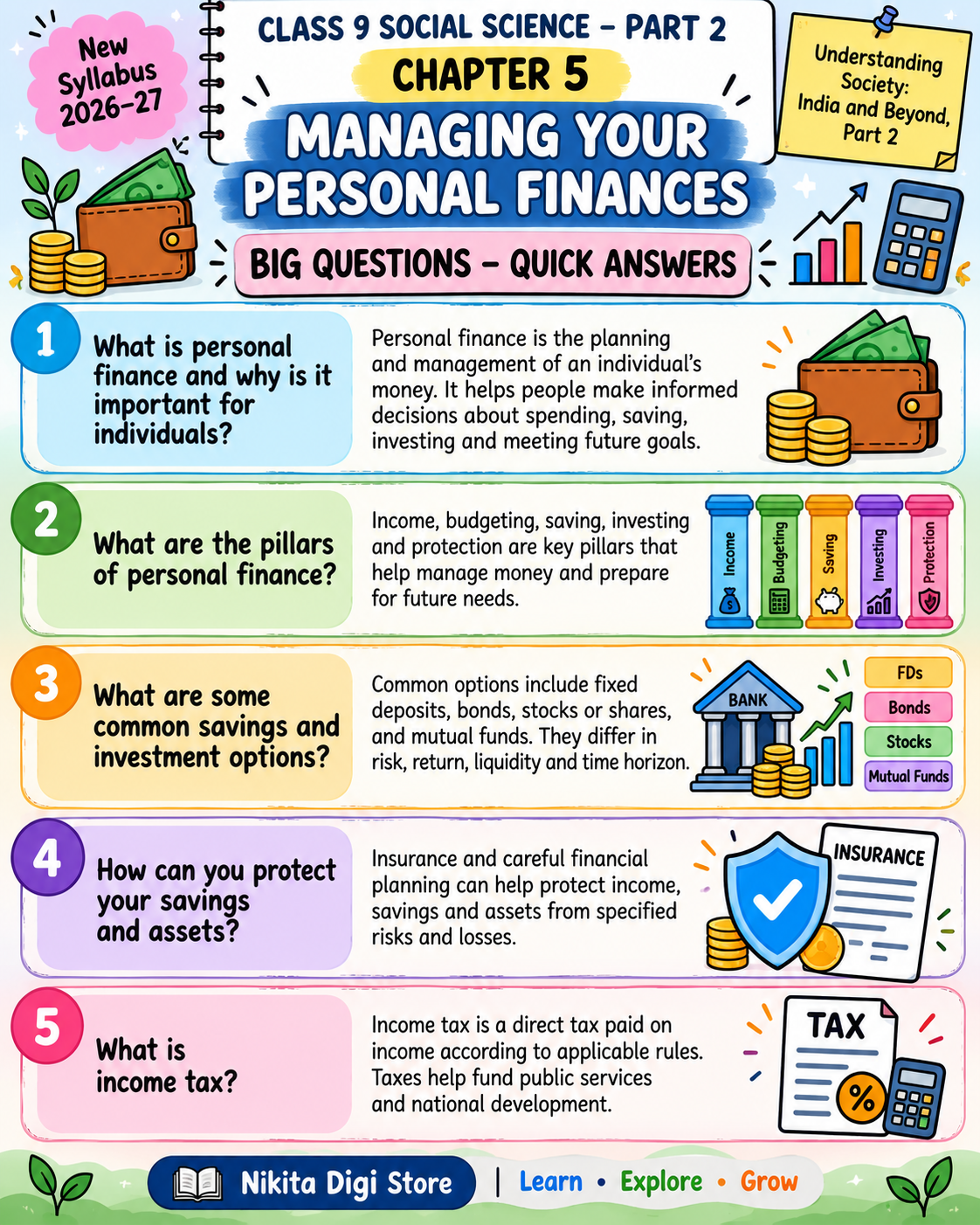
1. What is personal finance and why is it important for individuals?
Answer: Personal finance refers to the planning and management of an individual’s money to meet present needs and future goals. It involves making informed decisions about spending, saving, investing, borrowing and protecting money.
2. What are the pillars of personal finance?
Answer: The five pillars of personal finance are income, budgeting, saving, investing and protection. Together, they help individuals manage their money, prepare for future needs, build wealth and protect themselves from financial risks.
3. What are some common savings and investment options?
Answer: Common options include fixed deposits, bonds, stocks or shares and mutual funds. Different options have different levels of risk, return, liquidity and time horizon.
4. How can you protect your savings and assets?
Answer: Savings and assets can be protected through insurance, careful financial planning, responsible borrowing and appropriate risk management. Insurance helps provide financial support when unexpected events such as illness, accidents or property damage cause losses.
5. What is income tax?
Answer: Income tax is a direct tax paid on the income earned by individuals and organisations, according to applicable tax rules. The revenue collected through taxes helps the government fund public services and essential infrastructure.
🎨 Visual Revision: Big Questions at a Glance
Key questions and quick answers to help students understand and revise the important concepts of Chapter
⭐ Class 9 Social Science Chapter 5 Study Resources – Part 2
Get complete study and practice resources for Class 9 Social Science Chapter 5, Managing Your Personal Finances – Part 2 from Understanding Society: India and Beyond, Part 2, based on the new Class 9 Social Science curriculum for 2026–27.
📌 Important Questions
Most important questions to prepare for exams and chapter revision.
🗺️ Visual Learning Resources
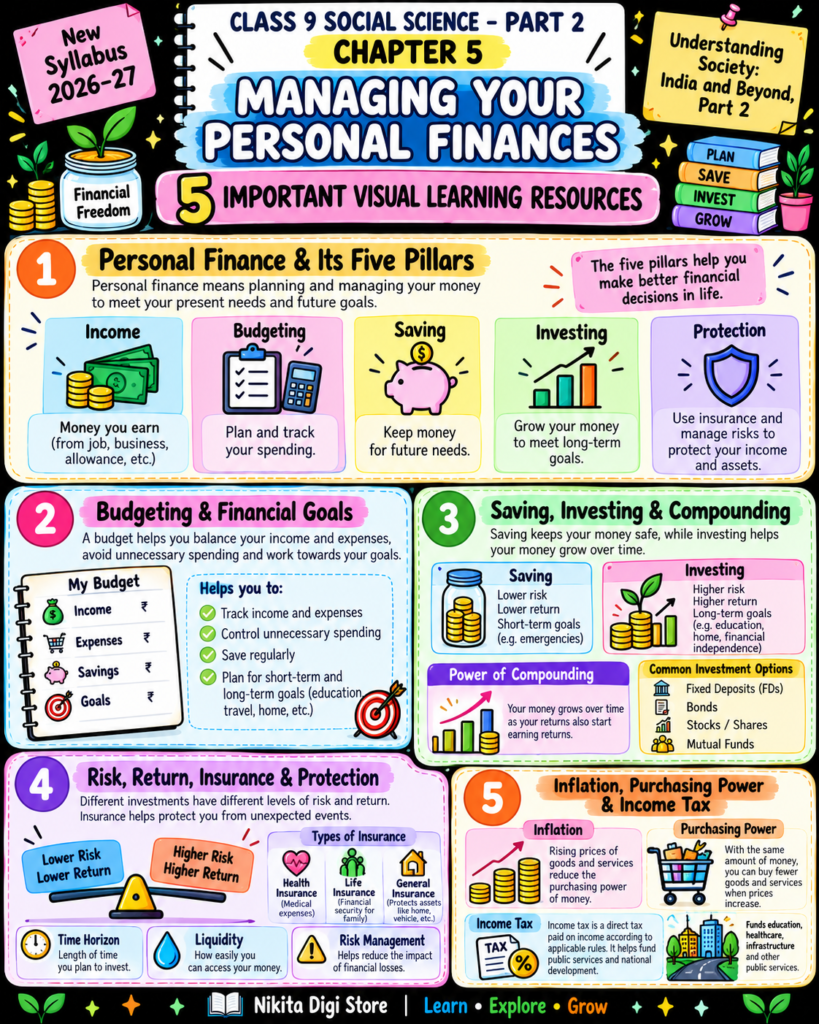
- 💰 Personal Finance & Its Five Pillars
Income • Budgeting • Saving • Investing • Protection 📊 Budgeting & Financial Goals
Income • Expenses • Savings • Financial Goals • Budget Planning📈 Saving, Investing & Compounding
Saving vs Investing • Compounding • FDs • Bonds • Stocks • Mutual Funds🛡️ Risk, Return, Insurance & Protection
Risk & Return • Time Horizon • Liquidity • Health Insurance • Life Insurance • General Insurance📉 Inflation, Purchasing Power & Income Tax
Inflation • Purchasing Power • Personal Income Tax • Public Services
🎁 Free Class 9 Social Science Chapter 5 Worksheets – Part 2
Start your Chapter 5 preparation with selected practice questions covering personal finance, budgeting, saving, investing, insurance, borrowing and credit, risk and return, and income tax.
📥 NCERT Exercise Solutions – Chapter 5 | Part 2
Find help with the questions and activities from Chapter 5 – Managing Your Personal Finances.
The chapter includes activities related to budgeting, financial goals, saving, investment options, compounding, insurance, borrowing and credit, risk and return, and personal income tax.
Why Students Choose Our Class 9 Social Science Resources?
2026–27 Focused
Printable PDFs
Original Practice
Chapter-Wise Resources
Mobile Friendly
Answer Keys
❓ FAQ of Class 9 Social Science Chapter 5, Managing Your Personal Finances Part 2
Q1. What is Chapter 5 of Class 9 Social Science Part 2?
Chapter 5 is “Managing Your Personal Finances” from Understanding Society: India and Beyond, Part 2. It introduces students to personal finance, budgeting, saving, investing, protection, borrowing and credit, risk and return, and income tax.
Q2. What are the main topics in Chapter 5 – Managing Your Personal Finances?
The main topics include personal finance, budgeting, saving, investing, compounding, fixed deposits, bonds, stocks, mutual funds, insurance, borrowing and credit, risk and return, liquidity, inflation and personal income tax.
Q3. What are the five pillars of personal finance?
The five pillars are income, budgeting, saving, investing and protection. These help individuals manage money and plan for present and future financial needs.
Q4. What is budgeting?
Budgeting means planning in advance how income will be spent. A budget helps balance income and expenses, control unnecessary spending and work towards financial goals.
Q5. What is the difference between saving and investing?
Saving means keeping aside a portion of income for future use, while investing means putting savings into assets with the aim of generating returns and growing wealth.
Q6. What are common investment options discussed in Chapter 5?
The chapter discusses fixed deposits, bonds, stocks or shares and mutual funds as common investment options.
Q7. What is compounding?
Compounding is the process in which investment earnings, such as interest or returns, are reinvested to generate additional earnings over time.
Q8. What is insurance and why is it important?
Insurance is a financial protection mechanism in which a person pays a premium to an insurance company in return for financial support against specified losses or risks. It can help protect individuals and families from the financial impact of unexpected events.
Q9. What is responsible borrowing?
Responsible borrowing means taking a loan or using credit only when necessary and when repayment can be managed. Borrowers should consider the total cost of borrowing and their ability to repay.
Q10. What factors should be considered before making an investment decision?
Important factors include risk, return, time horizon and liquidity. Different investments have different levels of these factors.
Q11. What is income tax?
Income tax is a direct tax paid on income earned by individuals or organisations according to applicable tax rules. Tax revenue helps fund public services and infrastructure.
Q12. Why is managing personal finances important?
Managing personal finances helps individuals plan expenses, save for future needs, make informed investment decisions, manage risks and work towards financial goals.
🚀 Continue Your Class 9 Social Science Journey
Previous Chapter
Next Chapter
📚 All Chapters
Ready to Practise Class 9 Social Science?
Build your understanding of Class 9 Social Science Chapter 5, Managing Your Personal Finances Part 2 with chapter-wise study and practice resources.
📢 Share this Class 9 Social Science Chapter 5, Managing Your Personal Finances Part 2
Found these Class 9 Social Science Chapter 5 resources helpful? Share this page with students, parents and teachers.
Did You Find This Chapter Helpful?
👍 Yes / 👎 No
- More worksheets
- More MCQs
- More important questions
- More maps & diagrams
- More revision notes
- NCERT solutions