
Class 9 Social Science Chapter 5 – State and Society up to 1000 CE
Understanding Society: India and Beyond | History | New NCERT Syllabus 2026–27
Explore Class 9 Social Science Chapter 5 – State and Society up to 1000 CE with chapter-wise study resources, easy notes, timelines, maps, MCQs, important questions, worksheets and NCERT exercise solutions for the 2026–27 academic session.
Official NCERT textbooks and educational resources can also be accessed through the NCERT website.
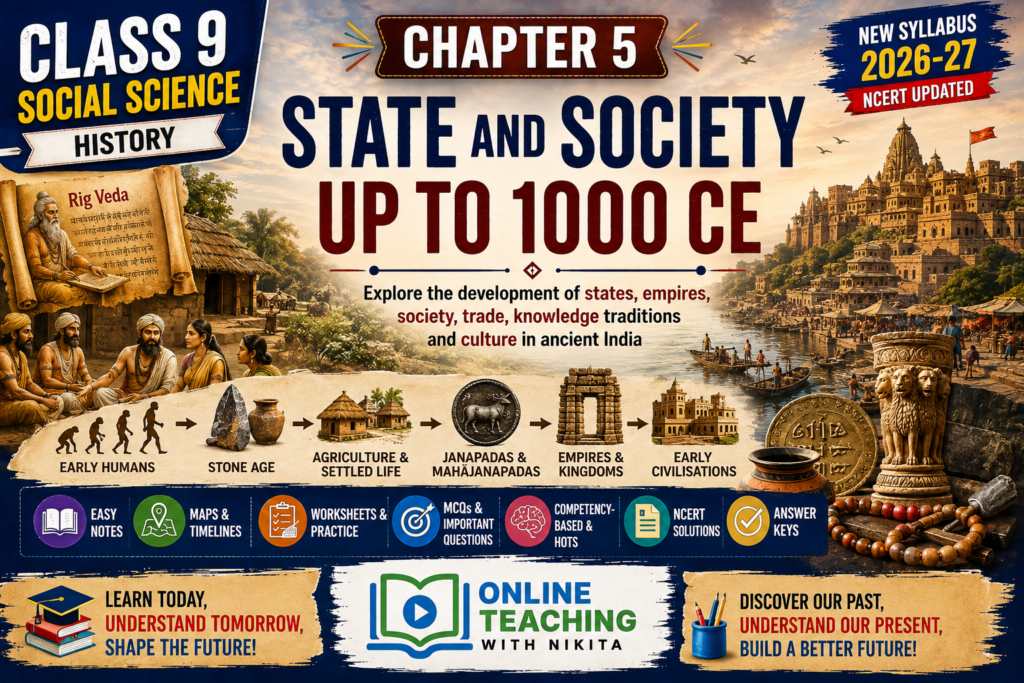
Table of Contents
📅 Last Updated: August 2026
📘 Syllabus: Based on the latest CBSE Class 9 (2026–27) syllabus
✅ Updated Resources Include:
- Chapter-wise Study Notes
- Free PDF Downloads
- MCQs
Chapter Overview
This chapter explores the development of state and society in the Indian subcontinent up to 1000 CE. It examines how early kin-based communities and political organisations developed into larger territorial states, janapadas, mahājanapadas and eventually powerful empires.
The chapter also introduces important ideas and institutions associated with early Indian society, including dharma, political authority, social organisation, knowledge traditions, trade, guilds and cultural practices.
Students also learn how literary sources, including the Rig Veda, supplement archaeological evidence and help historians understand the social, political, cultural and moral dimensions of the past.
| Detail | Information |
|---|---|
| Class | 9 |
| Subject | Social Science |
| Chapter | 5 |
| Chapter Name | State and Society up to 1000 CE |
| Textbook | Exploring Society: India and Beyond |
| Academic Session | 2026–27 |
About Chapter 5 – State and Society up to 1000 CE
Chapter 5 takes students through a long period of early Indian history, from the Vedic period to the end of the first millennium CE.
The chapter begins by asking how society and political authority were organised in early times and how these arrangements changed over centuries. It then examines the emergence of larger political units and the development of states and empires across different regions.
A major focus is the relationship between society, political institutions, cultural traditions and systems of knowledge.
Key questions explored in the chapter:
- How did society and state organise themselves prior to 1000 CE?
- How did states and societies emerge and spread across different parts of the Indian subcontinent?
- How did ideas such as dharma and chakravarti samrāṭ contribute to ideas of social and political unity?
- How did different social, administrative and occupational groups develop over time?
Learning Outcomes
After studying this chapter, students should be able to:
- Explain important features of early Indian society and polity.
- Describe the development of political organisation from kin-based communities to territorial states.
- Understand the emergence of janapadas and mahājanapadas.
- Explain important features of early Indian empires.
- Understand the significance of the Vedic Age.
- Identify important literary and archaeological sources used to study the period.
- Explain the role of dharma in social and political life.
- Understand the idea of chakravarti samrāṭ.
- Explore India’s traditions of education and knowledge.
- Understand the importance of trade, traders, guilds, crafts and industries.
- Recognise continuity and change in Indian social and political institutions.
These outcomes are consistent with the official syllabus emphasis on Vedic society and polity, early empires, knowledge traditions and trade/guilds.
Key Topics
🏛️ Vedic Age
Geography, texts, rituals, political institutions and social organisation.
👥 Early Indian Society
Kin-based organisation, social groups, customs and institutions.
👑 States and Political Organisation
The development of early political units and territorial states.
🗺️ Janapadas & Mahājanapadas
The emergence of larger territorial political units.
⚔️ Early Empires
The development and administration of major empires across the subcontinent.
📚 Knowledge Traditions
Education, institutions, knowledge systems and cultural practices.
🛤️ Trade & Guilds
Traders, merchants, trade routes, guilds, crafts and industries.
☸️ Dharma & Political Ideas
Ideas of dharma and chakravarti samrāṭ and their place in society and governance.
⭐Class 9 Social Science Chapter 5 Study Resources
Get complete practice and revision resources for State and Society up to 1000 CE, designed around the new Class 9 Social Science curriculum for 2026–27.
📌 Important Questions
Most important questions to prepare for exams and chapter revision.
🗺️ Maps
Maps showing locations associated with early human settlements and civilisations.
🎁 Free Class 9 Social Science Chapter 5 Worksheets
Start practising with our free Class 9 Social Science worksheets based on State and Society up to 1000 CE.
NCERT Solutions – Chapter 5 State and Society up to 1000 CE
Need help with the textbook questions? Explore our Class 9 Social Science Chapter 5 NCERT exercise solutions with clear, student-friendly answers designed for the 2026–27 curriculum.
Why Students Choose Our Class 9 Science Resources?
2026–27 Focused
Printable PDFs
Original Practice
Chapter-Wise Resources
Mobile Friendly
Answer Keys
❓FAQ
Q1. What is Chapter 5 of Class 9 Social Science?
Chapter 5 of the new Class 9 Social Science textbook Understanding Society: India and Beyond Part I is titled “State and Society up to 1000 CE.” It focuses on the development of state and society in the Indian subcontinent up to 1000 CE.
Q2. Which book contains Chapter 5?
Chapter 5 is part of the new NCERT Class 9 Social Science textbook Understanding Society: India and Beyond – Part I.
Q3. What period does Chapter 5 cover?
The chapter examines the development of state and society from early periods through the end of the first millennium CE.
Q4. What are the main topics in Chapter 5?
Major areas include the Vedic Age, early political organisation, states and empires, knowledge traditions, trade, guilds, merchants, crafts and industries.
Q5. What is the importance of the Vedic Age in this chapter?
The chapter examines the geography, texts, rituals, political institutions and social order associated with the Vedic Age.
Q6. Are Chapter 5 worksheets available?
Yes. You can provide printable worksheets, competency-based questions, MCQs, important questions and revision resources for Chapter 5.
Q7. Are these resources copies of the NCERT textbook?
No. Your worksheets, practice questions and other original learning materials should be described as supplementary resources designed to support learning. They should not be presented as copies of the NCERT textbook.
Q8. Are NCERT exercise solutions available?
Yes, if you have created the corresponding solution resource, link it here.
🚀 Continue Your Class 9 Social Science Journey
Ready to Practise Class 9 Social Science?
Strengthen your understanding of State and Society up to 1000 CE with chapter-wise worksheets, MCQs, important questions, revision resources and NCERT solutions.
Share this Chapter
Found this Class 9 Social Science Chapter 5 resource useful? Share it with classmates, parents and teachers preparing for the 2026–27 academic session.
Did You Find This Chapter Helpful?
👍 Yes, this was helpful
- More worksheets
- More MCQs
- More important questions
- More maps & diagrams
- More revision notes
- NCERT solutions