
Shape Matching Worksheets for Preschool & Kindergarten – Free Printable Activities
Learning shapes is an important part of early childhood education. Before children begin more advanced geometry, they need to recognize, compare, sort, and identify basic shapes.
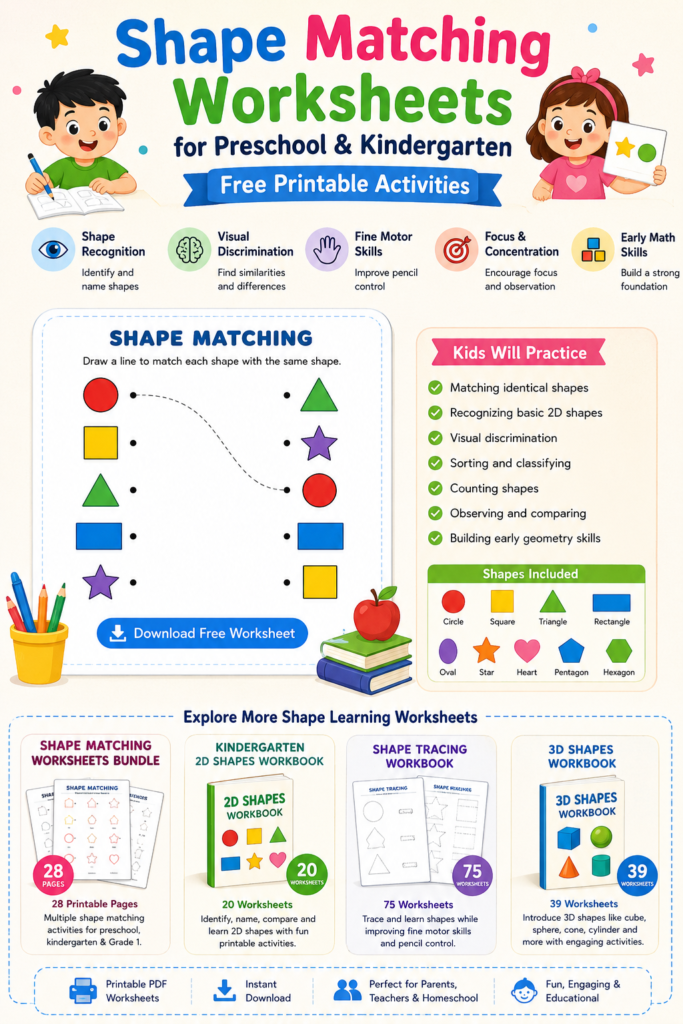
Shape Matching Worksheets for Preschool & Kindergarten provide a simple and engaging way for young learners to practice these skills through fun printable activities.
Shape matching activities help children recognize similarities and differences between shapes while also developing visual discrimination, observation, concentration, and early mathematical thinking.
Whether you are a parent, preschool teacher, kindergarten teacher, or homeschool educator, printable shape worksheets can be a convenient way to give children extra practice at home or in the classroom.
In this guide, you will find ideas for using shape matching worksheets, the benefits of shape-matching activities, common shapes children can learn, and a free printable Shape Matching Worksheets for Preschool & Kindergarten to get started.
What are Shape Matching Worksheets for Preschool & Kindergarten?
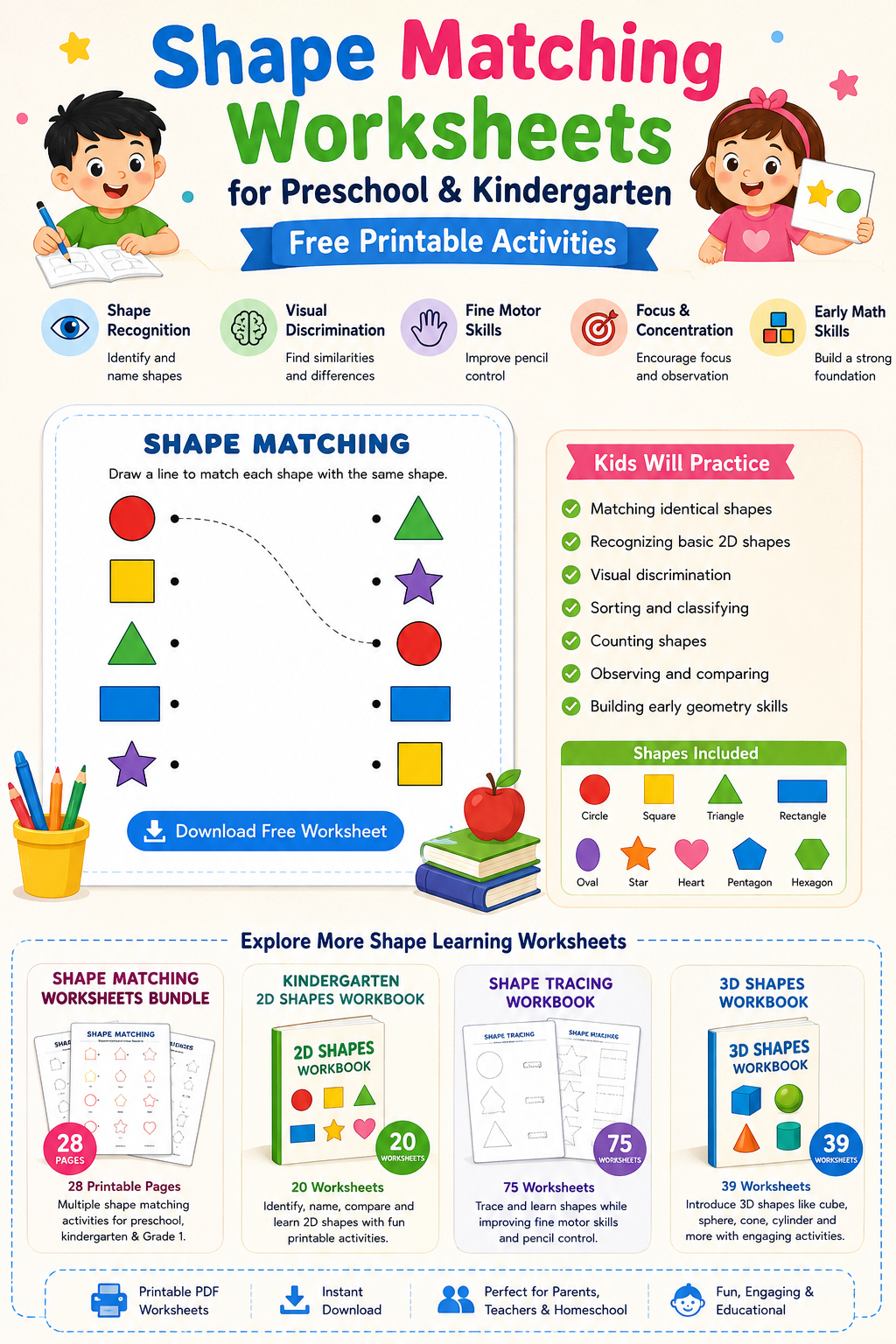
Shape Matching Worksheets for Preschool & Kindergarten are printable learning activities that ask children to identify and match shapes that are the same or similar.
For example, a worksheet may show several shapes on one side and ask children to draw lines to their matching shapes on the other side.
Other activities may ask children to:
- Match identical shapes
- Match shapes with the same properties
- Identify a shape from a group
- Find the shape that is different
- Match shapes with real-world objects
- Sort shapes into groups
- Count particular shapes
- Color matching shapes
- Trace basic shapes
- Identify shapes by name
These activities are especially useful for preschool, pre-K, kindergarten, and early elementary learners.
Why Are Shape Matching Activities Important?
Learning to recognize shapes is more than memorizing shape names. Children gradually learn how shapes look, how they are different, and how they appear in objects around them.
Regular practice with shape matching activities can support several early learning skills.
1. Develops Shape Recognition
The first step in learning geometry is recognizing basic shapes.
Children can practice identifying:
- Circles
- Squares
- Triangles
- Rectangles
- Ovals
- Stars
- Hearts
- Pentagons
- Hexagons
Repeated exposure helps children become more comfortable recognizing shapes in different sizes, colors, and orientations.
2. Builds Visual Discrimination Skills
Visual discrimination is the ability to notice differences and similarities between objects.
For example, a child may learn that a square and rectangle have four sides but are not exactly the same shape.
Shape matching worksheets encourage children to look carefully at:
- Number of sides
- Shape of corners
- Overall appearance
- Size
- Orientation
- Similarities and differences
These skills are useful not only for mathematics but also for early reading and writing activities.
3. Strengthens Observation Skills
Matching activities encourage children to slow down and observe.
Instead of simply guessing, children need to look at different shapes and decide which ones belong together.
This develops attention to detail and encourages children to think before choosing an answer.
4. Supports Early Math Skills
Shapes are an important part of early mathematics.
When children compare, sort, match, and classify shapes, they are developing early mathematical thinking.
Shape activities can introduce concepts such as:
same → different → compare → sort → classify → identify
These concepts provide a foundation for later geometry and mathematical reasoning.
5. Improves Fine Motor Skills
Many printable shape worksheets involve activities such as:
- Drawing lines between matching shapes
- Coloring shapes
- Circling answers
- Tracing shapes
- Cutting and matching shapes
- Drawing shapes
These activities can help children practice pencil control and other fine motor skills.
What Shapes Should Preschoolers Learn?
Young children usually begin with simple, familiar shapes before progressing to more complex ones.
Here are some useful shapes to introduce.
Circle
A circle is round and has no corners.
Children can find circles in objects such as:
- Plates
- Wheels
- Coins
- Clocks
- Buttons
Square
A square has four equal sides and four corners.
Examples include:
- Windows
- Tiles
- Picture frames
- Some blocks
Triangle
A triangle has three sides and three corners.
Children may see triangles in:
- Traffic signs
- Roofs
- Musical instruments
- Decorative objects
Rectangle
A rectangle has four sides and four corners, with opposite sides equal in length.
Examples include:
- Doors
- Books
- Tables
- Screens
Oval
An oval is similar to a stretched circle.
Children can find oval shapes in:
- Eggs
- Balloons
- Some leaves
- Mirrors
Star
Stars are easily recognizable and are often used in early learning activities.
Heart
Heart shapes are also familiar to young children and can make worksheets more engaging.
Shape Matching Worksheets for Preschool & Kindergarten
Preschool children benefit from simple activities with clear instructions and familiar shapes.
At this stage, worksheets should focus primarily on recognition rather than complicated geometry.
Some effective preschool shape matching activities include:
Match the Same Shapes
Children look at two groups of shapes and draw a line between identical shapes.
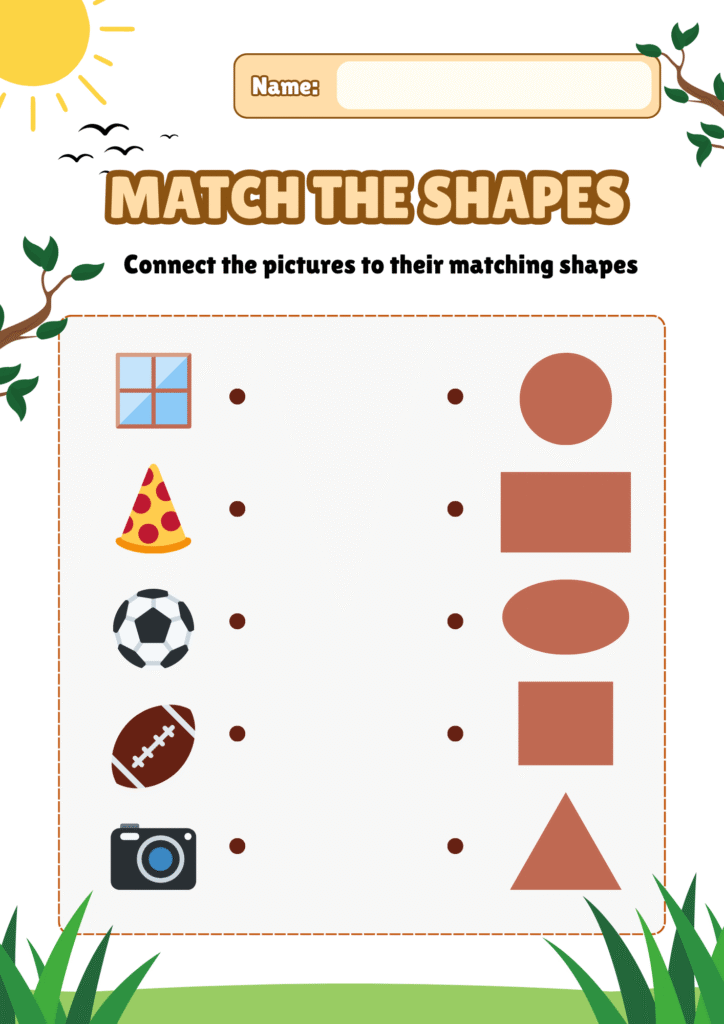
Match Shapes to Objects
Children match a shape to a real-world object.
For example:
Circle → Ball
Rectangle → Door
Triangle → Roof
Square → Window
Find and Circle the Shape
Give children a group of different shapes and ask them to circle all the circles, triangles, or squares.
Color the Matching Shapes
Children color all shapes that match a particular example.
These activities make shape learning interactive while keeping the difficulty appropriate for young learners.
Shape Matching Worksheets for Kindergarten
Kindergarten students can work with slightly more challenging shape activities.
At this stage, children can practice:
- Identifying shapes by name
- Matching shapes
- Sorting shapes
- Counting sides
- Counting corners
- Comparing shapes
- Finding shapes in pictures
- Matching 2D shapes to real-world objects
- Identifying shapes in different orientations
For example, a kindergarten worksheet might show several triangles pointing in different directions and ask children to identify all the triangles.
This helps children understand that changing the position of a shape does not change what the shape is.
Fun Shape Matching Activities for Preschool & Kindergarten
Worksheets don’t have to be used only as traditional pencil-and-paper exercises.
Here are several ways parents and teachers can extend shape learning.
Shape Hunt
Ask children to find shapes around the classroom or home.
For example:
Find 3 circles.
Find 2 rectangles.
Find 1 triangle.
Children can point to the objects or record their findings on a worksheet.
Shape Sorting
Give children a collection of objects or paper shapes.
Ask them to sort them into groups:
Circles | Squares | Triangles | Rectangles
This helps children practice classification.
Shape Memory Game
Create pairs of shape cards.
Place the cards face down and let children turn over two cards at a time.
The child keeps a pair when the two shapes match.
Shape Drawing
Ask children to draw:
- One circle
- Two squares
- Three triangles
- One rectangle
This combines shape recognition with fine motor practice.
Shape Coloring
Give children a page containing different shapes.
For example:
Color circles red.
Color squares blue.
Color triangles yellow.
This combines shape recognition with following directions and color recognition.
Free Shape Matching Worksheets for Preschool & Kindergarten
Looking for a simple activity that you can use right away?
You can download a free printable Shape Matching Worksheet and give children an opportunity to practice recognizing and matching basic shapes.
📥 Get Your Free Shape Matching Worksheet
Download a free printable Shape Matching Worksheet and help children practice shape recognition, visual matching, and early geometry skills.
👉 DOWNLOAD THE FREE SHAPE MATCHING WORKSHEET
This free activity is suitable for:
- Preschool
- Pre-K
- Kindergarten
- Homeschool
- Early learning centers
- Classroom practice
- At-home learning
What Children Can Practice With Shape Matching Worksheets for Preschool & Kindergarten?
A well-designed shape worksheet can combine several early learning skills in one activity.
Children may practice:
🔵 Shape Recognition
Identify common 2D shapes.
🟢 Matching
Find shapes that are identical or similar.
🟡 Visual Discrimination
Notice differences between shapes.
🟠 Fine Motor Skills
Draw, circle, trace, and color.
🟣 Concentration
Focus on completing a visual activity.
🔷 Early Geometry
Begin understanding basic properties of shapes.
How Parents Can Use Shape Worksheets at Home
Printable worksheets can be useful for short learning sessions at home.
Instead of giving children a large number of worksheets at once, choose one or two activities and spend a few minutes discussing the shapes.
For example, show a child a triangle and ask:
How many sides does it have?
How many corners does it have?
Can you find something shaped like a triangle in the room?
Then let the child complete the worksheet.
This combination of conversation and hands-on practice can make worksheet time more meaningful.
How Teachers Can Use Shape Matching Worksheets in the Classroom
Teachers can use printable shape worksheets in several ways.
Morning Work
Give children a simple shape matching page as a quiet activity when they arrive.
Math Centers
Place shape worksheets in a mathematics learning center.
Small-Group Practice
Work with a small group of students who need additional shape recognition practice.
Homework
Send printable worksheets home for additional practice.
Assessment
Simple matching activities can also help teachers see whether children can recognize basic shapes independently.
Tips for Teaching Shapes to Young Children
Start With Familiar Shapes
Begin with circles, squares, triangles, and rectangles before introducing more complex shapes.
Use Real-Life Examples
Children learn better when they can connect a shape with something they already know.
For example:
Circle → wheel
Rectangle → door
Square → tile
Triangle → roof
Use Different Sizes
Show children that a circle is still a circle whether it is large or small.
Rotate Shapes
Show shapes in different orientations so children don’t assume that a triangle or square must always appear in one particular position.
Combine Different Activities
Use matching, sorting, tracing, coloring, and shape hunts rather than relying on one type of activity.
From Shape Matching to Early Geometry
Shape matching is an excellent starting point for introducing children to geometry.
Once children can recognize basic shapes, they can begin exploring their properties.
For example:
Triangle
- 3 sides
- 3 corners
Square
- 4 sides
- 4 corners
Rectangle
- 4 sides
- 4 corners
Circle
- No straight sides
- No corners
Later, children can explore more advanced concepts such as:
- 2D shapes
- 3D shapes
- Faces
- Edges
- Vertices
- Symmetry
- Patterns
- Shape composition
This creates a natural progression from simple matching activities to more advanced geometry learning.
Want More Shape Matching Practice?
If your child enjoys the free worksheet and needs additional practice, you can move on to a larger collection of printable activities.
📚 Shape Matching Worksheets Bundle – 28 Printable Pages
The 28-page Shape Matching Worksheets Bundle provides additional practice for preschool, kindergarten, and Grade 1 learners.
The bundle includes:
✔ 28 printable worksheet pages
✔ Multiple shape-matching activities
✔ Practice with common 2D shapes
✔ Visual matching activities
✔ Early geometry practice
✔ Preschool, kindergarten & Grade 1 level activities
✔ Printable PDF format
✔ Instant download
👉 Get the Complete 28-Page Shape Matching Worksheets Bundle
This is a good option for parents and teachers who want more than a single free worksheet and need a larger collection for repeated practice.
More 2D Shape Worksheets for Kindergarten
Once children are comfortable matching shapes, they can move on to broader 2D shape practice.
Your Kindergarten 2D Shapes Workbook includes 20 printable worksheets designed to help young learners explore common 2D shapes and develop early geometry skills.
Children can practice concepts such as:
- Shape recognition
- Shape identification
- Comparing shapes
- Basic geometry
- Visual learning
- Shape properties
👉 Explore the Kindergarten 2D Shapes Workbook
Shape Tracing Worksheets
Tracing is another useful activity for children who are learning shapes.
Shape Tracing Workbook provides 75 printable worksheets for preschool and kindergarten learners ages 3–6.
Tracing activities can help children practice:
- Pencil control
- Hand-eye coordination
- Shape recognition
- Fine motor skills
- Pre-writing skills
👉 Explore the Shape Tracing Workbook
3D Shapes for Early Learners
After children become familiar with 2D shapes, they can begin exploring three-dimensional shapes.
Common 3D shapes include:
- Cube
- Sphere
- Cone
- Cylinder
- Cuboid
Children can connect these shapes to familiar objects.
Cube → dice
Sphere → ball
Cone → ice cream cone
Cylinder → can
Learning about 3D shapes helps children understand that geometry exists in the world around them.
👉 Explore the 3D Shapes Workbook
Shape Learning Activities by Age
| Age/Level | Recommended Activities |
|---|---|
| Preschool | Match identical shapes, color shapes, shape hunts |
| Pre-K | Match, sort, trace, and identify shapes |
| Kindergarten | Shape names, properties, matching, sorting, counting sides |
| Grade 1 | 2D/3D shapes, properties, classification, geometry practice |
Frequently Asked Questions About Shape Matching Worksheets
What are shape matching worksheets?
Shape matching worksheets are printable activities that help children identify and match identical or similar shapes. They are commonly used in preschool, pre-K, kindergarten, and early elementary classrooms.
What age is best for shape matching worksheets?
Shape matching activities can be introduced as early as preschool. Simple matching activities are suitable for young children, while kindergarten and Grade 1 students can work on more advanced shape recognition and classification activities.
What shapes should preschoolers learn first?
Start with familiar basic shapes such as circles, squares, triangles, and rectangles. Once children are comfortable with these, introduce ovals, stars, hearts, pentagons, and hexagons.
Are shape worksheets good for kindergarten?
Yes. Shape worksheets can provide useful practice with shape recognition, matching, sorting, visual discrimination, and early geometry.
How can I teach shapes at home?
Use printable worksheets together with real-world examples. Ask children to find circles, squares, triangles, and rectangles around the house. You can also use shape cards, coloring activities, sorting games, and shape hunts.
Can shape matching worksheets be used for homeschooling?
Yes. Printable shape matching worksheets are convenient for homeschool lessons, math centers, practice sessions, and independent learning.
What should children learn after basic shape matching?
After children become comfortable identifying and matching basic shapes, introduce shape tracing, sorting, shape properties, 2D geometry, and eventually 3D shapes.
Make Shape Learning Fun
Learning shapes doesn’t have to feel like a difficult math lesson.
With simple shape matching worksheets for preschool and kindergarten, children can practice important early math skills while drawing, matching, coloring, sorting, and exploring.
Start with simple shapes such as circles, squares, triangles, and rectangles. Then gradually introduce more challenging shapes and activities.
Whether you are preparing a preschool lesson, planning kindergarten math centers, homeschooling, or simply looking for an educational activity for your child, printable shape worksheets can be an easy and practical learning resource.
📥 Start With a Free Shape Matching Worksheet
Ready to practice?
Download the free Shape Matching Worksheet and give your child a fun way to practice shape recognition and visual matching.
👉 Download Your Free Shape Matching Worksheet
Looking for more practice?
📚 Get the 28-Page Shape Matching Worksheets Bundle
And continue learning with:
Related Learning Resources
- Shape Matching Activity Worksheet
- Number Tracing Worksheets
- Preschool Worksheets
- Single-Digit Addition Bundle
- Missing Number Addition Bundle
- Addition Word Problems Bundle
- Color by Addition Bundle
- 10 Maths Posters Bundle for Kids
- Free Math Worksheets Collection
- free worksheets
- Count & Color Worksheets
- Count & Circle Worksheets
- Count & Match Worksheets
- Kindergarten 2D Shapes Workbook
- Shape Matching Worksheets Bundle
- Shape Tracing Workbook