
Class 9 Social Science Chapter 6 – Democracy
Understanding Society: India and Beyond | Political Science | New Syllabus 2026–27
Explore Class 9 Social Science Chapter 6 – Democracy with easy study notes, competency-based questions, MCQs, important questions, worksheets, revision resources and NCERT exercise solutions based on the new 2026–27 curriculum.
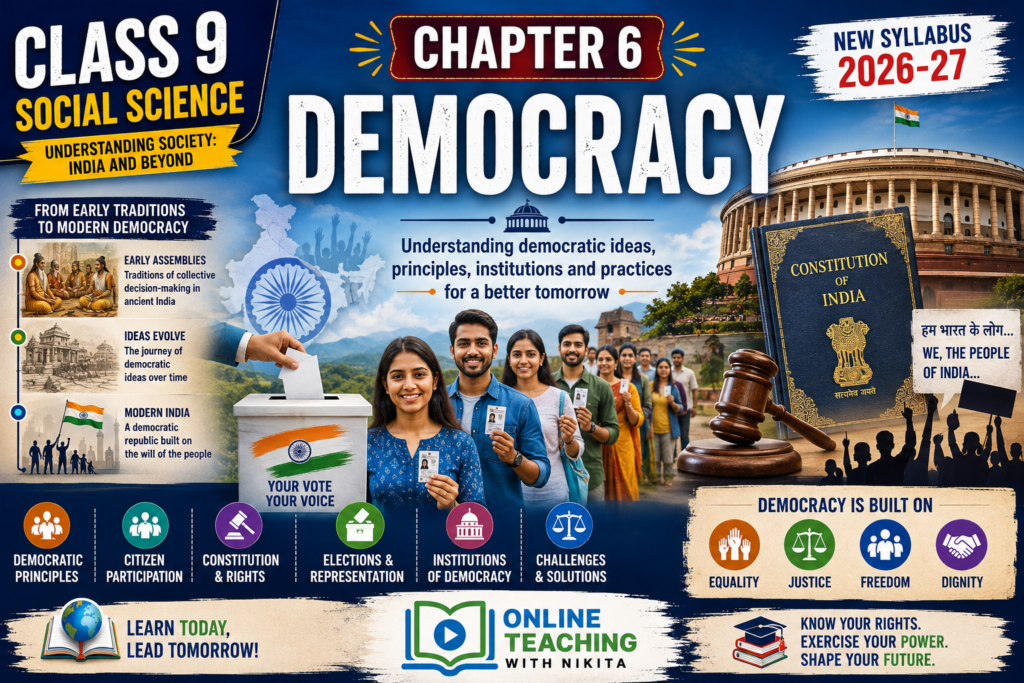
Table of Contents
📅 Last Updated: August 2026
📘 Syllabus: Based on the latest CBSE Class 9 (2026–27) syllabus
✅ Updated Resources Include:
- Chapter-wise Study Notes
- Free PDF Downloads
- MCQs
Chapter Overview
Democracy is an important part of understanding how people participate in governance and how political power is exercised.
This chapter explores the evolution of democratic ideas, including democratic traditions in India from early times. It develops students’ understanding of the meaning and essential features of democracy and examines how democratic principles operate in India and other parts of the world.
The chapter also discusses the Constitution of India, Fundamental Rights, citizen participation and democratic practices, along with challenges faced by Indian democracy.
| Detail | Information |
|---|---|
| Class | 9 |
| Subject | Social Science – Geography |
| Chapter | 6 |
| Chapter Name | Democracy |
| Textbook | Exploring Society: India and Beyond |
| Academic Session | 2026–27 |
About This Chapter
Democracy is not simply about elections. It involves the participation of citizens, the distribution and exercise of political power, rights, equality, accountability and constitutional safeguards.
The chapter begins by tracing democratic traditions from early times and examines how democratic ideas developed over a long historical period. It connects these traditions with India’s modern democratic system and the Constitution.
Students are introduced to ideas such as popular sovereignty, under which the authority of the state ultimately comes from the people, and Universal Adult Franchise, through which citizens aged 18 and above can participate in elections.
The chapter also examines democratic practices and challenges in India, including the 1975–77 Emergency, which the new textbook presents as a major challenge to democratic practices.
Learning Outcomes
After completing this chapter, students should be able to:
- Explain the meaning of democracy.
- Understand how democratic ideas evolved over time.
- Identify important features and principles of democracy.
- Understand the idea of popular sovereignty.
- Explain the importance of citizen participation.
- Understand the role of the Constitution in a democracy.
- Explain the importance of Fundamental Rights.
- Understand Universal Adult Franchise.
- Explore early Indian democratic traditions and assemblies.
- Distinguish between different forms and practices of democracy.
- Understand how democracy operates in India and other parts of the world.
- Examine challenges faced by Indian democracy.
These areas reflect the chapter’s stated focus on the evolution of democracy, forms of democracy, essential democratic features and challenges to Indian democracy.
Key Topics
🏛️ Meaning of Democracy
Understand what democracy means and why it is based on the participation and authority of citizens.
📜 Democratic Traditions from Early Times
Explore early Indian traditions and collective decision-making, including references to assemblies in the Rig Veda.
👥 Popular Sovereignty
Understand the principle that the state derives its authority from the people.
⚖️ Principles of Democracy
Explore important democratic principles such as equality, rights, participation and accountability.
🗳️ Forms of Democracy
Learn about different forms of democracy and how they are practised in India and elsewhere.
🇮🇳 Democracy in India
Understand India’s democratic system and the role of citizens in governance.
📖 Constitution & Fundamental Rights
Learn how the Constitution protects citizens’ rights and provides a framework for democratic governance.
⚠️ Challenges to Democratic Practices
Explore challenges to democracy in India, including the 1975–77 Emergency and other issues discussed in the new textbook.
⭐Class 9 Social Science Chapter 6 Study Resources
Get complete study and practice resources for Democracy, designed for the new Class 9 Social Science curriculum 2026–27.
📌 Important Questions
Most important questions to prepare for exams and chapter revision.
🗺️ Maps
Maps showing locations associated with early human settlements and civilisations.
🎁 Free Class 9 Social Science Chapter 6 Worksheets
Start practising Democracy with our free printable Class 9 Social Science worksheets based on the new 2026–27 curriculum.
NCERT Exercise Solutions – Chapter 6
Need help with the Chapter 6 textbook questions? Explore our student-friendly NCERT exercise solutions for Democracy.
Why Students Choose Our Class 9 Science Resources?
2026–27 Focused
Printable PDFs
Original Practice
Chapter-Wise Resources
Mobile Friendly
Answer Keys
❓FAQ
Q1. What is Chapter 6 of Class 9 Social Science?
Chapter 6 is titled “Democracy” and is part of the new NCERT textbook Understanding Society: India and Beyond – Part I for Class 9.
Q2. Which book contains Chapter 6 Democracy?
It is included in the new Class 9 Social Science textbook Understanding Society: India and Beyond – Part I.
Q3. What are the main topics in Chapter 6?
The chapter covers the evolution of democratic ideas, forms of democracy, democratic principles, popular sovereignty, citizen participation, the Constitution, Fundamental Rights and challenges to democratic practices.
Q4. Does Chapter 6 discuss democracy in ancient India?
Yes. The chapter traces democratic traditions from early times and discusses early Indian traditions of collective decision-making and assemblies.
Q5. What is popular sovereignty?
Popular sovereignty means that the state derives its authority from the people.
Q6. What is the role of the Constitution in democracy?
The Constitution provides the framework for democratic governance and protects citizens’ rights, including Fundamental Rights.
Q7. Does Chapter 6 cover challenges to Indian democracy?
Yes. The chapter discusses challenges to democratic practices in India, including the 1975–77 Emergency.
Q8. Are free worksheets available for Chapter 6?
Yes, if you have created the corresponding free worksheet, link it here.
Q9. Are these worksheets copies of the NCERT textbook?
No. Your worksheets and practice materials should be described as original supplementary resources created to support students’ learning.
Q10. Are NCERT exercise solutions available?
Yes, if you have created the Chapter 6 solution page, link it here.
🚀 Continue Your Class 9 Social Science Journey
Ready to Practise Class 9 Social Science?
Strengthen your understanding of Democracy with study notes, worksheets, MCQs, competency-based questions, important questions and NCERT solutions.
Share this Chapter
Found these Class 9 Social Science Chapter 6 resources useful? Share this page with classmates, parents and teachers preparing for the 2026–27 academic session.
Did You Find This Chapter Helpful?
If these resources helped you understand Chapter 6 – Democracy, explore the other Class 9 Social Science chapters and continue your preparation for the 2026–27 academic session.
- More worksheets
- More MCQs
- More important questions
- More maps & diagrams
- More revision notes
- NCERT solutions