
Class 9 Social Science Chapter 7 – Elections
Understanding Society: India and Beyond | Political Science | New Syllabus 2026–27
Explore Class 9 Social Science Chapter 7 – Elections with easy study notes, worksheets, MCQs, competency-based questions, important questions, revision resources and NCERT exercise solutions for the 2026–27 academic session.
This Class 9 Social Science Chapter 7 follows the latest Class 9 curriculum. For official curriculum information, visit CBSE Academic.
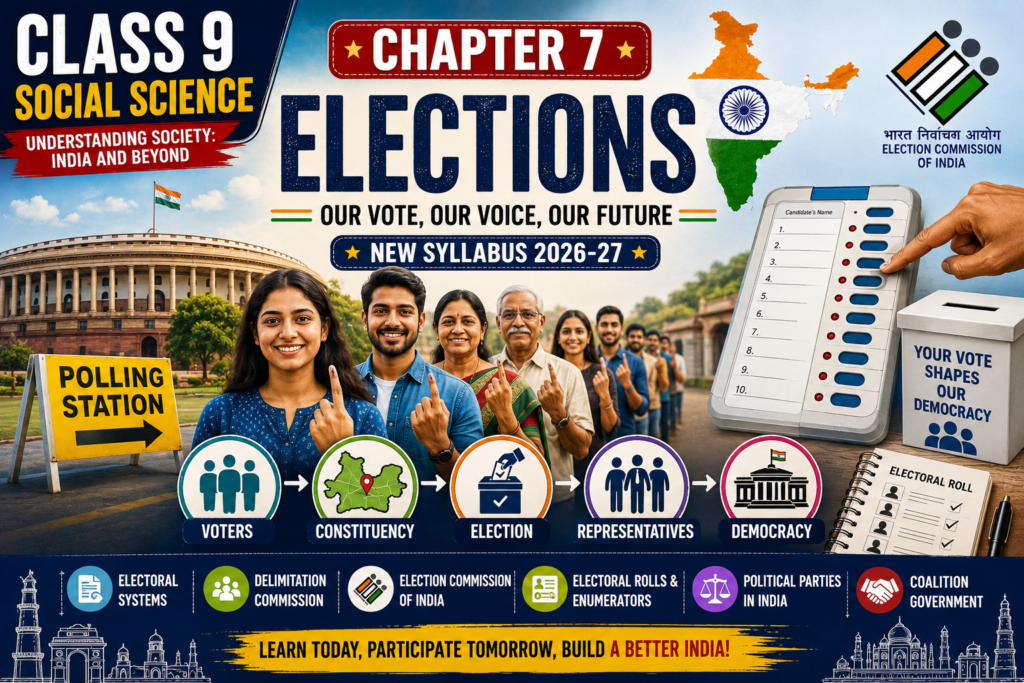
Table of Contents
📅 Last Updated: August 2026
📘 Syllabus: Based on the latest CBSE Class 9 (2026–27) syllabus
✅ Updated Resources Include:
- 📝 Chapter-wise Study Notes
- ❓ MCQs & Important Questions
- 📄 Free Worksheets
- 📘 NCERT Solutions
Chapter Overview of Class 9 Social Science Chapter 7
Elections are an essential part of democratic government because they provide a way for citizens to choose their representatives.
This chapter explores why elections are important in a democracy, how electoral systems work and how elections are organised in India. Students learn about constituencies, electoral rolls, the Election Commission of India, delimitation and political parties.
The official Class 9 syllabus allocates 9 hours to the Elections chapter and specifically includes electoral systems, the Delimitation Commission, the Election Commission of India, constituencies, electoral rolls, enumerators and the party system in India.
| Detail | Information |
|---|---|
| Class | 9 |
| Subject | Social Science |
| Chapter | 7 |
| Chapter Name | Elections |
| Textbook | Exploring Society: India and Beyond |
| Academic Session | 2026–27 |
About This Class 9 Social Science Chapter 7
A democracy needs a system through which citizens can choose their representatives. Elections provide citizens with an opportunity to participate in the political process and influence who represents them.
Chapter 7 introduces students to the electoral process in India and explains why elections matter for representative democracy.
Students explore different electoral systems and learn that the rules used to conduct elections can influence their outcomes. The chapter also introduces the institutions and processes that make elections possible.
Students will explore:
- Why elections are important in a democracy
- Different types of electoral systems
- How constituencies are organised
- What electoral rolls are
- The role of enumerators
- What delimitation means
- The role and functions of the Election Commission of India
- Laws governing elections
- The Representation of the People Acts
- Political parties and India’s party system
- Coalition governments
These are directly reflected in the official Class 9 syllabus
Learning Outcomes of Class 9 Social Science Chapter 7
After studying this chapter, students should be able to:
- Explain why elections are important in a democracy.
- Understand the purpose of electoral systems.
- Identify and distinguish the three types of electoral systems covered in the syllabus.
- Give examples of different electoral systems.
- Explain the meaning and purpose of delimitation.
- Understand the role of the Delimitation Commission.
- Explain the role and functions of the Election Commission of India (ECI).
- Define constituency.
- Explain the meaning of an electoral roll.
- Understand the role of an enumerator.
- Identify major laws governing elections in India.
- Understand the Representation of the People Acts.
- Explain the basic features of India’s party system.
- Understand the meaning and features of a coalition government.
These learning outcomes closely follow the official syllabus outcomes for Chapter 7.
Key Topics of Class 9 Social Science Chapter 7
🗳️ Importance of Elections
Understand why elections are necessary in a representative democracy.
📊 Electoral Systems
Learn about the different electoral systems and how they work.
🗺️ Delimitation
Understand how electoral boundaries are determined and why delimitation is required.
🏛️ Election Commission of India
Learn about the role and functions of the ECI in conducting elections.
📍 Constituencies
Understand what a constituency is and how constituencies function in elections.
📋 Electoral Rolls
Learn what electoral rolls are and why accurate voter records are important.
👤 Enumerators
Understand the role of enumerators in the electoral process.
🏳️ Political Parties & Coalition Government
Learn about India’s party system and the meaning and features of coalition governments.
⭐Class 9 Social Science Chapter 7 Study Resources
Get complete study and practice resources for Elections, designed around the new Class 9 Social Science curriculum for 2026–27.
📌 Important Questions
Most important questions to prepare for exams and chapter revision.
🗺️ Maps
Maps showing locations associated with early human settlements and civilisations.
🎁 Free Class 9 Social Science Chapter 6 Worksheets
Start practising Elections with our free printable worksheets created for Class 9 Social Science 2026–27.
NCERT Exercise Solutions – Chapter 7
Need help with the textbook questions? Explore our Class 9 Social Science Chapter 7 NCERT exercise solutions with clear, student-friendly answers.
Why Students Choose Our Class 9 Social Science Resources?
📘 CBSE 2026–27 Syllabus | 📄 Free PDF Downloads | ▶️ Video Lessons | 📝 Chapter-wise Notes | 🔍 Previous Year Questions | 🔄 Regular Updates | 📱 Mobile Friendly | 🎯 Board Exam Focused
❓FAQ
Q1. What is Chapter 7 of Class 9 Social Science?
Chapter 7 of the new Class 9 Social Science curriculum is titled “Elections.”
Q2. Which textbook contains Chapter 7?
It is part of the new NCERT Class 9 Social Science textbook Exploring Society: India and Beyond Part-I. NCERT’s textbook portal lists Chapter 7 among the chapters of the book.
Q3. Why are elections important in a democracy?
Elections provide a mechanism through which citizens participate in choosing their representatives and in the functioning of representative democracy.
Q4. What are the main topics in Chapter 7?
The official syllabus includes:
- Importance of elections
- Electoral systems
- Delimitation Commission
- Election Commission of India
- Constituencies
- Electoral rolls
- Enumerators
- Party system in India
- Coalition government
Q5. What is delimitation?
Delimitation refers to the process of determining or revising the boundaries of electoral constituencies.
Q6. What is the Election Commission of India?
The Election Commission of India is the constitutional authority responsible for conducting and supervising elections according to the constitutional and legal framework.
Q7. What is an electoral roll?
An electoral roll is the official list of eligible voters for an electoral constituency.
Q8. What is a constituency?
A constituency is a defined geographical area whose voters participate in electing a representative.
Q9. What is India's party system?
The chapter introduces students to the functioning and features of the political party system in India. The official syllabus specifically includes this topic.
Q10. What is a coalition government?
A coalition government is formed when two or more political parties come together to form a government, generally when no single party has sufficient support to form the government on its own.
Q11. Are free worksheets available for Chapter 7?
Yes, if you have created a free Chapter 7 worksheet, link it here.
Q12. Are these worksheets copies of NCERT?
No. Your worksheets and practice materials should be described as original supplementary resources, not copies of the NCERT textbook.
🚀 Continue Your Class 9 Social Science Journey
Previous Chapter
📚 All Chapters
Next Chapter →
Ready to Practise Class 9 Social Science?
Strengthen your understanding of Elections with study notes, worksheets, MCQs, competency-based questions, important questions and NCERT solutions.
Share this Chapter
Found these Class 9 Social Science Chapter 7 resources useful? Share this page with classmates, parents and teachers preparing for the 2026–27 academic session.
Did You Find This Chapter Helpful?
If these resources helped you understand Chapter 7 – Elections, explore the other Class 9 Social Science chapters and continue your preparation for the 2026–27 academic session.
- More worksheets
- More MCQs
- More important questions
- More maps & diagrams
- More revision notes
- NCERT solutions