
Class 9 Social Science Chapter 8 – Building Blocks in Economics: The Problem of Choice
Understanding Society: India and Beyond | Political Science | New Syllabus 2026–27
Explore Chapter 8 of the new Class 9 Social Science textbook with chapter notes, worksheets, competency-based questions, MCQs, revision resources and NCERT exercise solutions.
Official NCERT textbooks and educational resources can also be accessed through the NCERT website.
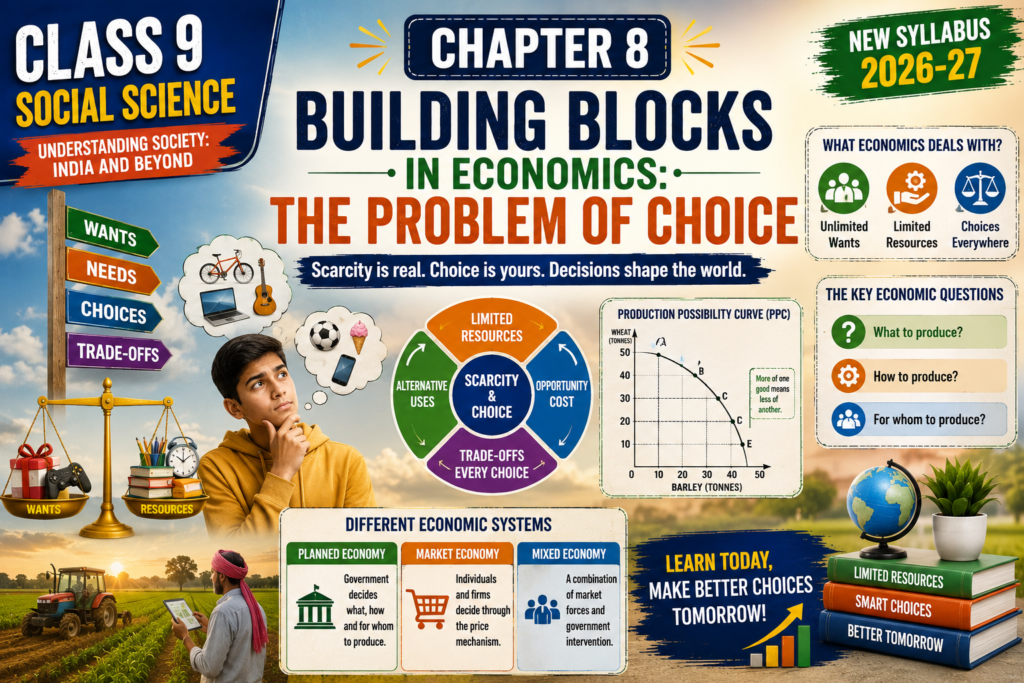
Table of Contents
📅 Last Updated: August 2026
📘 Syllabus: Based on the latest CBSE Class 9 (2026–27) syllabus
✅ Updated Resources Include:
- Chapter-wise Study Notes
- Free PDF Downloads
- MCQs
Chapter Overview of Class 9 Social Science Chapter 8
This chapter introduces the basic idea of economics as the study of how individuals and societies make choices when resources are limited and human wants are unlimited.
The textbook begins with everyday examples such as deciding how to spend pocket money, choosing what crops to grow, deciding whether an enterprise should use more labour or capital, and determining how governments should allocate resources. These examples show why economic choices are necessary.
| Detail | Information |
|---|---|
| Class | 9 |
| Subject | Social Science – Economics |
| Chapter | 8 |
| Chapter Name | Building Blocks in Economics: The Problem of Choice |
| Textbook | Understanding Society: India and Beyond, Part 1 |
| Academic Session | 2026–27 |
About Class 9 Social Science Chapter 8
The chapter explains that economics deals with the use of limited resources to satisfy unlimited wants. Because resources have competing uses, individuals, enterprises and governments have to make decisions about how those resources should be allocated.
It also introduces students to the role of economists, who use data, reports and analysis to understand alternatives, opportunity costs and possible outcomes of economic decisions.
Learning Outcomes of Class 9 Social Science Chapter 8
After studying this chapter, students should be able to:
- Explain the meaning of scarcity, choice and opportunity cost.
- Relate these concepts to everyday economic decisions.
- Explain what economists do.
- Understand how economists study production, distribution and consumption.
- Identify the three key economic questions.
- Explain how different economic systems address these questions.
- Understand the basic differences between market, planned and mixed economies.
These are directly aligned with the official 2026–27 curriculum outcomes for the Economics unit.
Key Topics of Class 9 Social Science Chapter 8
1. What Does Economics Deal With?
- Meaning of economics
- Limited resources
- Unlimited wants
- Allocation of resources
- Economic entities
- Consumers, producers, governments and enterprises
The textbook explains economics in terms of making choices and optimising the use of limited resources to satisfy needs and wants.
2. Needs and Wants
Students distinguish between:
- Needs — essentials such as food, water and shelter
- Wants — things such as gadgets, vacations and luxury items
The textbook emphasises that human wants are unlimited and keep changing.
3. Scarcity and Choice
- Limited resources
- Unlimited wants
- Need for making choices
- Competing uses of resources
4. Opportunity Cost
Understanding what is given up when one alternative is chosen over another.
5. Production Possibility Curve (PPC)
The chapter introduces the Production Possibility Curve using combinations of barley and wheat. It demonstrates trade-offs and opportunity cost when resources are used to produce different goods.
6. What Do Economists Do?
- Economic analysis
- Data and evidence
- Economic surveys
- Policy-making
- Finance
- Research and education
- Business consulting
The textbook specifically discusses the Economic Survey and several areas in which economists work.
7. Key Questions in Economics
The three central questions are:
- What to produce?
- How to produce?
- For whom to produce?
The textbook connects these questions to scarcity, choices and limited resources.
8. Economic Systems
- Planned Economy
- Market Economy
- Mixed Economy
The chapter explains how different economic systems answer the three key economic questions differently.
9. Economics in India
The chapter also discusses how India’s economic system has evolved and how modern economies combine elements of market and planned systems.
⭐Class 9 Social Science Chapter 8 Study Resources
Get complete study and practice resources for Building Blocks in Economics: The Problem of Choice, designed around the new Class 9 Social Science curriculum for 2026–27.
📌 Important Questions
Most important questions to prepare for exams and chapter revision.
🎁 Free Class 9 Social Science Chapter 8 Worksheets
Practise scarcity, choice, opportunity cost, economic decision-making and other important concepts from Chapter 8 with printable worksheets and answer keys.
NCERT Exercise Solutions – Chapter 8
Get step-by-step explanations for the questions and activities given at the end of Chapter 8.
Why Students Choose Our Class 9 Science Resources?
2026–27 Focused
Printable PDFs
Original Practice
Chapter-Wise Resources
Mobile Friendly
Answer Keys
❓FAQ of Class 9 Social Science Chapter 8
Q1. What is Chapter 8 of Class 9 Social Science?
Chapter 8 is “Building Blocks in Economics: The Problem of Choice” from Understanding Society: India and Beyond – Grade 9, Part 1. It introduces students to basic economic ideas such as scarcity, choice, opportunity cost, the Production Possibility Curve and economic systems.
Q2. What are the main topics covered in Chapter 8?
The chapter covers needs and wants, limited resources, choice, opportunity cost, the Production Possibility Curve (PPC), the scope of economics, the three key economic questions, and different economic systems.
Q3. What is the basic problem studied in economics?
Economics deals with the problem of making choices when resources are limited but human wants are unlimited and changing. Since resources have alternative uses, individuals, enterprises and governments must decide how to use them.
Q4. What is the difference between needs and wants?
Needs are essential requirements such as food, water and shelter, while wants are desires for things such as gadgets, vacations or luxury items. The chapter uses the distinction between needs and wants to introduce the problem of economic choice.
Q5. What is opportunity cost?
Opportunity cost is the value of what is given up when one alternative is chosen over another. For example, when a farmer uses limited land to grow more barley instead of wheat, the wheat that is sacrificed represents the opportunity cost of the choice.
Q6. What is a Production Possibility Curve (PPC)?
A Production Possibility Curve (PPC) shows different combinations of two goods that can be produced using all available resources efficiently. It illustrates the trade-off involved in production choices.
Q7. Why does the PPC slope downward?
The PPC slopes downward because producing more of one good requires sacrificing some quantity of the other good when resources are limited. Thus, it represents a trade-off and opportunity cost.
Q8. What are the three key questions every economy has to answer?
Every economy has to make decisions about:
- What to produce?
- How to produce?
- For whom to produce?
These questions arise because resources are limited and have alternative uses.
Q9. What are the different types of economic systems discussed in Chapter 8?
The chapter discusses planned, market and mixed economic systems and how they address the basic economic questions. The curriculum specifically expects students to distinguish between these systems.
Q10. What is a planned economy?
A planned economy is an economic system in which important decisions about production and allocation of resources are largely made through central planning.
Q11. What is a market economy?
A market economy relies substantially on interactions between buyers and sellers and market forces to guide economic decisions.
Q12. What is a mixed economy?
A mixed economy combines elements of market mechanisms with government involvement in economic activity. Chapter 8 uses economic systems to help students understand how different societies address the problem of choice.
Q13. Why is opportunity cost important in everyday life?
Opportunity cost helps us recognise that choosing one option means giving up another. It can apply to money, time, land, labour and other resources, helping individuals and organisations make more informed choices.
Q14. Why is Chapter 8 important for Class 9 students?
Chapter 8 provides the foundation for understanding economics. It helps students understand scarcity, choice, opportunity cost, resource allocation and economic systems, which are important for interpreting economic decisions in everyday life and society.
🚀 Continue Your Class 9 Social Science Journey
Previous Chapter
📚 All Chapters
Next Chapter →
Ready to Practise Class 9 Social Science?
Strengthen your understanding of scarcity, choice, opportunity cost and economic systems with chapter-wise practice resources.
Share this Chapter
Found these Class 9 Social Science Chapter 8 resources helpful? Share this page with students, parents and teachers.
Did You Find This Chapter Helpful?
👍 Yes / 👎 No
- More worksheets
- More MCQs
- More important questions
- More maps & diagrams
- More revision notes
- NCERT solutions