
The Price Puzzle: What Drives the Market
Understanding Society: India and Beyond | New Syllabus 2026–27
Explore Class 9 Social Science Chapter 9, The Price Puzzle: What Drives the Market, with notes, worksheets, competency-based questions, MCQs, revision resources and exercise solutions for the 2026–27 syllabus.
This chapter follows the latest Class 9 curriculum. For official curriculum information, visit CBSE Academic.
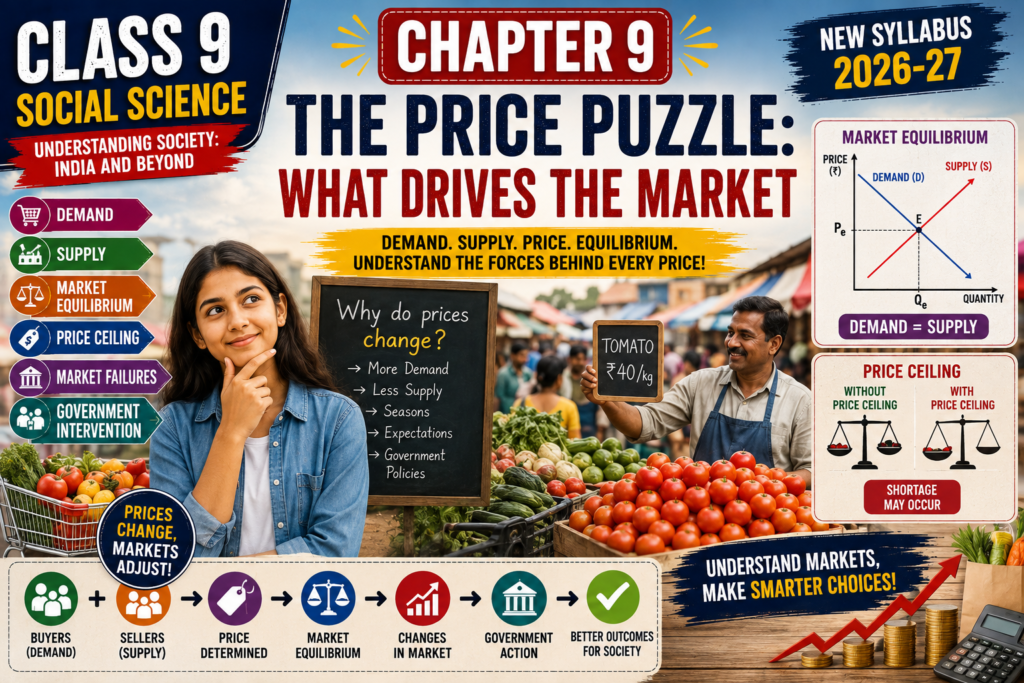
Table of Contents
📅 Last Updated: August 2026
📘 Syllabus: Based on the latest CBSE Class 9 (2026–27) syllabus
✅ Updated Resources Include:
- 📚 Chapter-wise Study Notes
- 📄 Free PDF Downloads
- ❓ MCQs
- 📝 Worksheets
- 📖 NCERT Exercise Solutions
Chapter Overview
The Price Puzzle: What Drives the Market introduces students to the economic forces that influence the prices of goods and services. The chapter explores how demand and supply interact, how prices are determined, and how markets respond when conditions change.
Students also learn about market equilibrium, shortages, surpluses, price ceilings and market failures, along with situations in which government intervention may be required.
Have you ever wondered why vegetable prices change during the day, why flight tickets can have very different prices on different days, or why shops offer discounts during particular seasons?
This chapter helps explain these everyday market situations by examining the relationship between buyers, sellers, demand, supply and prices.
| Detail | Information |
|---|---|
| Class | 9 |
| Subject | Social Science – Economics |
| Chapter | 9 |
| Chapter Name | The Price Puzzle: What Drives the Market |
| Textbook | Understanding Society: India and Beyond, Part 1 |
| Academic Session | 2026–27 |
About This Chapter
In this chapter, students explore the basic forces that drive markets.
The chapter begins with demand and supply, explaining how consumers and producers respond to changes in prices and other market conditions. It then examines how these forces interact to determine the equilibrium price and quantity.
The chapter also moves beyond simplified textbook models and considers real-world situations involving necessities, luxury goods, perishable goods and expectations.
Students further examine price ceilings, market failures, externalities, information asymmetry and public goods, and understand why governments may intervene in markets
Learning Outcomes
After completing Chapter 9, students should be able to:
- Explain the Law of Demand with real-life examples.
- Explain the Law of Supply with real-life examples.
- Understand how changes in price affect quantity demanded and quantity supplied.
- Identify equilibrium price and equilibrium quantity.
- Explain shortage and surplus.
- Analyse how changes in demand or supply affect market equilibrium.
- Explain the concept of a price ceiling.
- Understand how price ceilings can result in shortages or black markets.
- Understand the meaning of market failure.
- Identify major types of market failure.
- Explain the importance of public goods.
- Apply demand-and-supply concepts to real-world situations.
Key Topics
📈 Demand
The quantity of a product consumers are willing and able to buy at different prices.
📉 Law of Demand
As price falls, quantity demanded generally rises; as price rises, quantity demanded generally falls.
🏭 Supply
The quantity of a product sellers are willing and able to offer at a particular price.
📊 Law of Supply
As price increases, quantity supplied generally increases, while lower prices tend to reduce quantity supplied.
⚖️ Market Equilibrium
The point where quantity demanded equals quantity supplied. At equilibrium, there is neither excess demand nor excess supply.
🔺 Shortage and Surplus
Understand what happens when quantity demanded is greater than quantity supplied, and vice versa.
🏷️ Price Ceiling
A government-imposed maximum price that a seller can charge for a product or service.
🏛️ Market Failures
Understand situations where markets may not produce desirable outcomes, including externalities, information asymmetry and public goods.
🌳 Public Goods
Understand goods that are non-excludable and non-rival, such as parks or street lighting.
⭐Class 9 Social Science Chapter 9 Study Resources
Get complete study and practice resources for The Price Puzzle: What Drives the Market, designed around the new Class 9 Social Science curriculum for 2026–27.
📌 Important Questions
Most important questions to prepare for exams and chapter revision.
🎁 Free Class 9 Social Science Chapter 9 Worksheets
Start your Chapter 9 preparation with selected practice questions covering demand, supply, market equilibrium and real-life market situations.
NCERT Exercise Solutions – Chapter 9
Find help with the questions and activities from Chapter 9 – The Price Puzzle: What Drives the Market.
The textbook includes activities involving demand schedules, supply, market equilibrium, price controls and real-life market situations. For example, students are asked to analyse demand and supply data and identify equilibrium price and quantity.
Why Students Choose Our Class 9 Science Resources?
2026–27 Focused
Printable PDFs
Original Practice
Chapter-Wise Resources
Mobile Friendly
Answer Keys
❓FAQ
Q1. What is Chapter 9 of Class 9 Social Science?
Chapter 9 is “The Price Puzzle: What Drives the Market” from Understanding Society: India and Beyond. It focuses on demand, supply, price determination, market equilibrium and related market concepts.
Q2. What are the main topics in Chapter 9?
The chapter covers the Laws of Demand and Supply, real-world deviations from textbook theory, price ceilings and market failures, including externalities, information asymmetry and public goods.
Q3. What is market equilibrium?
Market equilibrium occurs when the quantity demanded equals the quantity supplied. At this point, there is neither excess demand nor excess supply.
Q4. What is a price ceiling?
A price ceiling is a government-imposed maximum price that a seller can charge for a product or service.
Q5. Can a price ceiling cause a shortage?
Yes. The curriculum specifically expects students to understand that price ceilings can lead to shortages or black markets.
Q6. What is the Law of Demand?
The Law of Demand describes the inverse relationship between price and quantity demanded: as price falls, quantity demanded generally rises, and as price rises, quantity demanded generally falls.
Q7. What is the Law of Supply?
The Law of Supply describes the direct relationship between price and quantity supplied: as price increases, sellers generally supply more.
Q8. What are public goods?
Public goods are goods that are non-excludable and non-rival, with examples in the curriculum including parks and street lighting.
🚀 Continue Your Class 9 Social Science Journey
Previous Chapter
📚 All Chapters
Ready to Practise Class 9 Social Science?
Build your understanding of demand, supply and market forces with chapter-wise practice resources.
Share this Chapter
Found these Class 9 Social Science Chapter 9 resources helpful? Share this page with students, parents and teachers.
Did You Find This Chapter Helpful?
👍 Yes / 👎 No
- More worksheets
- More MCQs
- More important questions
- More maps & diagrams
- More revision notes
- NCERT solutions