
Class 9 Social Science Chapter 4 – Governance and Public Policy | Part 2
Understanding Society: India and Beyond | New Syllabus 2026–27
Explore Class 9 Social Science Chapter 4, Governance and Public Policy – Part 2, with detailed notes, worksheets, competency-based questions, MCQs, revision resources and NCERT exercise solutions for the 2026–27 syllabus. This chapter explores governance, good governance, e-governance, public policy, policy-making and implementation, policy stakeholders, the policy cycle, NEP 2020, policy coordination and Khelo Bharat Niti 2025.
This chapter follows the latest Class 9 Social Science curriculum for 2026–27. For official curriculum information, visit CBSE Academic.
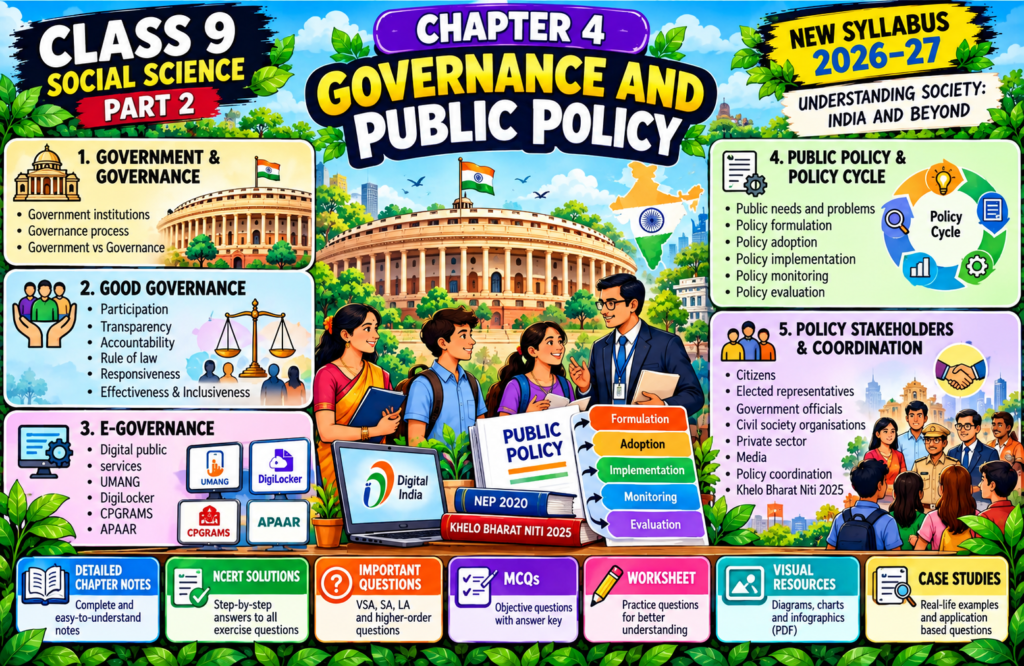
Table of Contents
📅 Last Updated: September 2026
📘 Syllabus: Based on the latest CBSE Class 9 (2026–27) syllabus
✅ Updated Resources Include:
- 📚 Chapter-wise Study Notes
- 📄 Free PDF Downloads
- ❓ MCQs
- 📝 Worksheets
- 📖 NCERT Exercise Solutions
Chapter Overview of Class 9 Social Science Chapter 4, Governance and Public Policy Part 2
Governance and Public Policy explores how a democratic government works to address the needs and problems of citizens. It explains the difference between government and governance and how various institutions and actors come together to ensure effective and responsible decision-making for a better society.
The chapter highlights the key features of good governance such as participation, transparency, accountability, rule of law, responsiveness, effectiveness and inclusiveness. It explains why these elements are important for a fair, just and democratic system and how they help build citizen trust and improve the quality of public services.
Students learn about e-governance and how digital technology is used to make governance more transparent, efficient and citizen-friendly. The chapter also introduces the concept of public policy, explaining how policies are made to address public problems and fulfil citizens’ needs.
The chapter discusses the stakeholders in public policy and the different stages of the policy cycle, from identifying and prioritising issues to policy formulation, implementation, monitoring and evaluation. It also explains the relationship between policy, programme and scheme and the importance of policy coordination.
The chapter includes case studies such as the National Education Policy (NEP) 2020 and Khelo Bharat Niti 2025, showing how public policies are designed to achieve specific goals and bring positive change in society.
About This Chapter Class 9 Social Science Chapter 4, Governance and Public Policy | Part 2
In this chapter, students explore how governance works in a democracy and how decisions are made, implemented and monitored for public welfare. The chapter explains the difference between government and governance, the principles of good governance, and the role of citizens and institutions in public life.
Students learn about e-governance, public policy, policy-making and implementation, policy stakeholders and the policy cycle. The chapter also covers NEP 2020, policy–programme–scheme, policy coordination and Khelo Bharat Niti 2025, highlighting how different levels of government and other stakeholders work together to address public needs.
Learning Outcomes of Class 9 Social Science Chapter 4, Governance and Public Policy | Part 2
After completing Chapter 4, students should be able to:
- Explain the meaning of government, governance and good governance and distinguish between them.
- Describe the key principles of good governance, including participation, transparency, accountability, rule of law, responsiveness and effectiveness.
- Explain the meaning and importance of e-governance and public policy in everyday life.
- Identify the major stakeholders involved in policy-making and implementation.
- Describe the different stages of the policy cycle, from identifying a public need to evaluation and feedback.
- Understand the difference between policy, programme and scheme.
- Explain the importance of policy coordination and citizen participation in effective governance.
Key Topics of Class 9 Social Science Chapter 4, Governance and Public Policy | Part 2
🏛️ Government & Governance
Meaning of government and governance, their differences, and the evolution of governance ideas in India.
⚖️ Good Governance
Participation, transparency, accountability, rule of law, responsiveness, effectiveness and inclusiveness.
💻 E-Governance
Use of technology in public services, including UMANG, Aadhaar, DigiLocker, GeM, CPGRAMS and APAAR.
📋 Public Policy
Meaning, importance, public problems, public welfare and the role of citizens.
🔄 Policy Cycle
Policy desirability, prioritising, formulation, adoption, implementation, monitoring and evaluation.
🤝 Policy Stakeholders
Citizens, elected representatives, government officials, civil society, experts, media, private organisations and international organisations.
📚 NEP 2020
Public consultation, expert participation and the policy-making process.
🏅 Policy Coordination & Khelo Bharat Niti 2025
Coordination among Central, State, district and block levels, sports institutions, private organisations and citizens.
❓ Big Questions of Class 9 Social Science Chapter 4 Governance and Public Policy | Part 2 | 2026–27
Key questions and quick answers to help students understand and revise the important concepts of Chapter
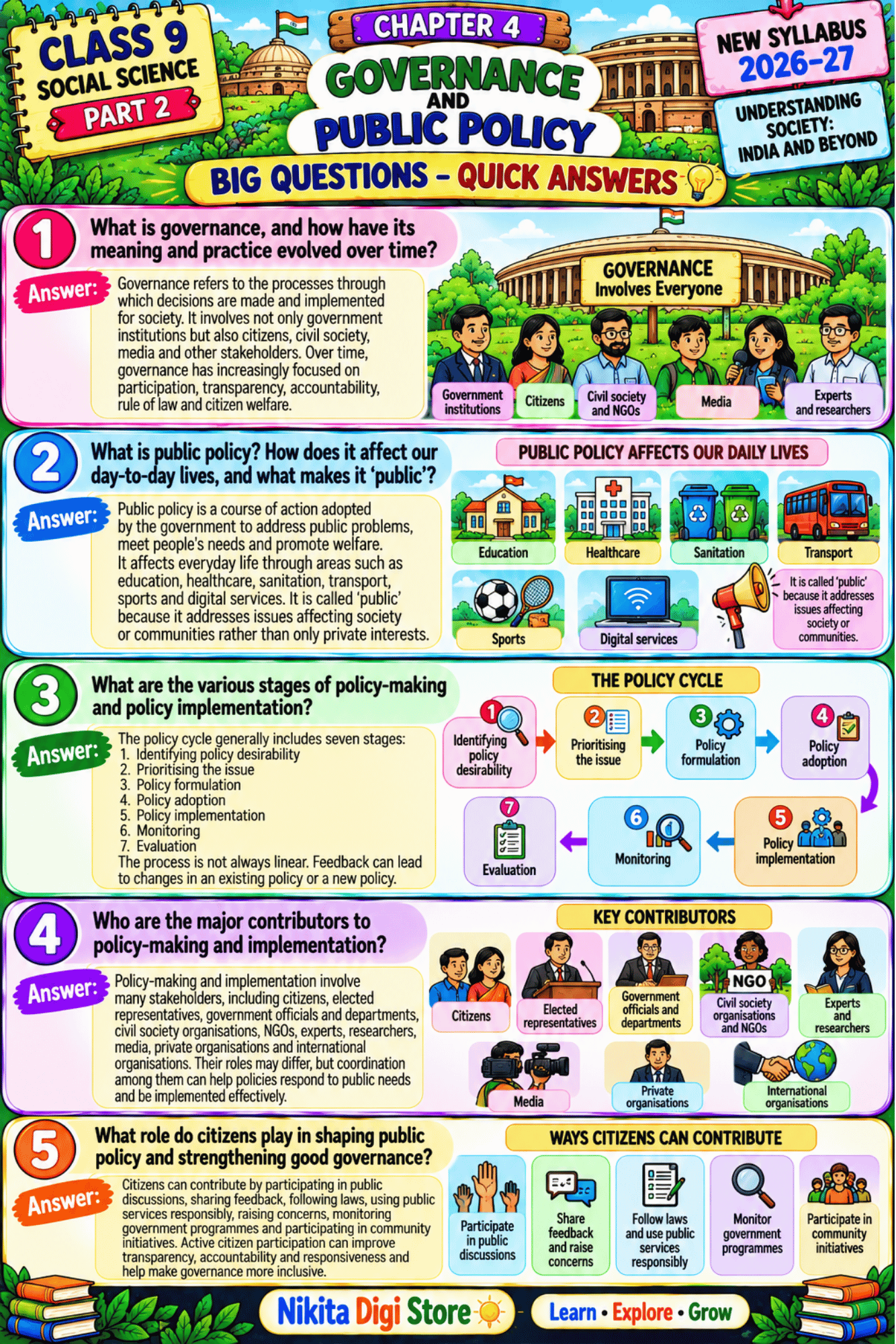
1️⃣ What is governance, and how have its meaning and practice evolved over time?
Governance refers to the processes through which decisions are made and implemented for society. It involves not only government institutions but also citizens, civil society, media and other stakeholders. Over time, governance has increasingly focused on participation, transparency, accountability, rule of law and citizen welfare.
2️⃣ What is public policy? How does it affect our day-to-day lives, and what makes it ‘public’?
Public policy is a course of action adopted by the government to address public problems, meet people’s needs and promote welfare. It affects everyday life through areas such as education, healthcare, sanitation, transport, sports and digital services. It is called ‘public’ because it addresses issues affecting society or communities rather than only private interests.
3️⃣ What are the various stages of policy-making and policy implementation?
The policy cycle generally includes seven stages:
- Identifying policy desirability
- Prioritising the issue
- Policy formulation
- Policy adoption
- Policy implementation
- Monitoring
- Evaluation
The process is not always linear. Feedback from monitoring and evaluation can lead to changes in an existing policy or the development of a new one.
4️⃣ Who are the major contributors to policy-making and implementation?
Policy-making and implementation involve many stakeholders, including citizens, elected representatives, government officials and departments, civil society organisations, NGOs, experts, researchers, media, private organisations and international organisations. Their roles may differ, but coordination among them can help policies respond to public needs and be implemented effectively.
5️⃣ What role do citizens play in shaping public policy and strengthening good governance?
Citizens can contribute by participating in public discussions, sharing feedback, following laws, using public services responsibly, raising concerns, monitoring government programmes and participating in community initiatives. Active citizen participation can improve transparency, accountability and responsiveness and help make governance more inclusive.
🔑 Quick Revision
🏛️ Government → Institutions that exercise political authority
🤝 Governance → Process of decision-making and implementation
⚖️ Good Governance → Participation, transparency, accountability, rule of law, responsiveness and effectiveness
💻 E-Governance → Use of technology to improve public services and communication
📋 Public Policy → Government action to address public needs
🔄 Policy Cycle → Desirability → Prioritising → Formulation → Adoption → Implementation → Monitoring → Evaluation
👥 Stakeholders → Citizens, government, experts, civil society, media, private sector and others
🎨 Visual Revision: Big Questions at a Glance
Key questions and quick answers to help students understand and revise the important concepts of Chapter
⭐ Class 9 Social Science Chapter 4 Study Resources – Part 2
Get complete study and practice resources for Class 9 Social Science Chapter 4, Governance and Public Policy from Understanding Society: India and Beyond, Part 2, based on the new Class 9 Social Science curriculum for 2026–27.
📌 Important Questions
Most important questions to prepare for exams and chapter revision.
🗺️ Visual Learning Resources
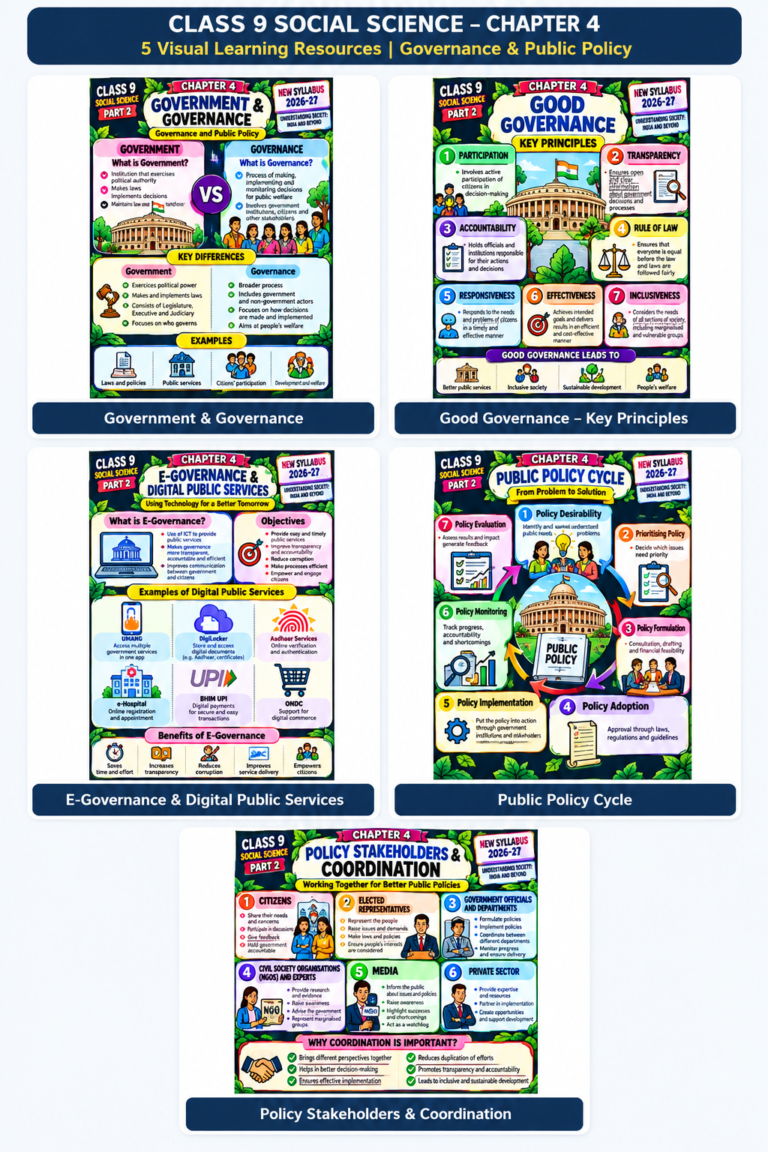
Explore diagrams, charts and visual resources to understand the key concepts of Governance and Public Policy, including government and governance, good governance, e-governance, the policy cycle, stakeholders and policy coordination.
The 5 most important visuals for Class 9 Social Science – Chapter 4: Governance and Public Policy are:
- 🏛️ Government & Governance
- ⚖️ Good Governance – Key Principles
- 💻 E-Governance & Digital Public Services
- 🔄 Public Policy Cycle
- 🤝 Policy Stakeholders & Coordination
🎁 Free Class 9 Social Science Chapter 4 Worksheets – Part 2
Start your Chapter 4 preparation with selected practice questions covering governance, government, good governance, e-governance, public policy, policy-making, policy implementation, policy stakeholders, the policy cycle, NEP 2020, policy coordination and Khelo Bharat Niti 2025.
📚 NCERT Exercise Solutions – Chapter 4 | Part 2
Find helpful answers to the questions and activities from Chapter 4 – Governance and Public Policy.
The chapter includes activities related to government and governance, principles of good governance, e-governance, public policy, policy stakeholders, the policy
Find helpful answers to the questions and activities from Chapter 4 – Governance and Public Policy.
The chapter includes activities related to government and governance, principles of good governance, e-governance, public policy, policy stakeholders, the policy cycle, NEP 2020, policy–programme–scheme, policy coordination and Khelo Bharat Niti 2025.
cycle, NEP 2020, policy–programme–scheme, policy coordination and Khelo Bharat Niti 2025.
Why Students Choose Our Class 9 Social Science Resources?
2026–27 Focused
Printable PDFs
Original Practice
Chapter-Wise Resources
Mobile Friendly
Answer Keys
❓ FAQ of Class 9 Social Science Chapter 4, Governance and Public Policy Part 2
Q1. What is Chapter 4 of Class 9 Social Science Part 2?
Chapter 4 is “Governance and Public Policy” from Understanding Society: India and Beyond, Part 2. It explains government and governance, good governance, e-governance, public policy, the policy cycle, policy stakeholders, NEP 2020, policy coordination and Khelo Bharat Niti 2025.
Q2. What is governance?
Governance is the process of making, implementing and monitoring decisions for public welfare. It involves government institutions as well as citizens and other stakeholders.
Q3. What is public policy?
Public policy is a course of action adopted by the government to address public problems, meet public needs and promote public welfare.
Q4. What are the principles of good governance?
Key principles include participation, transparency, accountability, rule of law, responsiveness, effectiveness and inclusiveness.
Q5. What is e-governance?
E-governance means using information and communication technology (ICT) to provide public services, share information, communicate with citizens and improve administrative processes.
Q6. What are the stages of the policy cycle?
The major stages are policy desirability, prioritising policy, policy formulation, policy adoption, policy implementation, policy monitoring and policy evaluation.
Q7. Who participates in public policy-making?
Major stakeholders include citizens, elected representatives, government officials, civil society organisations, experts, media, private organisations and international organisations.
Q8. What is the difference between government and governance?
Government refers to the institutions that exercise political authority, while governance refers to the process through which decisions are made and implemented.
Q9. Why is citizen participation important in governance?
Citizens help identify public problems, provide suggestions and feedback, participate in community activities and contribute to making public policies more responsive to people’s needs.
🚀 Continue Your Class 9 Social Science Journey
Keep learning with Class 9 Social Science Part 2 chapter-wise study and practice resources.
Next Chapter
📚 All Chapters
Ready to Practise Class 9 Social Science?
Build your understanding of Class 9 Social Science Chapter 4, Governance and Public Policy Part 2 with chapter-wise study and practice resources.
📢 Share this Class 9 Social Science Chapter 4, Governance and Public Policy Part 2
Found these Class 9 Social Science Chapter 4 resources helpful? Share this page with students, parents and teachers.
Did You Find This Chapter Helpful?
👍 Yes / 👎 No
- More worksheets
- More MCQs
- More important questions
- More maps & diagrams
- More revision notes
- NCERT solutions