
Class 9 Social Science Chapter 6 – From Ideas to Startups | Part 2
Understanding Society: India and Beyond | New Syllabus 2026–27
Explore Class 9 Social Science Chapter 6, From Ideas to Startups – Part 2, with detailed notes, worksheets, competency-based questions, MCQs, revision resources and NCERT exercise solutions for the 2026–27 syllabus. This chapter introduces entrepreneurship, business planning, functional areas of a business, startups, innovation, accounting and the contribution of businesses to society and the economy.
This chapter follows the latest Class 9 curriculum. For official curriculum information, visit CBSE Academic.
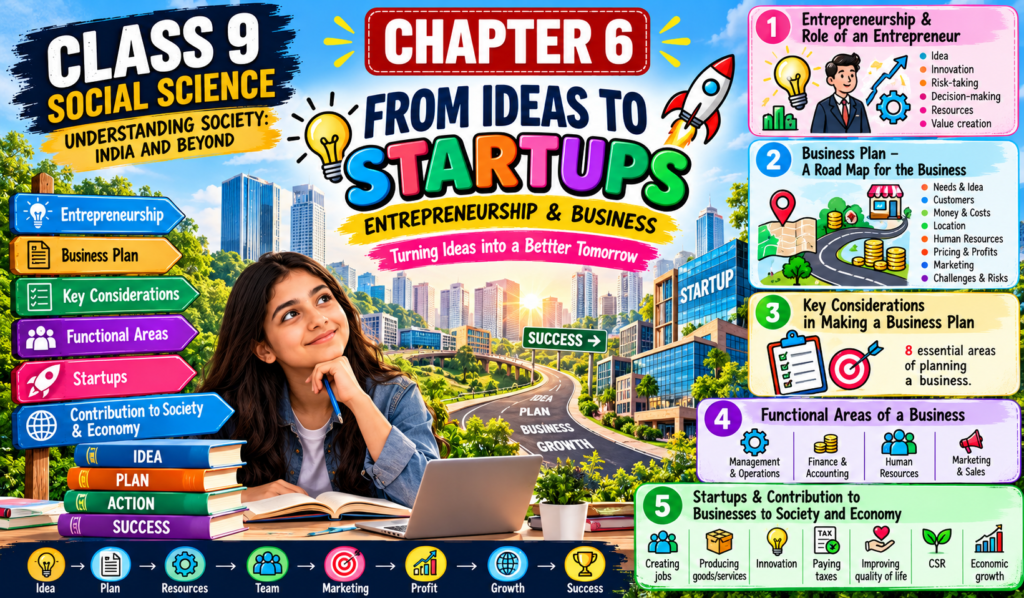
Table of Contents
📅 Last Updated: September 2026
📘 Syllabus: Based on the latest CBSE Class 9 (2026–27) syllabus
✅ Updated Resources Include:
- 📚 Chapter-wise Study Notes
- 📄 Free PDF Downloads
- ❓ MCQs
- 📝 Worksheets
- 📖 NCERT Exercise Solutions
Chapter Overview of Class 9 Social Science Chapter 6 – From Ideas to Startups | Part 2
From Ideas to Startups introduces students to the world of entrepreneurship, business ideas and startups and explains how an idea can be developed into a successful business venture. The chapter explores the meaning of entrepreneurship, the role of entrepreneurs, innovation, risk-taking, decision-making and the creation of value for society and the economy.
Students learn how entrepreneurs identify needs, opportunities and problems and use available resources to develop products or services. The chapter also highlights the importance of qualities such as curiosity, creativity, initiative, perseverance and responsible risk-taking, supported by examples of successful entrepreneurs and entrepreneurial journeys.
The chapter explains how to develop a business plan, including identifying customer needs, potential customers, money and costs, location, human resources, pricing and profits, marketing and promotion, and possible challenges and risks. A business plan provides a roadmap for organising resources and turning a business idea into action.
Students also learn about the functional areas of a business, including management and operations, finance and accounting, human resources, and marketing and sales. These areas work together to ensure efficient use of resources, financial management, employee development, customer engagement and business growth.
The chapter further introduces startups and India’s startup ecosystem, along with the role of entrepreneurship, innovation and businesses in creating employment, generating income, improving quality of life and supporting economic growth. It also highlights the contribution of traditional entrepreneurial communities, MSMEs and the unorganised sector, as well as initiatives that support entrepreneurship and self-reliance in India.
| Detail | Information |
|---|---|
| Class | 9 |
| Subject | Social Science – Economics |
| Chapter | 6 |
| Chapter Name | From Ideas to Startups |
| Textbook | Understanding Society: India and Beyond, Part 2 |
| Academic Session | 2026–27 |
About This Chapter Class 9 Social Science Chapter 6, From Ideas to Startups – Part 2
In this chapter, students explore the meaning of entrepreneurship and understand how ideas can be transformed into business ventures. The chapter explains the role of entrepreneurs in identifying opportunities, solving problems, taking calculated risks, making decisions and creating value for society and the economy.
Students learn about the resources required to start a business and explore examples of successful entrepreneurs and entrepreneurial journeys. The chapter highlights qualities such as innovation, curiosity, initiative, perseverance and effective decision-making.
The chapter introduces the business plan as a roadmap for starting and developing a business. Students learn about identifying needs and ideas, potential customers, money and costs, location, human resources, pricing and profits, marketing and promotion, and business challenges and risks.
Students also learn about the major functional areas of a business, including management and operations, finance and accounting, human resources, and marketing and sales. The chapter further introduces startups and India’s startup ecosystem, along with the contribution of businesses, MSMEs and the unorganised sector to employment, innovation and economic growth. NCERT
Learning Outcomes of Class 9 Social Science Chapter 6, From Ideas to Startups – Part 2
After completing Chapter 6, students should be able to:
- Explain what entrepreneurship means and why it is important for innovation, employment and economic growth.
- Identify the key resources required to start and operate a business.
- Understand how entrepreneurs identify problems, needs and opportunities and develop innovative solutions.
- Explain the importance of risk-taking, decision-making, planning and resource management in entrepreneurship.
- Analyse examples and case studies of successful entrepreneurs and understand the factors behind their success.
- Explain the purpose and major components of a business plan.
- Identify important business considerations such as customers, costs, location, human resources, pricing, marketing and risks.
- Describe the major functional areas of a business, including management and operations, finance and accounting, human resources, and marketing and sales.
- Understand the meaning of a startup and describe the key features of India’s startup ecosystem.
- Recognise the role of MSMEs and the unorganised sector in employment, innovation and inclusive economic growth.
- Explain how businesses contribute to employment, income generation, innovation, public revenue and improvement in quality of life.
Key Topics of Class 9 Social Science Chapter 6, From Ideas to Startups – Part 2
- 💡 Entrepreneurship & Entrepreneurs
- 🚀 Startups & Innovation
- 📋 Business Plan
- 🎯 Business Ideas & Opportunities
- 👥 Potential Customers
- 💰 Money, Costs & Finance
- 📍 Location
- 👩💼 Human Resources
- 💵 Pricing & Profits
- 📢 Marketing & Sales
- ⚠️ Business Challenges & Risks
- 🏢 Functional Areas of a Business
- 📊 Finance & Accounting
- 🌱 MSMEs & Unorganised Sector
- 🇮🇳 Startup Ecosystem in India
- 🤝 Contribution of Businesses to Society & Economy
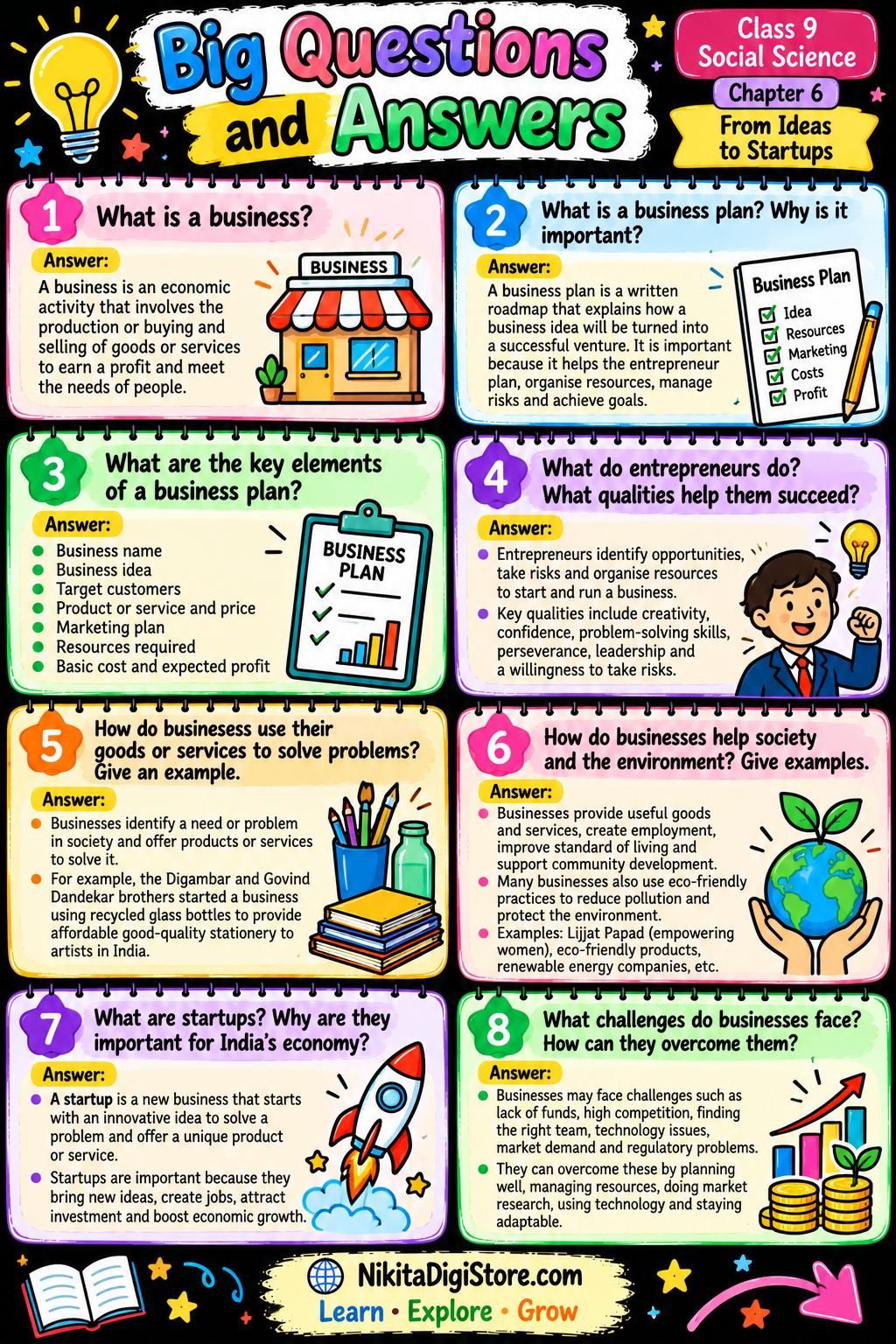
❓ Big Questions of Class 9 Social Science Chapter 6
Key questions and quick answers to help students understand and revise the important concepts of Chapter
1. How does entrepreneurship impact society and the economy?
Answer: Entrepreneurship contributes to society and the economy by creating jobs, generating income, encouraging innovation and producing useful goods and services. Entrepreneurs identify opportunities, solve problems and create value. Businesses also contribute through taxes, improved quality of life and community development.
2. What are some functional areas of a business?
Answer: The major functional areas of a business are Management and Operations, Finance and Accounting, Human Resources, and Marketing and Sales. Each area performs different tasks, while working together to ensure the smooth functioning and growth of a business.
3. How can a business plan be developed?
Answer: A business plan can be developed by identifying a business idea and customer needs, understanding potential customers, estimating money and costs, deciding the location, planning human resources, determining pricing and profits, developing marketing strategies, and identifying possible challenges and risks. A business plan acts as a roadmap for starting and running a business.
🎨 Visual Revision: Big Questions at a Glance
Key questions and quick answers to help students understand and revise the important concepts of Chapter
⭐ Class 9 Social Science Chapter 6 Study Resources – Part 2
Get complete study and practice resources for Class 9 Social Science Chapter 6, From Ideas to Startups – Part 2 from Understanding Society: India and Beyond, Part 2, based on the new Class 9 Social Science curriculum for 2026–27.
📌 Important Questions
Most important questions to prepare for exams and chapter revision.
🗺️ Visual Learning Resources
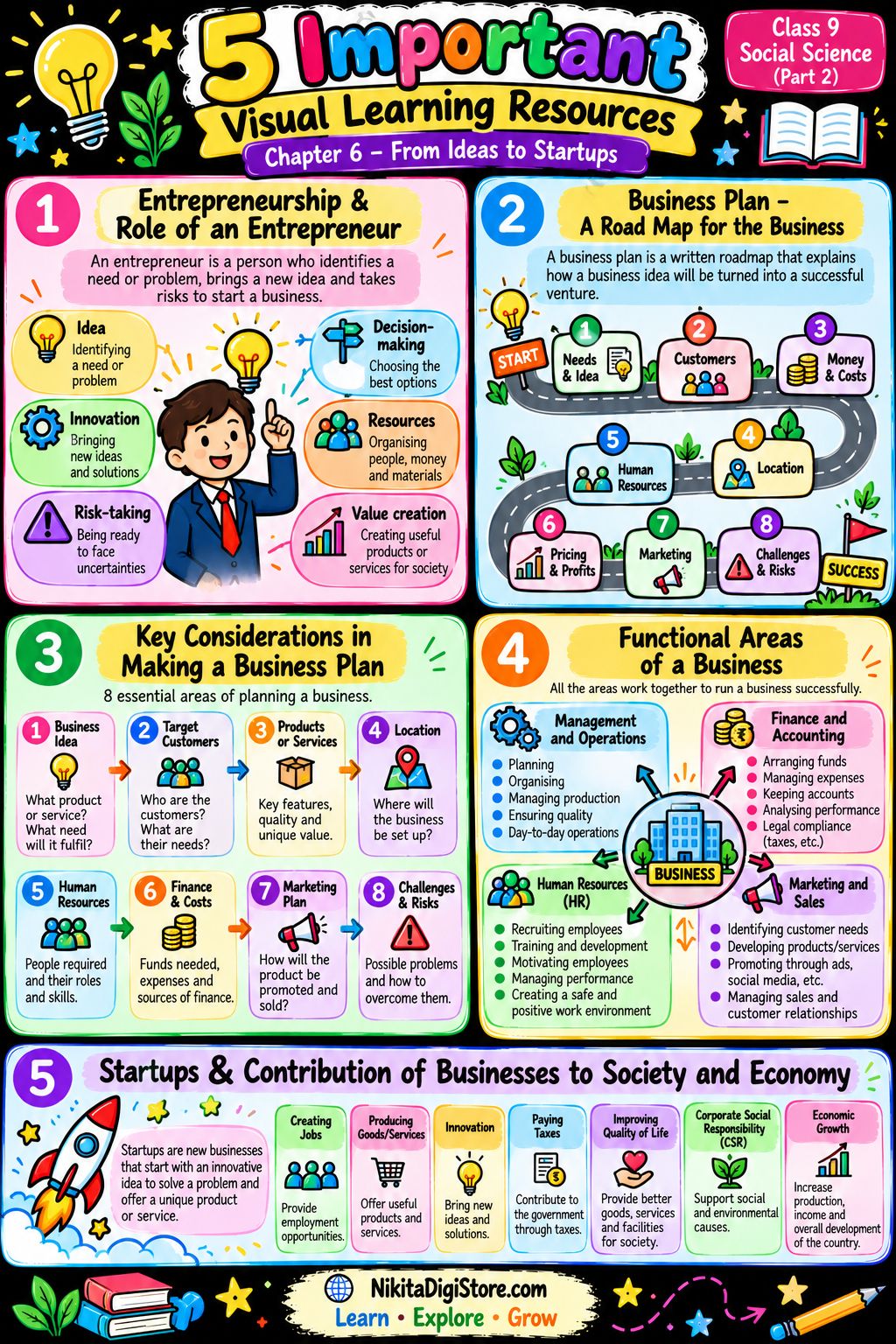
🌱 5 Important Visual Learning Resources – Chapter 6
💡 Entrepreneurship & Role of an Entrepreneur
Idea • Innovation • Risk-taking • Decision-making • Resources • Value creation🗺️ Business Plan – A Road Map for the Business
Needs & Idea → Customers → Money & Costs → Location → Human Resources → Pricing & Profits → Marketing → Challenges & Risks📋 Key Considerations in Making a Business Plan
The 8 essential areas of planning a business, presented as a clear step-by-step flowchart.🏢 Functional Areas of a Business
Management & Operations • Finance & Accounting • Human Resources • Marketing & Sales🚀 Startups & Contribution of Businesses to Society and Economy
Creating jobs • Producing goods/services • Innovation • Paying taxes • Improving quality of life • CSR • Economic growth
🎁 Free Class 9 Social Science Chapter 6 Worksheets – Part 2
Start your Chapter 6 preparation with selected practice questions covering entrepreneurship, business ideas, business planning, resources, functional areas of a business, startups, innovation, finance and accounting, and the contribution of businesses to society and the economy.
📥 NCERT Exercise Solutions – Chapter 6 | Part 2
Find help with the questions and activities from Chapter 6 – From Ideas to Startups.
The chapter includes activities and questions related to entrepreneurship, successful entrepreneurs, business plans, functional areas of a business, startups, innovation, accounting, MSMEs and the contribution of businesses to society and the economy.
Why Students Choose Our Class 9 Social Science Resources?
2026–27 Focused
Printable PDFs
Original Practice
Chapter-Wise Resources
Mobile Friendly
Answer Keys
❓ FAQ of Class 9 Social Science Chapter 6 – From Ideas to Startups | Part 2
Q1. What is Chapter 6 of Class 9 Social Science Part 2?
Chapter 6 is “From Ideas to Startups” from Understanding Society: India and Beyond, Part 2. It introduces students to entrepreneurship, business ideas, business planning, functional areas of a business, startups, innovation and the contribution of businesses to society and the economy.
Q2. What are the main topics in Chapter 6 – From Ideas to Startups?
The main topics include entrepreneurship, resources required for business, successful entrepreneurs, business plans, functional areas of business, startups, India’s startup ecosystem, MSMEs, the unorganised sector, accounting and the role of businesses in economic growth.
Q3. What is entrepreneurship?
Entrepreneurship is the process through which individuals or groups develop an idea into a business venture by identifying opportunities, using resources, taking risks and creating value.
Q4. What is a business plan?
A business plan is a written roadmap that explains a business idea, its goals, customers, resources, costs, pricing, marketing strategies and possible challenges.
Q5. What are the main functional areas of a business?
The major functional areas are Management and Operations, Finance and Accounting, Human Resources, and Marketing and Sales.
Q6. What is a startup?
A startup is a young, early-stage company founded to develop and offer an innovative product or service, often with the aim of growing its business.
Q7. How do businesses contribute to society and the economy?
Businesses contribute by creating employment, producing goods and services, encouraging innovation, generating income, paying taxes, improving quality of life and supporting community development.
🚀 Continue Your Class 9 Social Science Journey
Previous Chapter
📚 All Chapters
Ready to Practise Class 9 Social Science?
Build your understanding of Class 9 Social Science Chapter 6, From Ideas to Startups Part 2 with chapter-wise study and practice resources.
📢 Share this Class 9 Social Science Chapter 6 – From Ideas to Startups | Part 2
Found these Class 9 Social Science Chapter 6 resources helpful? Share this page with students, parents and teachers.
Did You Find This Chapter Helpful?
👍 Yes / 👎 No
- More worksheets
- More MCQs
- More important questions
- More maps & diagrams
- More revision notes
- NCERT solutions