
Class 9 Social Science Chapter 1 – Understanding Social Science
CBSE Class 9 Social Science 2026–27 | New Syllabus | Chapter-wise Study Resources
Explore Class 9 Social Science Chapter 1 – Understanding Social Science with study notes, practice worksheets, competency-based questions, revision resources and printable learning materials aligned with the 2026–27 curriculum.
This Class 9 Social Science Chapter 1 follows the latest Class 9 curriculum. For official curriculum information, visit CBSE Academic.
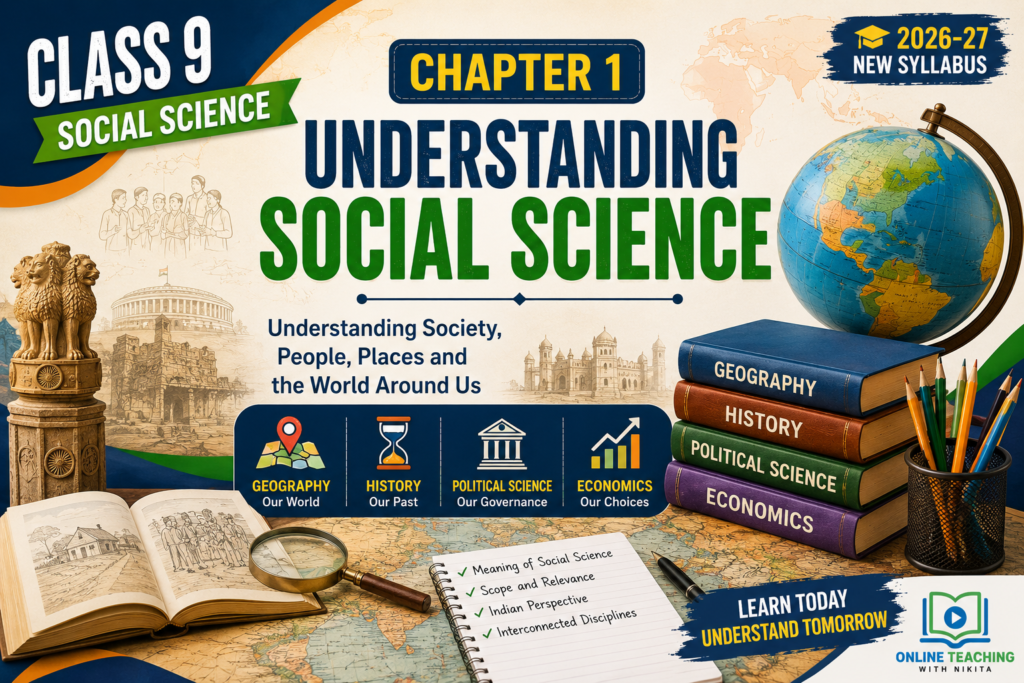
Table of Contents
📅 Last Updated: August 2026
📘 Syllabus: Based on the latest CBSE Class 9 (2026–27) syllabus
✅ Updated Resources Include:
- 📝 Chapter-wise Study Notes
- ❓ MCQs & Important Questions
- 📄 Free Worksheets
- 📘 NCERT Solutions
Chapter Overview of Class 9 Social Science Chapter 1
Understanding Social Science is the introductory chapter of the new Class 9 Social Science textbook. It helps students understand what Social Science is, why it matters, and how different disciplines help us understand people, society and the world around us.
Chapter 1 – Understanding Social Science
| Details | Information |
|---|---|
| Class | 9 |
| Subject | Social Science |
| Part | Part 1 |
| Chapter | 1 |
| Theme | Understanding Social Science |
| Session | 2026–27 |
| Instructional Time | 4 Hours |
| Textbook | Understanding Society India and Beyond – Part 1 |
About This Class 9 Social Science Chapter 1
Understanding Social Science is the introductory theme of the new Class 9 Social Science curriculum for 2026–27. The chapter helps students understand what Social Science is, why it is relevant to everyday life, and how different Social Science disciplines help us understand society and the world around us. The official curriculum allocates 4 instructional hours to this theme.
Students are introduced to the meaning, scope and relevance of Social Science and are encouraged to understand it from an Indian perspective. The curriculum also connects Geography, History, Political Science and Economics, helping students recognise how these disciplines are interconnected.
In this chapter, students will explore:
- 📚 Meaning and Scope of Social Science
- 🌍 Relevance of Social Science in our lives
- 🇮🇳 Social Science from an Indian perspective
- 🗺️ Geography and its role in understanding our world
- 📜 History and the study of the past
- 🏛️ Political Science and governance
- 💰 Economics and economic life
- 🔗 Connections between different Social Science disciplines
- 🤝 Diversity, inclusivity, sustainability and equity
The chapter’s learning outcomes emphasise using Social Science to understand society, environment, economy and governance, while appreciating diversity, inclusivity, sustainability and equity when studying society and making decisions.
This introductory chapter provides the foundation for the Social Science themes that follow in Class 9.
Learning Outcomes of Class 9 Social Science Chapter 1
After studying this chapter, students should be able to:
- explain what Social Science means
- understand why Social Science is important
- connect Social Science with everyday life
- understand how societies change over time
- recognise the relationship between people, places and systems
- understand Social Science as a group of disciplines
- distinguish Social Science from natural sciences
- identify the four core disciplines:
- Geography
- History
- Political Science
- Economics
- understand how these disciplines complement one another
- appreciate the importance of evidence and systematic enquiry
- understand the relevance of Social Science to present and future life
Key Topics of Class 9 Social Science Chapter 1
What Is Social Science?
Explain:
- meaning of Social Science
- systematic study of human society
- what Social Science investigates
- why it asks not only what happened but also why
Social Science in Everyday Life
Examples involving:
- family and community
- food
- occupations
- transport
- education
- government
- markets
- environment
Understanding Society Through Time and Traditions
Cover:
- how societies change
- how the past influences the present
- traditions
- knowledge passed between generations
- continuity and change
India’s Tradition of Inquiry
Introduce the concepts presented in the chapter, such as:
- Pañchamahābhūtas
- Vasudhaiva Kuṭumbakam
- Arthaśhāstra
These concepts are specifically associated with current Class 9 Chapter 1 study material.
Social Science as a Study of Disciplines
Explain why one discipline cannot provide the complete picture of society.
The Four Core Disciplines
Geography
People, places, environment and spatial relationships.
History
The human past and change over time.
Political Science
Governance, power, institutions, rights and responsibilities.
Economics
Resources, production, distribution, choices and markets.
⭐ Class 9 Social Science Chapter 1 Study Resources
📌 Important Questions
Most important questions to prepare for exams and chapter revision.
🎁 Free Class 9 Social Science Chapter 1 Worksheets
Practise the important concepts from Understanding Social Science with free printable questions and worksheets.
NCERT Exercise Solutions – Understanding Social Science
Find clear and easy-to-understand solutions to the exercise questions from Class 9 Social Science Chapter 1.
Why Students Choose Our Class 9 Science Resources?
📘 CBSE 2026–27 Syllabus | 📄 Free PDF Downloads | ▶️ Video Lessons | 📝 Chapter-wise Notes | 🔍 Previous Year Questions | 🔄 Regular Updates | 📱 Mobile Friendly | 🎯 Board Exam Focused
❓FAQ
Q1. What is Class 9 Social Science Chapter 1 about?
Chapter 1, “Understanding Social Science,” introduces students to Social Science and explains how it helps us understand people, society, the world around us and the different aspects of human life.
Q2. What is Social Science?
Social Science is the systematic study of human society and human life. It helps us understand people, communities, institutions, places, economies, political systems and changes over time.
Q3. Why is Social Science important?
Social Science helps students understand the society in which they live. It develops the ability to observe, ask questions, examine evidence and understand different aspects of human life and society.
Q4. Which subjects are included in Class 9 Social Science?
The Class 9 Social Science curriculum covered by Exploring Society: India and Beyond includes four major disciplines: Geography, History, Political Science and Economics.
Q5. How are the different Social Science disciplines connected?
The disciplines of Social Science study different aspects of human society, but they are closely connected. Geography helps us understand places and the environment, History examines the past, Political Science studies governance and political systems, and Economics examines choices, resources and economic activities.
Q6. How does Social Science relate to everyday life?
Social Science is connected to many aspects of everyday life, including family and community, education, occupations, government, markets, resources, the environment and relationships between people and places.
Q7. What is the importance of studying society from different perspectives?
Different perspectives help us understand complex social situations more completely. Looking at an issue through different Social Science disciplines can reveal connections that may not be visible from a single perspective.
Q8. What are the Pañchamahābhūtas?
The Pañchamahābhūtas are the five elements traditionally described in Indian thought: earth, water, fire, air and space (ākāśa). The concept is discussed in the chapter as part of India’s traditions of knowledge and inquiry.
Q9. What is Vasudhaiva Kuṭumbakam?
Vasudhaiva Kuṭumbakam is a Sanskrit expression meaning “the world is one family.” The idea reflects a broader understanding of interconnectedness and the relationship among people.
Q10. What is Arthaśāstra?
Arthaśāstra is an important work associated with ancient Indian thought on matters such as governance, administration, economics and statecraft. The chapter refers to it while introducing India’s traditions of knowledge and inquiry.
🚀 Continue Your Class 9 Social Science Journey
📚 All Chapters
Next Chapter →
Ready to Practise Class 9 Social Science?
Start with Chapter 1 and explore free worksheets, practice questions and chapter-wise learning resources for the new 2026–27 curriculum.
Share this Chapter
Found this chapter useful? Share it with classmates, parents or teachers.
Did you find this helpful?
Rate this chapter