

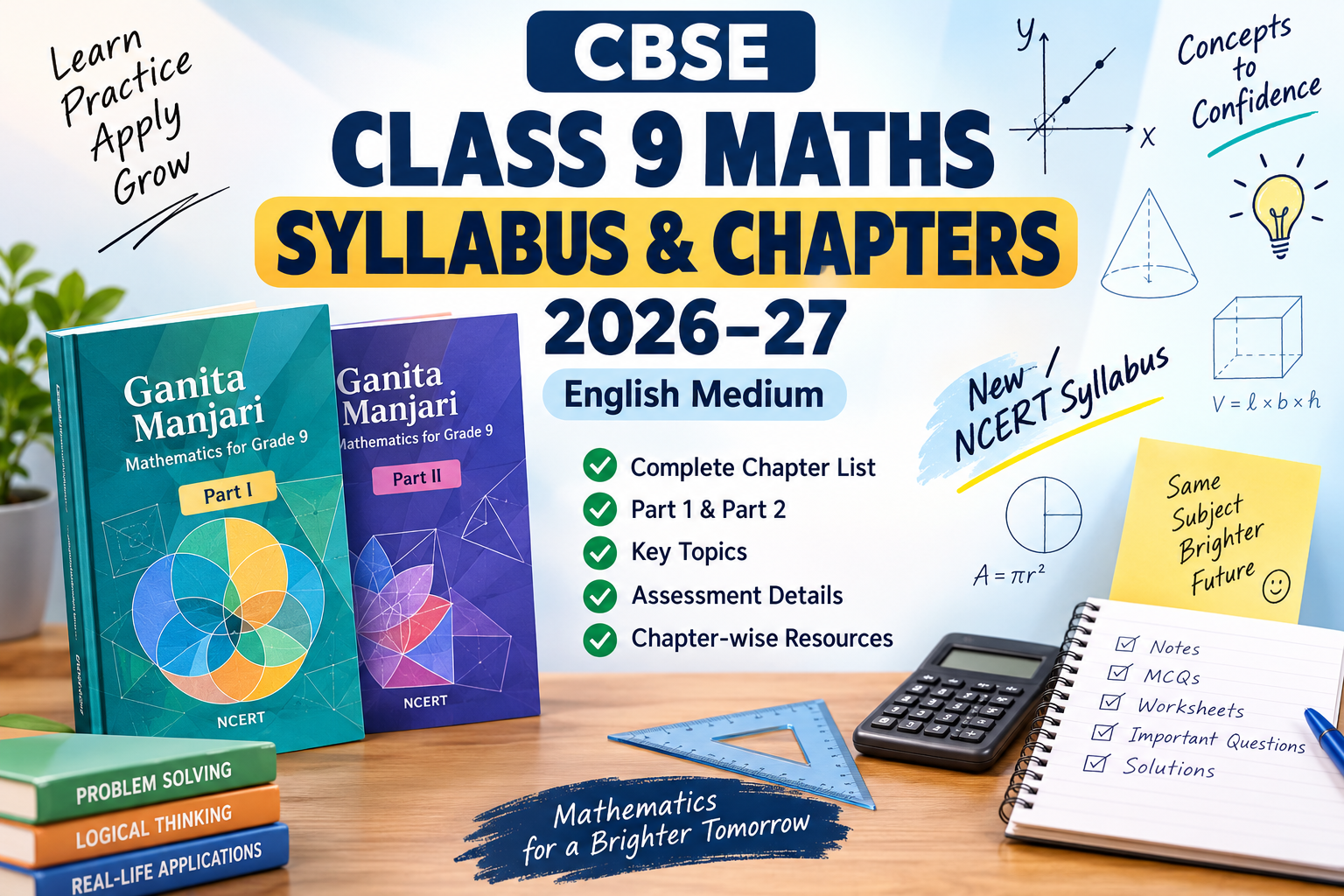
📐 Class 9 Maths Syllabus & Chapters 2026–27 – English Medium
Class 9 Maths 2026–27 | Ganita Manjari | Chapter-wise Study Resources
Last Updated: September 2026
The Class 9 Maths Syllabus 2026–27 introduces students to the new Ganita Manjari Mathematics textbook and a redesigned approach to learning Mathematics.
The CBSE Class 9 Mathematics curriculum for 2026–27 introduces students to a redesigned approach to Mathematics with greater emphasis on conceptual understanding, logical reasoning, problem-solving, visualisation, mathematical modelling, computational thinking and real-life applications.
For the 2026–27 academic session, Class 9 students study the new NCERT Mathematics textbook – Ganita Manjari, organised into Part I and Part II. The new textbook structure is different from the earlier Class 9 Mathematics textbook and introduces a new sequence of chapters and learning experiences.
This page provides the Class 9 Maths syllabus and complete chapter list for 2026–27 (English Medium) along with links to chapter-wise notes, worksheets, MCQs, important questions, solutions, formulas and other study resources.
Note: This page is for English Medium Class 9 Mathematics. For Hindi Medium resources, visit the separate Class 9 Maths Hindi Medium hub.
📚 Class 9 Maths 2026–27 at a Glance
| Information | Details |
|---|---|
| Board | CBSE |
| Class | Class 9 / Grade 9 |
| Academic Session | 2026–27 |
| Subject | Mathematics |
| Medium | English Medium |
| Textbook | Ganita Manjari |
| Textbook Parts | Part I and Part II |
| Total Chapters | 14 |
| Curriculum Focus | Conceptual understanding, reasoning, problem-solving and application |
The revised Mathematics curriculum is aligned with the National Curriculum Framework for School Education (NCF-SE) 2023 and places emphasis on mathematical competencies rather than rote procedural learning. CBSE specifically highlights problem-solving, visualisation, mathematical modelling, communication, computational thinking and data analytics.
📘 Class 9 Maths Syllabus 2026–27 – Ganita Manjari
Ganita Manjari is the new NCERT Mathematics textbook for Grade 9 for the 2026–27 session.
The textbook is organised into two parts:
📗 Ganita Manjari Part I
Chapters 1–8
📕 Ganita Manjari Part II
Chapters 9–14
The new sequence is substantially different from the older Class 9 Mathematics textbook. For example, the new textbook begins with “Orienting Yourself: The Use of Coordinates”, while the earlier textbook began with Number Systems.
📗 Ganita Manjari Part I – Class 9 Maths Chapters
Chapter 1 – Orienting Yourself: The Use of Coordinates
This chapter introduces students to coordinate-based thinking and the Cartesian plane.
Key topics include:
Coordinates
The Cartesian coordinate system
Locating points
Position of one point relative to another
Distance between points
Midpoint of a line segment
Coordinate-based representations
Applications of coordinates
📚 Chapter Resources:
Notes • MCQs • Important Questions • Worksheets • Formula Sheet • Diagrams • NCERT Solutions
👉 Explore Chapter 1 – Orienting Yourself: The Use of Coordinates
Chapter 2 – Introduction to Linear Polynomials
This chapter introduces students to polynomials and linear relationships, with a focus on recognising patterns, modelling linear growth and decay, and representing relationships using equations and graphs.
Key topics include:
- Algebraic expressions
- Polynomials
- Degree of a polynomial
- Introduction to linear polynomials
- Linear patterns
- Linear growth and decay
- Linear relationships
- Visualising linear relationships
- Slope and y-intercept of a line y=ax+b
Students also develop computational thinking by identifying patterns and representing linear relationships systematically using expressions, equations and graphs.
👉 Explore Chapter 2 – Introduction to Linear Polynomials
Chapter 3 – The World of Numbers
This chapter explores rational and irrational numbers and their representations.
Key topics include:
Rational numbers
Representation on the number line
Density of rational numbers
Finding rational numbers between two numbers
Decimal representation
Irrational numbers
Irrationality of √2 and √3
Square root spiral
The chapter develops students’ understanding of the number system through reasoning, representation and visualisation.
👉 Explore Chapter 3 – The World of Numbers
Chapter 4 – Exploring Algebraic Identities
This chapter develops algebraic reasoning through identities, factorisation and visual models.
Key topics include:
Algebraic identities
Geometrical visualisation of identities
Factorisation
Quadratic expressions
Algebra tiles
New identities
Simplification of rational expressions
Applications of identities
Students are encouraged to understand why identities work rather than simply memorising formulas.
👉 Explore Chapter 4 – Exploring Algebraic Identities
Chapter 5 – I’m Up and Down, and Round and Round
This chapter introduces geometric ideas through circular shapes and their properties.
Key topics include:
Circles
Chords
Arcs
Angles
Relationships involving circles
Cyclic figures
Geometric reasoning
Applications of circle-related concepts
The chapter encourages students to explore geometry through visualisation, reasoning and mathematical relationships.
👉 Explore Chapter 5 – I’m Up and Down, and Round and Round
Chapter 6 – Measuring Space: Perimeter and Area
This chapter develops the concepts of perimeter and area through measurement and mathematical reasoning.
Key topics include:
Perimeter
Area
Measurement of plane figures
Circles
Circumference
Area of a circle
Derivation and use of formulas
Applications of perimeter and area
Students learn to connect mathematical formulas with actual measurement and real-life situations.
👉 Explore Chapter 6 – Measuring Space: Perimeter and Area
Chapter 7 – The Mathematics of Maybe: Introduction to Probability
This chapter introduces students to the idea of uncertainty and chance.
Key topics include:
Randomness
Chance
Outcomes
Events
Probability
Experimental probability
Theoretical probability
Everyday applications of probability
The chapter helps students understand how Mathematics can be used to describe uncertain events.
👉 Explore Chapter 7 – The Mathematics of Maybe: Introduction to Probability
Chapter 8 – Predicting What Comes Next: Exploring Sequences and Progressions
This chapter develops students’ ability to identify patterns and make predictions.
Key topics include:
Number sequences
Patterns
Explicit/general rules
Recursive rules
Arithmetic Progressions
nth term
Geometric Progressions
Practical applications
Fractals
Tower of Hanoi
The chapter also develops computational thinking by encouraging students to describe patterns through step-by-step rules and procedures.
👉 Explore Chapter 8 – Predicting What Comes Next: Exploring Sequences and Progressions
📕 Ganita Manjari Part II – Class 9 Maths Chapters
Chapter 9 – Propositions and their Converses
This chapter introduces mathematical statements and logical reasoning.
Key topics include:
Propositions
Mathematical statements
Truth and reasoning
Converse of a proposition
Conditions and conclusions
Counterexamples
Logical reasoning
Applications of propositions
Students learn to examine mathematical statements carefully and understand that a converse is not necessarily true.
👉 Explore Chapter 9 – Propositions and their Converses
Chapter 10 – How Quantities Combine: Understanding Data
This chapter introduces students to data and the ways quantities can be organised and interpreted.
Key topics include:
Data
Collection and organisation of data
Representation of data
Interpretation
Comparison of quantities
Graphical representation
Drawing conclusions from data
The chapter develops mathematical thinking that is useful for understanding information in everyday life.
👉 Explore Chapter 10 – How Quantities Combine: Understanding Data
Chapter 11 – The World of Algorithms
This chapter connects Mathematics with computational thinking and systematic problem-solving.
Key topics include:
Algorithms
Step-by-step procedures
Logical thinking
Problem decomposition
Patterns and procedures
Algorithmic problem-solving
Mathematical applications of algorithms
Students learn how a complex problem can be broken down into smaller steps and solved systematically.
👉 Explore Chapter 11 – The World of Algorithms
Chapter 12 – Quadrilaterals
This chapter develops geometric reasoning through four-sided figures.
Key topics include:
Quadrilaterals
Parallelograms
Properties of parallelograms
Theorems
Midpoint theorem
Converse of the midpoint theorem
Medians
Centroid
Central symmetry
Reflection and rotational symmetry
Tiling
The chapter includes important theorem-based reasoning and applications of geometric properties.
👉 Explore Chapter 12 – Quadrilaterals
Chapter 13 – Two Variables, One Line
This chapter develops understanding of relationships involving two variables and their graphical representation.
Key topics include:
Two variables
Linear relationships
Linear equations
Graphical representation
Coordinate plane
Lines
Interpreting graphs
Real-life applications
Students learn to represent relationships between two quantities and interpret them graphically.
👉 Explore Chapter 13 – Two Variables, One Line
Chapter 14 – Math of Space: Surface Area and Volume
This chapter introduces students to three-dimensional measurement.
Key topics include:
Three-dimensional shapes
Cubes
Cuboids
Cylinders
Cones
Spheres
Hemispheres
Surface area
Volume
Applications of surface area and volume
Students use mathematical formulas and spatial reasoning to solve practical problems involving three-dimensional objects.
👉 Explore Chapter 14 – Math of Space: Surface Area and Volume
📊 Class 9 Maths 2026–27 – Main Areas of Learning
The new Mathematics curriculum develops learning across several interconnected mathematical areas, including:
🔢 Numbers
Students develop understanding of rational and irrational numbers and their representations.
➗ Algebra
Students explore polynomials, algebraic identities, linear relationships and sequences.
📍 Coordinate Geometry
Students learn to represent locations and relationships using coordinates.
📐 Geometry
Students develop reasoning, proof, propositions, congruence, quadrilaterals and other geometric ideas.
📏 Measurement
Students work with perimeter, area, surface area and volume.
🎲 Probability
Students explore chance, uncertainty and probability.
📊 Data
Students learn to organise, represent and interpret information.
💻 Computational Thinking
Algorithms, step-by-step procedures and mathematical problem-solving are integrated into learning.
CBSE’s 2026–27 Mathematics curriculum explicitly identifies mathematical modelling, algorithm building, computational thinking, visualisation and mathematical communication as important competencies.
🌟 What Is New in Class 9 Maths 2026–27?
The new Class 9 Mathematics curriculum places greater emphasis on understanding and applying Mathematics rather than learning procedures through rote memorisation.
Students are encouraged to:
Understand concepts deeply
Develop logical reasoning
Solve problems systematically
Visualise mathematical ideas
Use mathematical representations
Connect Mathematics with real-life situations
Develop mathematical communication
Build computational thinking
Explore patterns
Use mathematical modelling
Make connections with other subjects
Learn about contributions of Indian mathematicians
The curriculum is aligned with NEP 2020 and NCF-SE 2023 and explicitly promotes competency-based learning.
📝 Class 9 Maths Assessment 2026–27
The assessment approach for the revised Mathematics curriculum includes both examination and school-based components.
The CBSE curriculum provides an 80-mark theory component along with 20 marks of internal assessment for Mathematics.
Students should also follow the assessment instructions provided by their school and the applicable CBSE curriculum for the academic session.
Internal Assessment
Internal assessment can include components such as:
Pen-paper tests
Multiple assessment activities
Portfolio work
Mathematics laboratory activities
The purpose is to assess students through more than just a final written examination.
📚 Class 9 Maths Chapter-wise Study Resources
Use the links below to access resources for each chapter of Ganita Manjari.
| Chapter | Study Resources |
|---|---|
| Chapter 1 – Orienting Yourself: The Use of Coordinates | Notes • MCQs • Worksheets • Important Questions • NCERT Solutions |
| Chapter 2 – Introduction to Linear Polynomials | Notes • MCQs • Worksheets • Important Questions • NCERT Solutions |
| Chapter 3 – The World of Numbers | Notes • MCQs • Worksheets • Important Questions • NCERT Solutions |
| Chapter 4 – Exploring Algebraic Identities | Notes • MCQs • Worksheets • Important Questions • NCERT Solutions |
| Chapter 5 – I’m Up and Down, and Round and Round | Notes • MCQs • Worksheets • Important Questions • NCERT Solutions |
| Chapter 6 – Measuring Space: Perimeter and Area | Notes • MCQs • Worksheets • Important Questions • NCERT Solutions |
| Chapter 7 – The Mathematics of Maybe: Introduction to Probability | Notes • MCQs • Worksheets • Important Questions • NCERT Solutions |
| Chapter 8 – Predicting What Comes Next: Exploring Sequences and Progressions | Notes • MCQs • Worksheets • Important Questions • NCERT Solutions |
| Chapter 9 – Propositions and their Converses | Notes • MCQs • Worksheets • Important Questions • NCERT Solutions |
| Chapter 10 – How Quantities Combine: Understanding Data | Notes • MCQs • Worksheets • Important Questions • NCERT Solutions |
| Chapter 11 – The World of Algorithms | Notes • MCQs • Worksheets • Important Questions • NCERT Solutions |
| Chapter 12 – Quadrilaterals | Notes • MCQs • Worksheets • Important Questions • NCERT Solutions |
| Chapter 13 – Two Variables, One Line | Notes • MCQs • Worksheets • Important Questions • NCERT Solutions |
| Chapter 14 – Math of Space: Surface Area and Volume | Notes • MCQs • Worksheets • Important Questions • NCERT Solutions |
📐 Explore Class 9 Maths – English Medium
Looking for chapter-wise Class 9 Maths resources?
Explore our Class 9 Maths 2026–27 – English Medium hub for:
Chapter-wise notes
MCQs
Important questions
Worksheets
NCERT solutions
Formula sheets
Important diagrams
Practice resources
Other study materials
👉 Explore Class 9 Maths English Medium →
🇮🇳 Looking for Class 9 Maths Hindi Medium?
We also have a separate Class 9 Maths Hindi Medium hub with chapter-wise resources for students studying Mathematics in Hindi Medium.
👉 Explore Class 9 Maths Hindi Medium →
📘 Official NCERT Textbook
Students should refer to the official NCERT textbook for the complete chapter content, activities, examples and exercises.
📗 Ganita Manjari – Grade 9
👉 Check Official NCERT Textbook →
The NCERT textbook portal provides access to the new Ganita Manjari textbook and its individual chapters.
❓ Frequently Asked Questions
What is the Class 9 Maths textbook for 2026–27?
The new NCERT Mathematics textbook for Grade 9 is Ganita Manjari, organised into Part I and Part II.
How many chapters are there in Ganita Manjari Class 9 Maths?
The complete Ganita Manjari Class 9 Mathematics textbook has 14 chapters across Part I and Part II. Part I contains Chapters 1–8 and Part II contains Chapters 9–14.
Is the new Class 9 Maths syllabus different from the old syllabus?
Yes. The new 2026–27 Ganita Manjari textbook has a substantially different chapter sequence and structure from the previous Class 9 Mathematics textbook. For example, the new textbook begins with Orienting Yourself: The Use of Coordinates, rather than the older Number Systems chapter.
What are the main skills developed through the new Class 9 Maths curriculum?
The revised curriculum emphasises conceptual understanding, logical reasoning, problem-solving, visualisation, mathematical modelling, mathematical communication, computational thinking and data analytics.
Is this page for English Medium?
Yes. This page is specifically for Class 9 Maths English Medium. Hindi Medium Mathematics resources are available through the separate Hindi Medium hub.
Where can I find Class 9 Maths chapter-wise resources?
You can use the chapter links on this page to access your chapter-wise resources, including notes, MCQs, worksheets, important questions, solutions, formulas and diagrams.
📚 Related Class 9 Resources
Conclusion
The Class 9 Mathematics curriculum for 2026–27 introduces students to a new learning approach through Ganita Manjari, with greater emphasis on conceptual understanding, reasoning, visualisation, problem-solving, mathematical communication and computational thinking.
Use this page as a guide to the Class 9 Maths chapters for 2026–27, and explore the linked chapter pages for detailed study resources, practice materials and solutions.
All Class 9 Maths resources are available at Nikita Digi Store.